Mike Sharples

210 Followers
157 Following
69 Posts
Emeritus Professor of #edtech at #OpenUniversity. Curious about innovative #Pedagogy, #AI and #Education, #OpenScience, #Creativity and #Writing. Author of "Practical Pedagogy: 40 New Ways to Teach and Learn" and co-author of "Story Machines: How Computers Have Become Creative Writers".
My websitehttps://www.mikesharples.org/
Free AI story generatorhttps://story-machines.net/
10 minutes chats – Generative AI from Monash Education Academy
@timbocop talks to @sharplm about reframing our thinking of generative artificial intelligence.
Ping @bron .
Ta, @gamerlearner . We'll miss your 'must reads'.
https://www.monash.edu/learning-teaching/TeachHQ/Teaching-practices/artificial-intelligence/10-minute-chats-on-generative-ai

I agree with @sharplm who wrote on Twitter:

“OpenAI has just released APIs for ChatGPT and Whisper (speech to text). Expect #edtech developers to pile in, with apps for conversational language learning, quizzes, creative (and essay) writing. Add speech for educational toys, virtual worlds, tutoring...”

Some of that will be good, a lot will be bad, but the genie is definitely out of the bottle.

https://openai.com/blog/introducing-chatgpt-and-whisper-apis

Introducing ChatGPT and Whisper APIs

Developers can now integrate ChatGPT and Whisper models into their apps and products through our API.

@tomstafford @Sebschmoller I agree the guidelines are flawed, which is why I have been careful to call them "draft guidelines". I did it in large part to demonstrate the possibility for AI generators to provoke constructive debate and provide a basis for improvement, both valuable for learning.

Over on Twitter Mike Sharples posted link to this paper. (https://twitter.com/sharplm/status/1621537532163792896?s=20&t=XZQCRYerFEV_gUE1cf1Iow)

Worth a read if this is your interest (genesis of technological ideas):

https://arxiv.org/abs/2301.05570

Mike Sharples on Twitter

“Preprint of my paper for IEEE Annals of the History of Computing, on a 19th century parallel to #GPT3 - a machine that could generate at random over 26 million lines of perfectly formed Latin verse. It provoked hype and concern. A fascinating story. 🧵https://t.co/61cA8v8JEp”

Twitter
Another very interesting thread on the use #gpt3 (post from twitter), this time writing an #academic paper. @sharplm https://twitter.com/sharplm/status/1603659898948132865?t=4ez1spMCx_BxAYvWX174aw&s=08
Mike Sharples - @[email protected] on Twitter

“How to write an academic paper in 10 minutes with GPT-3. First, I chose at random the title of a real paper. I chose Hutchins et al., “Domain-Specific Modeling Languages in Computer- Based Learning Environments" from Int. Jnl. AIED. 🧵”

Twitter
@dlongm01 Good to see you on Mastodon! And glad it performed its tricks! The more precise the prompt, the better the result. And yes, I have a limit of 250 tokens, imposed by OpenAI (though I think they may have relaxed that now).
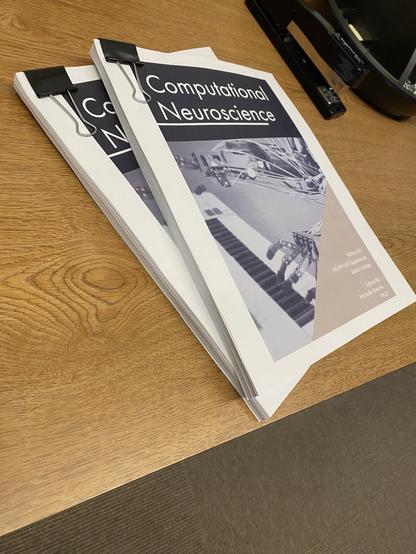
Printing my students’ open textbook! 12 chapters, 179 pages of awesomeness!
#neuroscience #computationalneuroscience #openeducation
@tltgisch @serenissimaj The latest version of GPT-3 can certainly follow a story arc if that's given as a prompt, can produce tellable short stories around a theme, and can imitate literary styles. Whether that results in literature can, and will, be debated. In 1977, James Meehan coined the term "mis-spun" tales for computer-generated "wrong" stories that revealed something about the limits of machine creativity. Maybe GPT-3's "fake stories" are bad news but good learning.
@serenissimaj I hope nobody will object to their AI-generated stories forming part of your research. GPT-3 wasn't trained on any genre. I simply called on the standard GPT-3, with an additional prompt "Write an imaginative short story with the title" added before the title.