Oleksii Salnykov

10 Followers
11 Following
11 Posts
Ukrainian designer researching Cyrillic as a site of power, conflict, and technological change. Co-founder of KULTURA.
Websitehttps://thisiskultura.com
Instagramhttps://www.instagram.com/a.salio

I can’t resist commenting on this year’s ATypI. On the one hand, I appreciate the gesture: two full conferences, wider geography, and (at least in theory) more room for non-Latin scripts and communities.

On the other hand, I can’t unsee the colonial trope in how this "bridge" is framed: "innovation, infrastructure, and the future of the field" are positioned in the Western center (Stanford), while "culture, tradition, and voices" are neatly relocated to an exoticized periphery (Sharjah).

I’d even respect an honest disclaimer like: political reality of USA forces us to split the event. But the "double the fun" tone reads as tone-deaf — a privilege-coded PR gloss that ignores asymmetric access to. I mean… are you welcomed if you don’t hold a privileged passport?
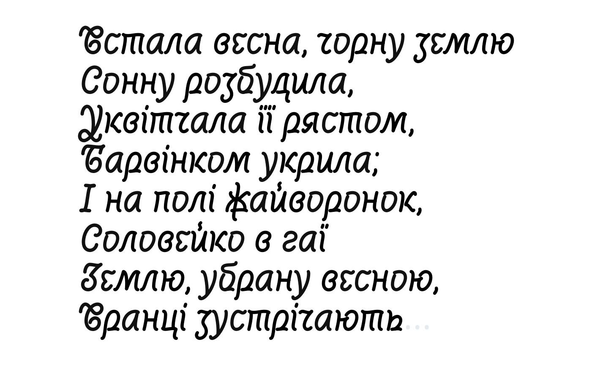
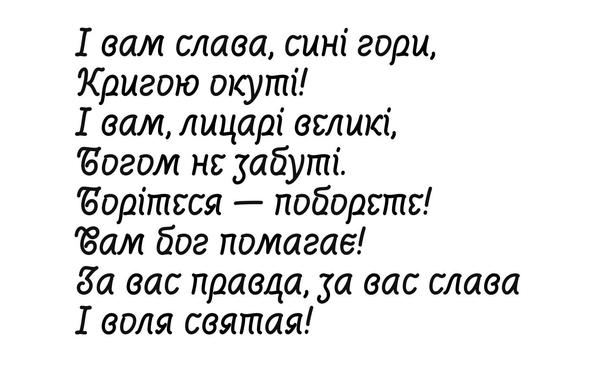
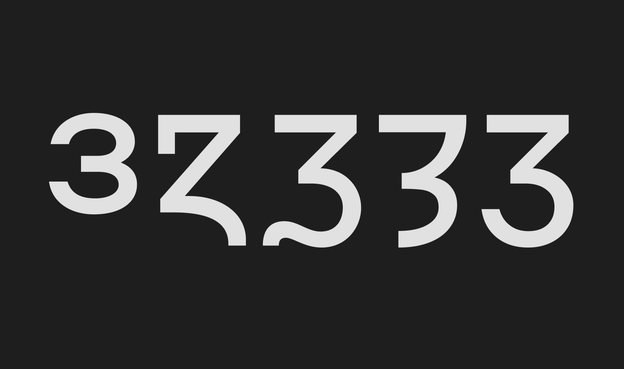
Kyrylo Tkachov from Alfabravo shared a work in progress—an Ukrainian Cyrillic cursive project that feels especially interesting for the way it engages local traditions, historical references, and alternative graphic logics, rather than defaulting to so-called 'standard' Cyrillic italics. Curious to see where this goes with Latin and Greek characters.🤔
#Typography #TypeDesign #Cyrillic #UkrainianDesign
@TiroTypeworks Ukrainian designers are becoming more confident in integrating historical forms into typefaces and visual communication, so readers are gradually getting used to them too. At the same time, in certain contexts z-shaped form can still be triggering, as it resembles the Russian military Z symbol 'zvastika' associated with the invasion of Ukraine.

@alexeystar
Yes, it does create a closed circle. That’s precisely the point: state neglect and platform neglect reinforce each other. Apple did not invent this hierarchy, but by not supporting Belarusian as a system language, it reproduces it.

Still, I’m afraid this is not how it works if we place the burden primarily on a corporation. The struggle for a language has to start from below — from society itself, from people who insist on using it in everyday life, education, media, and culture.

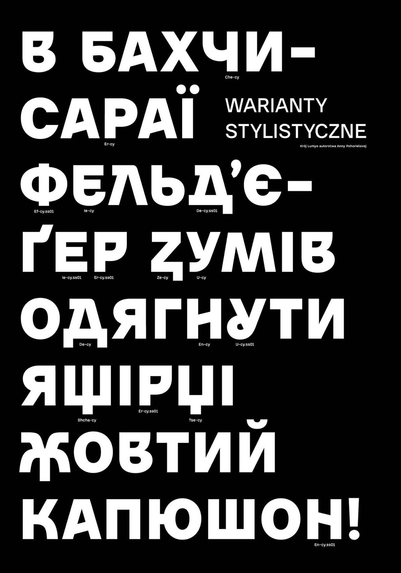
Good to see a master’s project centered on Ukrainian type design presented in UAP (Poznań).

Lumyo is described as a text typeface family shaped by Ukrainian authenticity. What matters here is not “local flavor” as decoration, but an attempt to think through Ukrainian Cyrillic as a design problem, a historical layer, and a living graphic tradition with its own logic and references.

Congrats to Anna Pohorielova.

#Typography #TypeDesign #Cyrillic #UkrainianDesign

@alexeystar I can’t speak for Apple’s product or market logic behind Belarusian being missing from macOS. But I do know that in this region, language infrastructure was long routed through russian contractor chains. Even Ukrainian localization passed through that pipeline. Monopoly works not only through culture or politics, but interfaces, vendors, and payment flows.
I think state language policy is part of the story. Why would an operating system fully support language if the Belarusian state itself has not consistently fought for it as a real language of administration, education, services, and digital infrastructure? In practice the state has long reinforced russian dominance. So the absence of Belarusian reflects the political downgrading of the language itself.

@TiroTypeworks @alexeystar Ha-ha, it does look funny! Especially because I can read it.

I think such a pangram could be useful as an additional or experimental layer alongside a set of genuinely diverse representative examples, but not as a new “neutral” default.

And there is another issue here: if we are speaking about actual script traditions, even letter construction cannot be flattened so easily. Choosing one form as default already privileges one tradition over another. Selecting д-construction may erase the Bulgarian g-shaped form, while Ukrainian typographic practice has its own conventions as well.

@TiroTypeworks Exactly! And this is where I see epistemic violence enters the picture: historical flattening becomes more than a factual issue, because it reinforces one dominant perspective as the default, especially when it aligns with an imperial point of view.

That’s why I’m genuinely glad to see someone treating Cyrillic beyond russia as a distinct field of inquiry. It feels both necessary and surprisingly rare! I’d be very interested in reading your chapter. Is it only available in the Bloomsbury volume for now, or is there perhaps another way to access your research?

When designing multilingual systems, what becomes the default? Whose language serves as the sample? Whose history shapes the narrative?

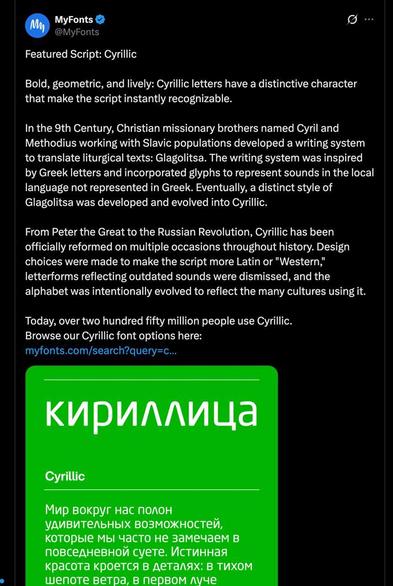
“Erasure by Default” describes cases where one dominant example stands in for the whole.
The MyFonts post on Cyrillic is a clear example: a script used by over 50 languages is framed solely through a russian lens. A shared typographic ecology is reduced to an imperial norm, even though Cyrillic also lives in Ukrainian, Bulgarian, or many Central Asian languages (which were forced into it under russification policies).

Power operates through defaults, metadata, and taxonomy. It’s not merely exclusion but deciding who gets to represent the many.
#Typography #Cyrillic #DecolonizeDesign #ErasureByDefault #TypeDesign #DesignPolitics

@ANRT Indigné par la tenue de cet événement à l’ANRT. Comment peut-on parler de la « carte des archives » avec des experts russes alors que la Russie mène un épistémicide documenté en Ukraine, pillant les archives de Kherson et détruisant le patrimoine de Marioupol ? Cette complaisance institutionnelle est inacceptable. J'ai adressé ce jour un signalement officiel à la direction de l’ENSAD Nancy ainsi qu’au Ministère de la Culture pour exiger des éclaircissements sur cette collaboration. La culture ne peut servir de paravent au pillage colonial.