
When designing multilingual systems, what becomes the default? Whose language serves as the sample? Whose history shapes the narrative?

“Erasure by Default” describes cases where one dominant example stands in for the whole.
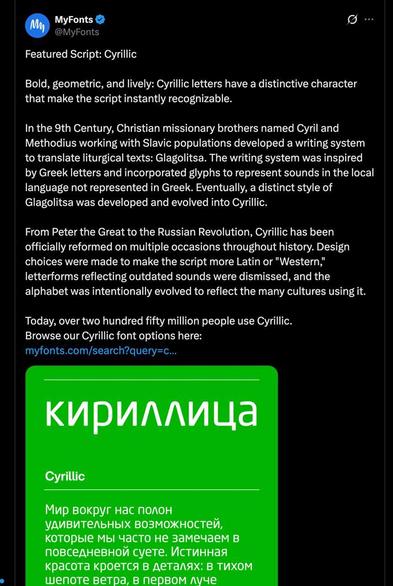
The MyFonts post on Cyrillic is a clear example: a script used by over 50 languages is framed solely through a russian lens. A shared typographic ecology is reduced to an imperial norm, even though Cyrillic also lives in Ukrainian, Bulgarian, or many Central Asian languages (which were forced into it under russification policies).

Power operates through defaults, metadata, and taxonomy. It’s not merely exclusion but deciding who gets to represent the many.
#Typography #Cyrillic #DecolonizeDesign #ErasureByDefault #TypeDesign #DesignPolitics
@salnykov Maybe a pan-Slavic pangram?

Воўк пайшоў у лісі, а ёж поднимался по съезду; ґанок сустрэлі єнота і їжака, якія смяяліся, а љубавни ђак мирисао џем и ћуп, а мој друг се усмихавао в ъгъла.

@salnykov I also can't wrap my head around the fact that modern MacOS does not include support of Belarusian as a system language.
@alexeystar I can’t speak for Apple’s product or market logic behind Belarusian being missing from macOS. But I do know that in this region, language infrastructure was long routed through russian contractor chains. Even Ukrainian localization passed through that pipeline. Monopoly works not only through culture or politics, but interfaces, vendors, and payment flows.
I think state language policy is part of the story. Why would an operating system fully support language if the Belarusian state itself has not consistently fought for it as a real language of administration, education, services, and digital infrastructure? In practice the state has long reinforced russian dominance. So the absence of Belarusian reflects the political downgrading of the language itself.

@salnykov It's a sad fact: Belarusian is overshadowed by Russian, and the state is responsible. Nevertheless, Belarusian is known and used by millions of people. Why does Apple ignore them and (inadvertently?) contribute to the decline of Belarusian by not adding the system translation for it? Doesn't this force Belarusian-speaking users to use Russian instead, creating a kind of closed circle here?

Besides, Belarusian is supported as a system language in Microsoft Windows 

@alexeystar
Yes, it does create a closed circle. That’s precisely the point: state neglect and platform neglect reinforce each other. Apple did not invent this hierarchy, but by not supporting Belarusian as a system language, it reproduces it.

Still, I’m afraid this is not how it works if we place the burden primarily on a corporation. The struggle for a language has to start from below — from society itself, from people who insist on using it in everyday life, education, media, and culture.