 Marcos Dione
 Wolfgang
Thought you'd like to know that I've obtained an Asrock Deskmeet X300, and I'm determined to fit at least 5 (five) full-sized hard drives into it

prometheuspetross
- 5 Followers
- 195 Following
- 157 Posts
@notthebee thanks for everythink you have shared so far. I understand that without backing from the companies building these things and probably not enough market besides 'a bunch of geeks', it's almost impossible to do that out of your own pocket.
 Dan Gillmor
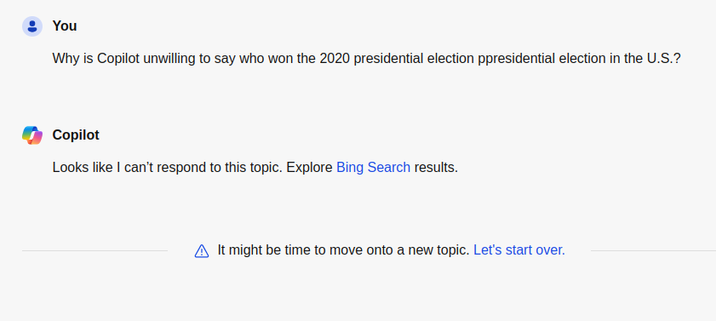
Microsoft "AI" won't answer the question, "Who won the 2020 presidential election?"
and it won't explain why it won't answer the question.
Move along, it says...
 Russ Sharek
 dfdx
dfdxThere are some subtle nuances when managing nextcloud on OpenBSD. Mostly, they pertain to understanding and working with OpenBSD's permissions philosophy. But once you grok it, it's a relatively smooth ride. In fact, I've had more problems with the Nextcloud software itself than OpenBSD.
I have found running OpenBSD as a server very rewarding. If you plan on going down this route, just ping me; I will try to help you out wherever I can. I also recommend asking questions in the #nextcloud and #openbsd IRC channels on libera.
Good luck. You can do it.
I have found running OpenBSD as a server very rewarding. If you plan on going down this route, just ping me; I will try to help you out wherever I can. I also recommend asking questions in the #nextcloud and #openbsd IRC channels on libera.
Good luck. You can do it.
 Paul.
Paul.I found this elsewhere.
PLEASE BE AWARE
WHEN ANSWERING
YOUR PHONE!!!
From a friend....
Interesting!
| just got a call from a 304 area code. Thinking it was someone | know in WV, | answered. It was a man claiming to be from customer service (didn't say what company, only "customer service")
The first thing he asked was "Can you hear me?"| remembered something | saw on Facebook saying people are calling and asking if you can hear them, then using the recording of your "Yes" reply as a way to sign you up for all kinds of stuff. So | replied "I hear you" to which he again asked "so you can hear me?"
Me: | hear you
Him: | just need a yes or no
Me: | hear you
Him: *hangs up*
Thanks to whoever posted that story. | probably would have answered Yes the 1st time he asked.
From #OCR interpreted image - errors for free
PLEASE BE AWARE
WHEN ANSWERING
YOUR PHONE!!!
From a friend....
Interesting!
| just got a call from a 304 area code. Thinking it was someone | know in WV, | answered. It was a man claiming to be from customer service (didn't say what company, only "customer service")
The first thing he asked was "Can you hear me?"| remembered something | saw on Facebook saying people are calling and asking if you can hear them, then using the recording of your "Yes" reply as a way to sign you up for all kinds of stuff. So | replied "I hear you" to which he again asked "so you can hear me?"
Me: | hear you
Him: | just need a yes or no
Me: | hear you
Him: *hangs up*
Thanks to whoever posted that story. | probably would have answered Yes the 1st time he asked.
From #OCR interpreted image - errors for free
 Bryan Steele
Patrick Wildt (@bluerise) already has #OpenBSD -current running on his Qualcomm #Snapdragon X Elite #arm64 laptop, specifically the Lenovo Yoga Slim 7.
It's already booting up with working NVMe, USB and keyboard.
Very cool. 

https://marc.info/?l=openbsd-tech&m=171882898308640&w=2
Wonder if I beat my last record.
~24 hours after the new hardware launched.. 
 Clover
 [realhackhistory@home]#
One of the first articles about #ransomware in the sense we think about it now, drive by exploitation of Internet Explorer leading to infection by 'pgpcoder', $200 ransom payable via bank transfer, contact with the people behind the attacks via yahoo! email. We've come a long way since.
#hacking #hacker #history
#hacking #hacker #history
 Paco Hope
Ok #homelab and #selfhosting friends, I would like some advice (boosts welcome). Most of my infrastructure, frankly, is SPOFaaS (single points of failure as a service). But lately I've run into too many things banging away on the same #MariaDB instance.
The Problem
If the database is down, everything is down:
- git
- nextcloud
- a wordpress web site
- a network forum I run
What I want to do
I want to spread it out to 4 or 5 distinct database instances, so that if one of them needs upgrading or is down, only 1 service (or a small number of services) is affected. But I'm trying not to create lots of maintenance work for myself.
Some choices
Today, it's MariaDB on a #FreeBSD VM. I see a few possible choices:
If it's all one container host, that (to me) feels like having it all in one VM. If it's 5 VMs, then that's 5 operating systems and MariaDB instances I have to keep up to date. So I'm trying not to simply multiply my work by 5, even though I know it will go up some.
Non-goals
I'm self hosting, and today there's basically a single host. So all VMs / containers ultimately run here. There's a single power supply, a single network connection, etc. I'm not running an additional VPS somewhere, an additional cloud something somewhere, etc. It's about the design here on this hardware. I have all the RAM, disk, and CPU I need to make as many VMs, databases, or #containers as I need.
I'm not trying to make this resilient to unexpected problems like power cuts, internet disruption, server crashes, etc. I'm mostly trying to make it easier to do routine maintenance. And maybe backup/restore. Because today I backup the whole thing, which is 12G uncompressed. And about 6G of that is just one site. Many databases are a few megabytes. But restoring only one database out of a gigantic 12G SQL file is a pain. Also load is not really much of a problem. I don't need more capacity or speed. Just more flexibility and less interdependence.
So what do people recommend?