Patricio Farrell

@patriciofarrell
11 Followers
20 Following
10 Posts
#Mathematician & research group leader at 
@WIAS Berlin, specializing in #numerical methods and #semiconductor applications. I enjoy writing, too.
webhttps://www.farrell.de
LinkedInhttps://www.linkedin.com/in/patricio-farrell/
ResearchGatehttps://www.researchgate.net/profile/Patricio-Farrell
Twitterhttps://twitter.com/pafarr
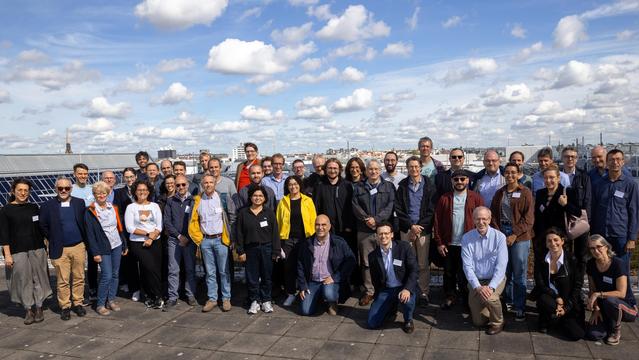
Last month NUMSEMIC co-organized the "Applied Mathematics for Simulation of Semiconductor Devices" (AMaSiS) workshop in Berlin. The three-day workshop attracted 55 participants, 28 talks and 10 posters. It connects related fields such as mathematical analysis, numerical simulations and applications of devices and materials.
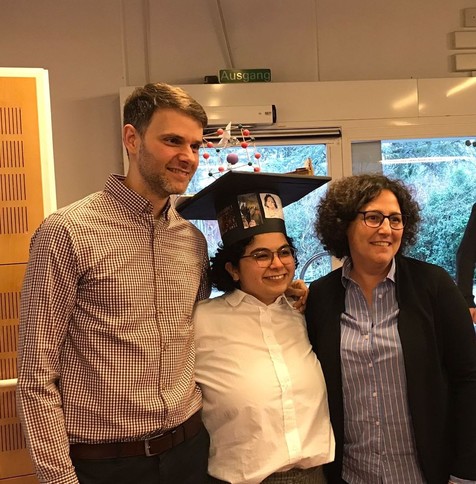
Congratulations to Dilara Abdel for finishing her PhD! 🥳 Her thesis is titled "Modeling and simulation of vacancy-assisted charge transport in innovative semiconductor devices". For her defence she gave a talks on physics-informed #DeepONets, #pervovskites & #memristors.

„In Berlin gibt es mehrere exzellente Mathematik-Institutionen und eine Fülle an interessanten Bereichen, um Mathematik anzuwenden.“ #BrainCityBotschafter Dr. Patricio Farrell, Forschungsgruppenleiter

https://braincity.berlin/brains-of-berlin/berlin/dr-patricio-farrell

Brain City Botschafter Dr. Patricio Farrell | Brain City Berlin

Als Spezialist für Angewandte Mathematik am Berliner Weierstraß-Institut versucht Dr. Patricio Farrell, Fragen aus der Praxis über mathematische…

A belated greeting from the #ICIAM conference in #Tokyo, where we presented our modelling and simulation results on #2D materials and #memristors to 5000 applied #math colleagues from around the globe!
Exciting times in #SolarEnergy! #PerovskiteSolarCells shine brighter than ever as a green energy solution. Our publication adds valuable insights by a comparison of two ionic current densities, incorporating volume exclusion effects. #SciencePublication
https://link.springer.com/article/10.1007/s11082-023-05125-9
Volume exclusion effects in perovskite charge transport modeling - Optical and Quantum Electronics

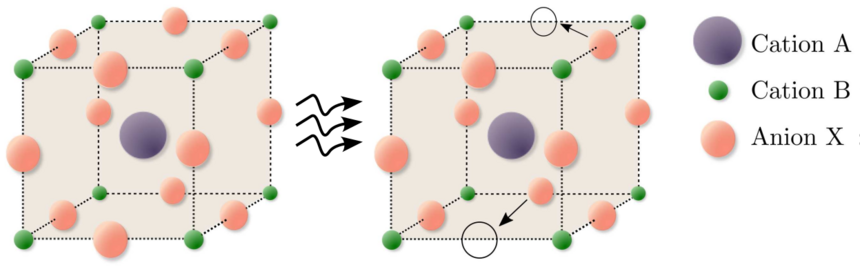
Due to their flexible material properties, perovskite materials are a promising candidate for many semiconductor devices such as lasers, memristors, LEDs and solar cells. For example, perovskite-based solar cells have recently become one of the fastest growing photovoltaic technologies. Unfortunately, perovskite devices are far from commercialization due to challenges such as fast degradation. Mathematical models can be used as tools to explain the behavior of such devices, for example drift-diffusion equations portray the ionic and electric motion in perovskites. In this work, we take volume exclusion effects on ion migration within a perovskite crystal lattice into account. This results in the formulation of two different ionic current densities for such a drift-diffusion model – treating either the mobility or the diffusivity as density-dependent while the other quantity remains constant. The influence of incorporating each current density description into a model for a typical perovskite solar cell configuration is investigated numerically, through simulations performed using two different open source tools.

SpringerLink

#PerovskiteSolarCells achieved record-breaking energy conversion in the past 15 years and are now ready for mass production. Our publication establishes for the first time the existence of a #numerical solution for a #reallife model. #numericalanalysis
https://doi.org/10.1093/imanum/drad034

This is a joint work with colleagues from INRIA Lille/University of Lille in France.

Numerical analysis of a finite volume scheme for charge transport in perovskite solar cells

Abstract. In this paper, we consider a drift-diffusion charge transport model for perovskite solar cells, where electrons and holes may diffuse linearly (Boltzm

OUP Academic

This is hilarious. It appears that Twitter is DDOSing itself.

The Twitter home feed's been down for most of this morning. Even though nothing loads, the Twitter website never stops trying and trying.

In the first video, notice the error message that I'm being rate limited. Then notice the jiggling scrollbar on the right.

The second video shows why it's jiggling. Twitter is firing off about 10 requests a second to itself to try and fetch content that never arrives because Elon's latest genius innovation is to block people from being able to read Twitter without logging in.

This likely created some hellish conditions that the engineers never envisioned and so we get this comedy of errors resulting in the most epic of self-owns, the self-DDOS.

Unbelievable. It's amateur hour.

#TwitterDown #MastodonMigration #DDOS #TwitterFail #SelfDDOS

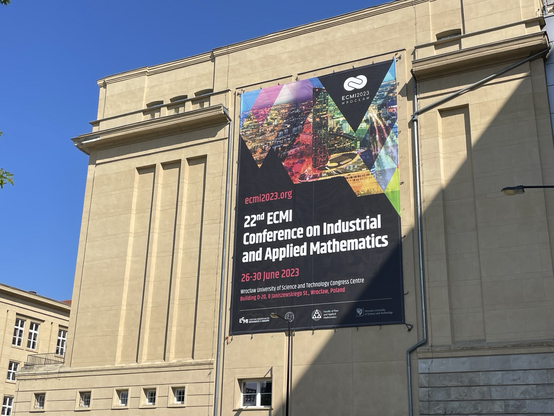
Greetings from the 22nd #ECMI Conference on Industrial and Applied Mathematics in Wrocław! Close to 300 participants from academia and #industry will discuss new #mathematical methods to solve problems in business, #technology and #applied sciences.

https://ecmiindmath.org/2023/06/25/22nd-ecmi-conference-begins/

22nd ECMI Conference begins

22nd ECMI Conference on Industrial and Applied Mathematics starts Monday 26 June 2023. Close to 300 participants from academia and industry during 5 days of the conference will meet, discuss and co…

ECMI

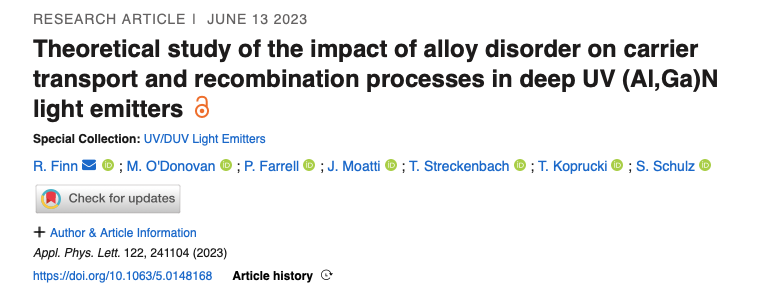
Aluminum gallium nitride (Al,Ga)N holds promise for efficient deep #UV light emitters but unfortunately current devices suffer from low #efficiency. We offer an explanation: Our simulations reveal disorder-induced transport #percolation in #quantum wells. But radiative and non-radiative recombination increase both!

https://pubs.aip.org/aip/apl/article/122/24/241104/2896108/Theoretical-study-of-the-impact-of-alloy-disorder

Collaboration between #Tyndall institute, Université #Lille and #Weierstrass Institute Berlin.

Theoretical study of the impact of alloy disorder on carrier transport and recombination processes in deep UV (Al,Ga)N light emitters

Aluminum gallium nitride [(Al,Ga)N] has gained significant attention in recent years due to its potential for highly efficient light emitters operating in the d

AIP Publishing

Worried about the energy consumption of AI models like ChatGPT? Consider leveraging the incredible computational efficiency of the human brain with memristors! In our latest preprint, we explore how mobile defects impact hysteresis in memristors. Check it out!

https://arxiv.org/abs/2304.06527

The Role of Mobile Point Defects in Two-Dimensional Memristive Devices

Two-dimensional (2D) layered transition metal dichalcogenides (TMDCs) are promising memristive materials for neuromorphic computing systems as they could solve the problem of the excessively high energy consumption of conventional von Neumann computer architectures. Despite extensive experimental work, the underlying switching mechanisms are still not understood, impeding progress in material and device functionality. This study reveals the dominant role of mobile defects in the switching dynamics of 2D TMDC materials. The switching process is governed by the formation and annihilation dynamics of a local vacancy depletion zone. Moreover, minor changes in the interface potential barriers cause fundamentally different device behavior previously thought to originate from multiple mechanisms. The key mechanisms are identified with a charge transport model for electrons, holes, and ionic point defects, including image-charge-induced Schottky barrier lowering (SBL). The model is validated by comparing simulations to measurements for various 2D MoS$_2$-based devices, strongly corroborating the relevance of vacancies in TMDC devices and offering a new perspective on the switching mechanisms. The insights gained from this study can be used to extend the functional behavior of 2D TMDC memristive devices in future neuromorphic computing applications.

arXiv.org