 Robert McNees
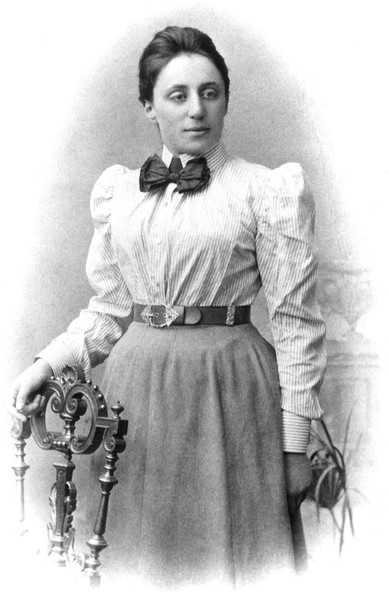
Hungarian mathematician Rózsa Péter was born #OTD in 1905.
She was one of the founders of Recursion Theory – also known as Computability Theory – along with Gödel, Church, Turing, and Post.
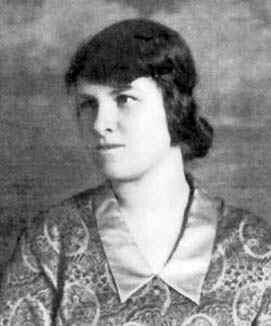

Hungarian mathematician Rózsa Péter was born #OTD in 1905.
She was one of the founders of Recursion Theory – also known as Computability Theory – along with Gödel, Church, Turing, and Post.

Short-term forecasting of solar photovoltaic energy (PV) production is important for powerplant management. Ideally these forecasts are equipped with error bars, so that downstream decisions can account for uncertainty. To produce predictions with error bars in this setting, we consider Gaussian processes (GPs) for modelling and predicting solar photovoltaic energy production in the UK. A standard application of GP regression on the PV timeseries data is infeasible due to the large data size and non-Gaussianity of PV readings. However, this is made possible by leveraging recent advances in scalable GP inference, in particular, by using the state-space form of GPs, combined with modern variational inference techniques. The resulting model is not only scalable to large datasets but can also handle continuous data streams via Kalman filtering.
https://arxiv.org/abs/2301.12466
'Kernelized Cumulants: Beyond Kernel Mean Embeddings'
- Patric Bonnier, Harald Oberhauser, Zoltán Szabó
Cumulants are algebraic functionals of a probability measure which are able to characterise various structural properties of the measure (e.g. independence, Gaussianity, ...). This work looks at a nonparametric 'kernelised' version of cumulants.
In $\mathbb R^d$, it is well-known that cumulants provide an alternative to moments that can achieve the same goals with numerous benefits such as lower variance estimators. In this paper we extend cumulants to reproducing kernel Hilbert spaces (RKHS) using tools from tensor algebras and show that they are computationally tractable by a kernel trick. These kernelized cumulants provide a new set of all-purpose statistics; the classical maximum mean discrepancy and Hilbert-Schmidt independence criterion arise as the degree one objects in our general construction. We argue both theoretically and empirically (on synthetic, environmental, and traffic data analysis) that going beyond degree one has several advantages and can be achieved with the same computational complexity and minimal overhead in our experiments.
https://arxiv.org/abs/2301.12600
'Bagging Provides Assumption-free Stability'
- Jake A. Soloff, Rina Foygel Barber, Rebecca Willett
Bagging (bootstrap aggregation) is an algorithm-agnostic tool for improving the stability of predictive algorithms. This work obtains finite-sample guarantees which rigorously characterise how this stability is achieved.

Bagging is an important technique for stabilizing machine learning models. In this paper, we derive a finite-sample guarantee on the stability of bagging for any model. Our result places no assumptions on the distribution of the data, on the properties of the base algorithm, or on the dimensionality of the covariates. Our guarantee applies to many variants of bagging and is optimal up to a constant. Empirical results validate our findings, showing that bagging successfully stabilizes even highly unstable base algorithms.
A short thread on Emmy Noether and giving credit.
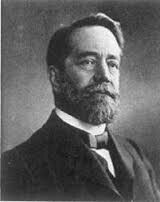
Felix Klein gave a lecture at the Mathematical Society of Göttingen #OTD in 1918. The title was “On Hilbert’s first note on the foundations of physics."
Klein included excerpts from letters in which he and Hilbert give priority to Emmy Noether for her results on conservation of energy in general relativity.
For the past 3+ years, I've been chairing an all-star National Academies committee charged with creating a series of posters on Illustrating the Impact of Mathematics. The website is finally live, and I'm really excited to share the results!! 💃 Please share!!
#science #mathematics #appliedmathematics #statistics #illustrations
https://nap.nationalacademies.org/resource/other/deps/illustrating-math/interactive/

https://arxiv.org/abs/2212.14319
'Gaussian Process Priors for Systems of Linear Partial Differential Equations with Constant Coefficients'
- Marc Härkönen, Markus Lange-Hegermann, Bogdan Raiţă
For a function to be a solution to a given linear PDE is itself a linear property, and so it can be expected to interface nicely with Gaussian processes. This work introduces some kernels for GP modelling of functions which automatically satisfy a given (linear, constant-coefficient) PDE.
Partial differential equations (PDEs) are important tools to model physical systems and including them into machine learning models is an important way of incorporating physical knowledge. Given any system of linear PDEs with constant coefficients, we propose a family of Gaussian process (GP) priors, which we call EPGP, such that all realizations are exact solutions of this system. We apply the Ehrenpreis-Palamodov fundamental principle, which works as a non-linear Fourier transform, to construct GP kernels mirroring standard spectral methods for GPs. Our approach can infer probable solutions of linear PDE systems from any data such as noisy measurements, or pointwise defined initial and boundary conditions. Constructing EPGP-priors is algorithmic, generally applicable, and comes with a sparse version (S-EPGP) that learns the relevant spectral frequencies and works better for big data sets. We demonstrate our approach on three families of systems of PDEs, the heat equation, wave equation, and Maxwell's equations, where we improve upon the state of the art in computation time and precision, in some experiments by several orders of magnitude.
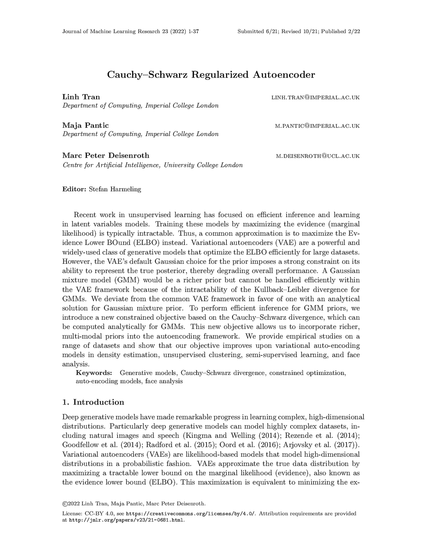
'Cauchy–Schwarz Regularized Autoencoder', by Linh Tran, Maja Pantic, Marc Peter Deisenroth.
http://jmlr.org/papers/v23/21-0681.html
#autoencoders #autoencoder #generative
 Uncle Duke
 Dan Stowell
 Sam Power
 Tammy Kolda
 Janet D. Stemwedel
 JMLR
JMLR