Meike van der Heijden

107 Followers
40 Following
14 Posts
Thinking about work, life, and balance. Looking for answers in the cerebellum.
www.mevanderheijden.com
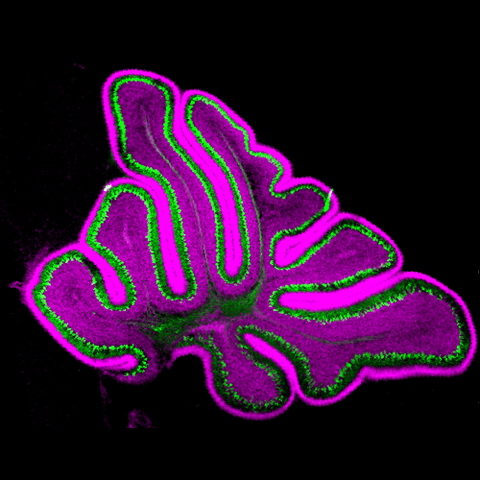
Here’s some cleared postnatal cerebellum #microscopy #EyeCandy to continue my #neuroscience #introduction. This image volume was acquired by Niraj Trivedi in my lab on an UltraMicroscope II. Magenta is the nucleus of all proliferating cerebellar granule #neurons in the external granule layer 🤩 These cells proliferate faster than a tissue culture cell line in a dish 🤯

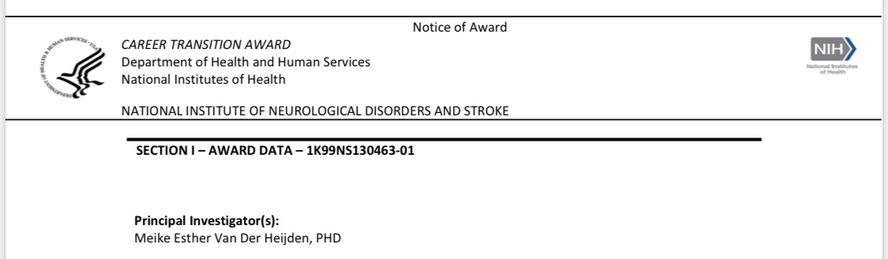
Smiling ear to ear after receiving my NIH/NINDS K99 NOA today!

I look forward to future discoveries about cerebellar signals in dystonia, and I am so grateful for my village of supporters, mentors, and advisors who helped me along the long way here.

RT @katjaQheuer
🧠🐒🐐🦘🦙🦌🐷🐻‍❄️🦫🦁🐑🐇🐈🦔🐕🦇🦭🦥🦓We’ve been diving into the mesmerising anatomical diversity and evolution of cerebellar folding across 56 mammalian species with @R3RT0 @nicolas_traut @AleAliSousa @sofievalk
https://www.biorxiv.org/content/10.1101/2022.12.30.522292v1
Check it out in a short thread 🔽
Alt text: green neurons with round cell bodies with red triangular shaped hat-like structures on top of them.

For this #FluorescentFriday, I want to share the most festive Purkinje cell of them all: Joy Zhou’s Purkinje cells with Santa hats.

Original image: https://elifesciences.org/articles/55569

Purkinje cell neurotransmission patterns cerebellar basket cells into zonal modules defined by distinct pinceau sizes

Targeted genetic silencing and reporter labeling reveal that Purkinje cell activity organizes cerebellar basket cells into zonal modules based on the sizes of their projections.

eLife

#introduction
Hi, #neuroscience community.

I'm an assistant professor at the University of Washington who works at the intersection of engineering and neuroscience. I am excited about using engineering tools like closed-loop motor brain-computer interfaces to probe basic neuroscience questions, and using insights about the brain to improve functionality of BCI applications.

My lab's current work
1) explores using BCIs as tools to begin unravelling how learning computations happen in neural populations
2) studies the interactions between users who learn alongside algorithms ("co-adaptation").
3) investigates how brains build "internal models", with a current interest in how to quantify internal model formation behaviorally.
We use both animal models (non-human primates) and human subject experiments. We also collaborate closely with computational and theoretical neuroscientists.

Trying out this thing as an alternative to Twitter. I'm already intimidated by the space to write and minimal pressure to edit.

Did you know that the beta-blocker propranolol is so effective in reducing tremors that it is banned in the Olympics?

But how does it work?

New paper with wonderful graduate student Joy Zhou now published in Cells:

https://www.mdpi.com/2073-4409/11/23/3889

Propranolol Modulates Cerebellar Circuit Activity and Reduces Tremor

Tremor is the most common movement disorder. Several drugs reduce tremor severity, but no cures are available. Propranolol, a β-adrenergic receptor blocker, is the leading treatment for tremor. However, the in vivo circuit mechanisms by which propranolol decreases tremor remain unclear. Here, we test whether propranolol modulates activity in the cerebellum, a key node in the tremor network. We investigated the effects of propranolol in healthy control mice and Car8wdl/wdl mice, which exhibit pathophysiological tremor and ataxia due to cerebellar dysfunction. Propranolol reduced physiological tremor in control mice and reduced pathophysiological tremor in Car8wdl/wdl mice to control levels. Open field and footprinting assays showed that propranolol did not correct ataxia in Car8wdl/wdl mice. In vivo recordings in awake mice revealed that propranolol modulates the spiking activity of control and Car8wdl/wdl Purkinje cells. Recordings in cerebellar nuclei neurons, the targets of Purkinje cells, also revealed altered activity in propranolol-treated control and Car8wdl/wdl mice. Next, we tested whether propranolol reduces tremor through β1 and β2 adrenergic receptors. Propranolol did not change tremor amplitude or cerebellar nuclei activity in β1 and β2 null mice or Car8wdl/wdl mice lacking β1 and β2 receptor function. These data show that propranolol can modulate cerebellar circuit activity through β-adrenergic receptors and may contribute to tremor therapeutics.

MDPI

Since the link didn’t make it in the masto-twit crossposter, here it is!!

https://youtu.be/jqCTdI0PxWY

MW:M Convention 2022 | Signal Transformation - Science as Music Material | Kesselhaus | 09.11.22

YouTube

How does one take data and make music out of it?

I gave a talk about how I approach my music making, and how I think it can be applied to all kinds of data! I hope for a new era of sciart that starts cool dialogues between scientists and artists 👩‍🔬 👨‍🎨 👩‍🎤

https://youtu.be/jqCTdI0PxWY

MW:M Convention 2022 | Signal Transformation - Science as Music Material | Kesselhaus | 09.11.22

YouTube

Hi #ScienceMastodon!

My name is Meike and I am a postdoc studying cerebellar development and its role in neurodevelopmental movement and affective disorders.

Looking forward to meeting you and learning about your cool work!

Follow me for stories about and pretty pictures of the cerebellum.

#Science #Introduction #Cerebellum #womeninstem