Massimo Pizzol

178 Followers
247 Following
100 Posts

Prof. in industrial ecology @AalborgUniv. Life Cycle Assessment of emerging technologies. Focus on uncertainty analysis.

๐Ÿ‘‰Hi, great you landed here

I am a #researcher in #Sustainability and #Professor at the #University of #Aalborg (AAU)
Toots on #environment #climate #research and peak #academia.

Also #Blogger , reader, #openwater swimmer, alto player....Born in ๐Ÿ‡ฎ๐Ÿ‡น, living in ๐Ÿ‡ฉ๐Ÿ‡ฐ, European๐Ÿ‡ช๐Ÿ‡บ

Univ. Profile Pagehttps://vbn.aau.dk/en/persons/117459
Bloghttps://moutreach.science/
GitHubhttps://github.com/massimopizzol
ORCIDhttps://orcid.org/0000-0002-7462-2668

Registration open! ๐Ÿ‘Œ ๐Ÿ‘Œ ๐Ÿ‘Œ Excited to announce the second edition of the hashtag#SummerSchool in "Applied Circular Economy" at the hashtag#TECH4CE centre, Aalborg University

Check the flyer for info๐Ÿ‘‡ and sign up here: https://forms.gle/yetMq8oASwnLGwzA9

This is a cross-departments initiative, learn more about the centre here: https://lnkd.in/eQD2ad7p
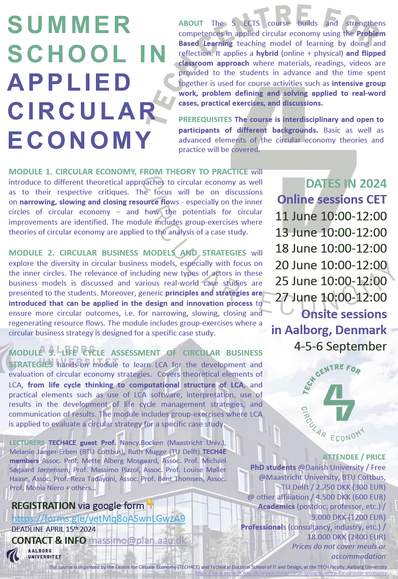
Summer School in Applied Circular Economy - Aalborg 2024

Please fill in the form below with your details if you wish to enrol to the course. It is important that you clearly explain your background, experience, and motivation for joining the course please. We will then return back to you via mail regarding acceptance to the course.

Google Docs
Check out this rocking paper๐Ÿ’ช: we demonstrate that one can get significantly DIFFERENT scores for the SAME product by following different guidelines in the EPD system that are all formally choosable. This casts doubts on both comparability and validity of results within the system. "Same product, different score: how methodological differences affect EPD results" https://link.springer.com/article/10.1007/s11367-023-02246-x
Same product, different score: how methodological differences affect EPD results - The International Journal of Life Cycle Assessment

Purpose Demand for Environmental Product Declarations (EPDs) is already high and increasing in the construction and building sectors. The overall purpose of EPDs is comparability of product environmental performance, and they are thus developed in accordance with product category rules (PCRs): requirements and guidelines for how to make EPDs for one or more product groups. Since several organisations publish PCRs, there is a risk of creating conflicting rules leading to inconsistencies and jeopardising the objective of comparability. Methods This study analyses the causes for inconsistency and the consequences in terms of difference in the results across the life cycle assessment (LCA) models underlying the EPDs. Taking four EPD programmes and their actors as cases, first a document analysis was conducted to identify qualitative and quantitative differences in their guidelines. Further focusing on selected quantitative differences, a series of LCA models were designed for the same triple-glazed window product by adhering to the PCRs of each operator, to highlight the differences in results that occur when performing the same assessment via different but all formally selectable operators and compliant EPDs. Results and discussion Results show that the EPD of a specific product can return very different impact scores if one or the other guideline is followed. Results can vary more than 10% from the base scenarios, what we consider a significant variation. This is observed across all impact categories. Focusing specifically on the climate change impact, the results show that differences are due to the choice of energy mix, reference service life and other parameters. It is thus the combination of several modelling differences that leads to a overall divergence in results, rather than one single methodological choice. Conclusions Numerous different but at the same time compliant EPDs can be obtained for the same product, highlighting a serious harmonisation issue within the EPD system. EPDs are thus not necessarily accurate, and it remains doubtful whether EPD comparability can be achieved. This weakness of the EPD system can in the worst case be exploited by producers to obtain lower results and undermines the system. Recommendations Besides recommending using LCA for learning and process improvement rather than just for external communication and compliance, to increase harmonisation in the EPD system, we recommend limiting the number of product-specific PCRs (e.g. complementary PCRs), align default values, learn from verification, use just one background database, increase transparency and move towards one centralized operator.

SpringerLink
Accounting for the impact of #carbon emissions and release according to different guidelines for #LifeCycleAssessment. Large differences across them. (picture taken at #LCM2023 #conference).
Interesting New Yorker article on Reverse Logistics โ€”. What happens to all the stuff we return? https://stocks.apple.com/ANn5Gm6sKQ_SiZPxI9tNabg
What Happens to All the Stuff We Return? โ€” The New Yorker

How product returns became an industry.

Well, on the principle that you should post like no-one is reading, I only today found the annual stats on my blog sterna paradisaea.net.

Clearly that's not a massive reach but a huge majority of this year's views have apparently been sent from mastodon so thank you again for reading. It's definitely motivation to keep posting...

Tell me again that #blogging is dead?

Here's the latest, a response to a piece on #ClimateGrief

http://sternaparadisaea.net/2023/08/20/on-climate-grief/

#blog #oldSchool #BlogLikeNooneIsWatching

On Climate Grief..

A short post on climate grief and how to survive itโ€ฆ

Sterna Paradisaea

New paper out by Pierre Jouannais ๐Ÿ“„ on #LifeCycleAssessment of #FishFarming

https://link.springer.com/article/10.1007/s11367-023-02211-8

Reducing losses in #Aquaculture saves precious resources, and we shed light on the best reduction strategies, environmentally-wise.

Here:
- A parametrised #python LCA model for finfish farms
- that can model losses at different growth stages๐Ÿ“ˆ
- different mortalities and different biological feed conversion ratios...โœ…
- and evaluate the environmental benefit of reducing losses ๐Ÿ‘ฉโ€๐Ÿ’ป

#BlueEconomy

LCA to evaluate the environmental opportunity cost of biological performances in finfish farming - The International Journal of Life Cycle Assessment

Purpose Mortality and suboptimal biological performance are a widespread problem in finfish farming. The associated losses constitute an environmental opportunity cost that needs to be thoroughly assessed to prioritize actions aiming at reducing the environmental impacts of finfish aquaculture. We here propose and demonstrate the use of a new parameterized and consequential LCA model of sea-trout production designed to assess the environmental opportunity costs of suboptimal biological performances, considering distinct mortalities and biological feed conversion ratios (FCRs) along the rearing process. Methods Primary data was collected in Danish and Italian farms to reconstitute the whole production process for sea-reared trouts. The level of detail allowed us to divide this production into seven different growth stages for which mortality and biological FCR can be assessed and modified. Excretion and valorization of fish sludge were modeled with a calibrated mass-balance model. Together with fish sludge, dead fish was modeled as valorized by anaerobic digestion. The foreground system was linked to the consequential version of ecoinvent 3.8 for which the embedded uncertainty was considered in Monte Carlo simulations. The model was used to assess the current environmental opportunity costs and evaluate the effect of losses happening at different timings along the rearing process. Results and discussion Results showed a low environmental opportunity cost for the current mortality rate of 5% as suppressing this mortality decreased impacts by 3.5 to 5% across impact categories. Decreasing the biological FCR decreased the environmental impacts proportionally. The timing of the losses was shown to greatly influence the environmental opportunity cost, and the same mortality rate happening in the late stages had substantially more impact than in the first stages. The valorization of the dead fish showed a negligible contribution to the reduction of impacts in the current system but showed a substantial contribution in the case of higher mortalities, such as observed for other farms and foreseen in the future. Conclusion The model demonstrated that assessing an opportunity cost by multiplying the lost biomass by a unique impact factor constitutes an oversimplification neglecting the losses timing and the fact that fish biomass is not a marketable product. Even though the current environmental opportunity cost for losses appeared neglectable, suboptimal biological FCR should be tackled. The model and approach can be used to project trout farming within future disease regimes and assess the trade-offs regarding fish health issues and new treatments and practices.

SpringerLink

Great 1st practical session today at the Uni degli Studi di Cagliari, having a go at drawing movement, organizing space on the page & thinking about framing & focus. Hurray for the students!

I am doing all this teaching in Italian & it reminds me of how lucky I am to usually not have to work in a 2nd or 3rd language, unlike many in academia. ๐Ÿ˜ฉ๐Ÿ˜…๐Ÿคช
#comics #geography #creativeMethods #culturalGeography #visualMethods @academicchatter @geography

Finally wrote up some of my thoughts on #chatGPT (prompted by last week's WP stuff, but not really specific to it)

I think I now have a better sense of when and why it starts bullshitting, but how on earth it seemed a good idea to release it with that behaviour is beyond me.

https://www.generalist.org.uk/blog/2023/on-chatgpt/

on chatGPT โ€“ Andrew Gray

We have a #postdoc position open in #LifeCycleAssessment for the #bioeconomy. Check it out and apply with deadline April 16th. https://www.vacancies.aau.dk/show-vacancy/?vacancy=1207488
Postdoc in Life cycle assessment for the bioeconomy

At the Technical Faculty of IT and Design, Department of Planning Aalborg, a position as Postdoc in Life cycle assessment for the bioeconomy is open for appointment from September 1, 2023 or soon hereafter. The position is available for a period of two years.

We have a #postdoc position open in #LifeCycleAssessment for the #bioeconomy. Check it out and apply with deadline April 16th. https://www.vacancies.aau.dk/show-vacancy/?vacancy=1207488
Postdoc in Life cycle assessment for the bioeconomy

At the Technical Faculty of IT and Design, Department of Planning Aalborg, a position as Postdoc in Life cycle assessment for the bioeconomy is open for appointment from September 1, 2023 or soon hereafter. The position is available for a period of two years.