Marino Pagan

@marinopagan
351 Followers
116 Following
27 Posts
Group Leader at the Simons Initiative for the Developing Brain and the University of Edinburgh studying the neural substrates of flexible decision-making, and how they are altered by genetic disorders. SCGB postdoctoral fellow and SFARI BTI fellow. (he/him)

What neural mechanisms underlie flexible decision-making? And how are these mechanisms altered by genetic mutations in neurodevelopmental disorders? To answer these questions, we study how rats solve tasks requiring flexible decision-making using electrophysiology, optogenetics and computational modelling. I am currently recruiting a PhD student at the Simons Initiative for the Developing Brain in beautiful Edinburgh! Please feel free to get in touch with any questions!
https://t.ly/SFc2s

Study of the neural mechanisms underlying cognitive flexibility and their alterations in rat models of autism at University of Edinburgh on FindAPhD.com

PhD Project - Study of the neural mechanisms underlying cognitive flexibility and their alterations in rat models of autism at University of Edinburgh, listed on FindAPhD.com


www.FindAPhD.com
@jerlich The monkeys are tracking the marker, but they are not explicitly reporting which stimulus they are perceiving. The monkeys first learn to track an unambiguous marker (i.e. same stimulus to both eyes), and the marker is always jumping around, so I don't think the monkeys have any way to know whether the marker jumped, or the percept switched. This seems to me like a solid way to measure changes in neural coding upon percept switching without risking contamination from the monkey report.

@jerlich @NicoleCRust @dbarack @tdverstynen @Neurograce

On the topic of "consciousness", I found a recent study by Janis Karan Hesse and Doris Tsao very clever and interesting. It adds a neat trick to the classic binocular rivalry paradigm, allowing the experimenters to infer the subject's percept from eye movement patterns, without any active report:

https://elifesciences.org/articles/58360 .

A new no-report paradigm reveals that face cells encode both consciously perceived and suppressed stimuli

Conscious visual percepts are encoded by face patches in the absence of report, can be decoded from population recordings, and are multiplexed with the veridical physical stimulus.

eLife

New preprint, led by @marinopagan
(he's on the job market! he's awesome!), together with a great team of collaborators!

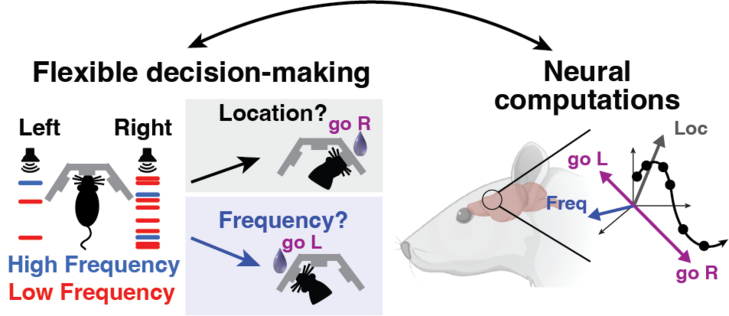
For flexible, context-dependent decision-making, the space of network solutions is much larger than previously appreciated.

Moreover, variability across and even within individuals on where they are in this space is the underlying variable that jointly explains neural and behavioral variability.

https://www.biorxiv.org/content/10.1101/2022.11.28.518207v1

1/
On the bird site, I said that Marino and the Brody lab’s paper is a major advance. @NicoleCRust asked why. I’m sure Marino and Carlos have their own bits that excite each of them the most. This thread explains what excites me the most, as a peripheral contributor.

In short, I’m super stoked on the work because it’s a significant *indirect* validation of the line attractor hypothesis for frontal cortices and for computation through neural population dynamics in general.

Here goes nothing!

@Rob_Mok @NicoleCRust @SussilloDavid @kordinglab
Not sure what you mean by "attention effects". RNNs are trained to form context-dependent decisions so context must somehow influence computation. Here we find that RNNs trained with backprop rely mostly on changes of recurrent dynamics across contexts, so the general cautionary tale is that the space of solutions can be bigger than what is found w/ backprop. However I am super interested in understanding how these findings relate to other tasks!
@Rob_Mok @NicoleCRust @SussilloDavid @kordinglab
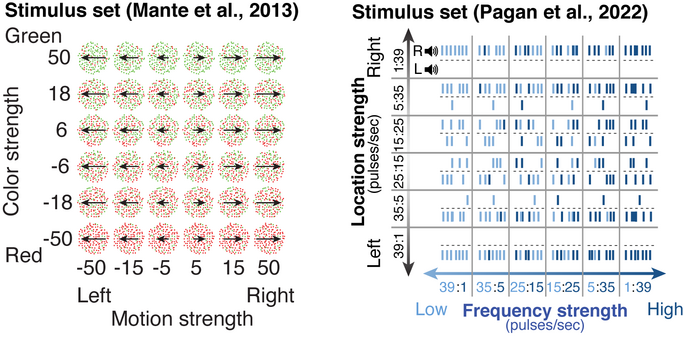
Two quick points: 1) In our rat task the two features (location and frequency) are orthogonal exactly like motion and color in the original Mante/Sussillo task (see figure). 2) There is an ongoing debate about gating of irrelevant info before reaching frontal cortex, with potentially different results across tasks. We note that, even though we don't observe it experimentally, gating of irrelevant info is also captured by our theoretical framework.

@NicoleCRust @SussilloDavid @kordinglab
2) Using the math of our theory result (Eq. 1 and Eq. 2 in the paper) we can now engineer RNNs spanning the full space of solutions. 3) Different solutions have anatomical implications (i.e. impose constraints on network architecture), as well as implications on the resulting neural dynamics and behavior. 4) A specific link exists between neural dynamics and behavioral integration, which was crucial to explain individual variability in our rat data.

3/3

@NicoleCRust @SussilloDavid @kordinglab
In our work, we asked whether other solutions exist. Our key theory result is that, under assumptions supported by both monkey and rat data, all networks solving the task use a combination of three components. This led us to multiple insights: 1) Most RNNs trained with gradient descent converge to a single solution, context-dependent recurrent dynamics (which we call selection vector modulation), but the full space of solutions is larger than that!

2/3