Marino Pagan

@marinopagan
351 Followers
116 Following
27 Posts
Group Leader at the Simons Initiative for the Developing Brain and the University of Edinburgh studying the neural substrates of flexible decision-making, and how they are altered by genetic disorders. SCGB postdoctoral fellow and SFARI BTI fellow. (he/him)

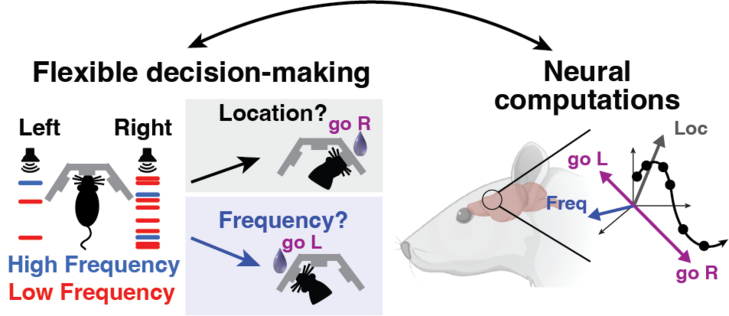
What neural mechanisms underlie flexible decision-making? And how are these mechanisms altered by genetic mutations in neurodevelopmental disorders? To answer these questions, we study how rats solve tasks requiring flexible decision-making using electrophysiology, optogenetics and computational modelling. I am currently recruiting a PhD student at the Simons Initiative for the Developing Brain in beautiful Edinburgh! Please feel free to get in touch with any questions!
https://t.ly/SFc2s

Study of the neural mechanisms underlying cognitive flexibility and their alterations in rat models of autism at University of Edinburgh on FindAPhD.com

PhD Project - Study of the neural mechanisms underlying cognitive flexibility and their alterations in rat models of autism at University of Edinburgh, listed on FindAPhD.com
www.FindAPhD.com

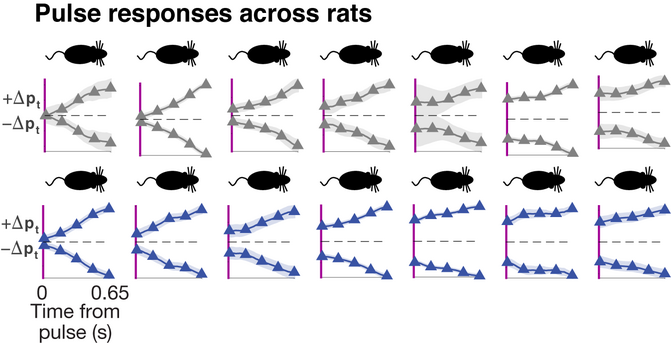
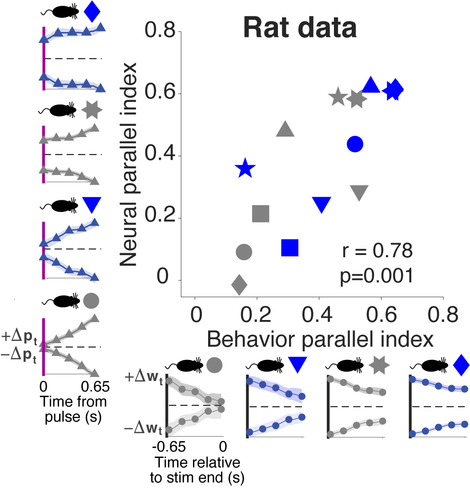
Remarkably, it works out also in rats! The variability of neural pulse-evoked trajectories is highly correlated with the variability of behavioral kernels, strongly suggesting that both measurements reflect the individual variability of the underlying mechanisms!

12/16

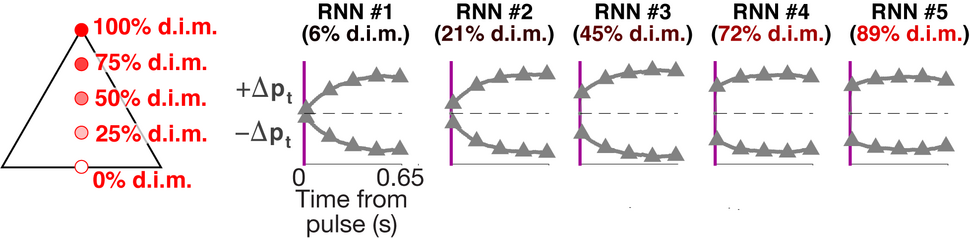
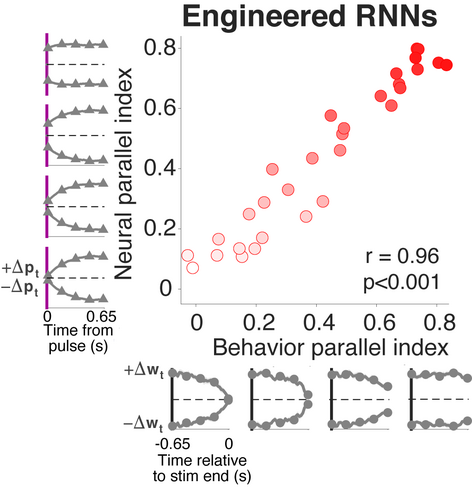
Our theory also predicts a specific behavioral “fingerprint”. The context-dependent behavioral kernels should be a reflection on the time axis of the pulse responses.

When measuring these behavioral kernels using logistic regression, that’s exactly what we observe in RNNs.

11/16

Ok, now that we have validated our analysis using RNNs, let’s apply it to data from rat brains!🧠

The result? Different individual rats display different pulse-evoked neural trajectories, very similar to those produced by RNNs implementing different mechanisms!🤯

10/16

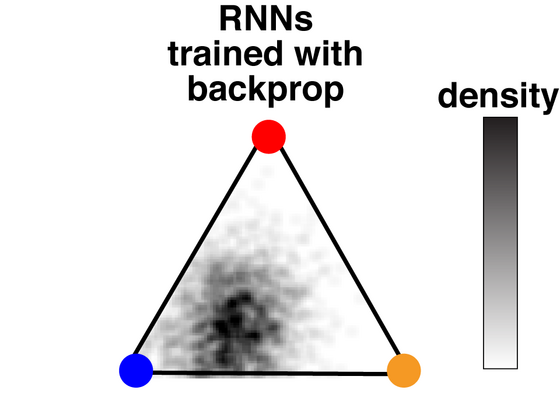
Why did we develop a new method to build RNNs, you might ask, instead of simply training RNNs using backprop and studying those solutions?

It turns out that RNNs trained using backprop only find a small subset of the larger space of solutions!

9/16

We then developed a new method to engineer recurrent neural networks (RNNs) to implement different mechanisms, and we applied the analysis to their dynamics as they solved the task.

The pulse-evoked trajectories clearly distinguish RNNs using different mechanisms.

8/16

Can we tell apart different mechanisms using neural data collected during the task? 🤔

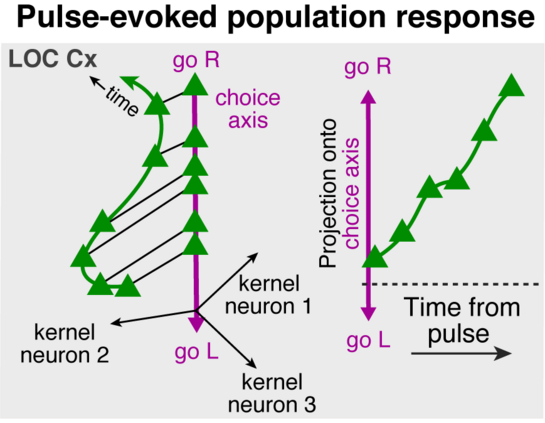
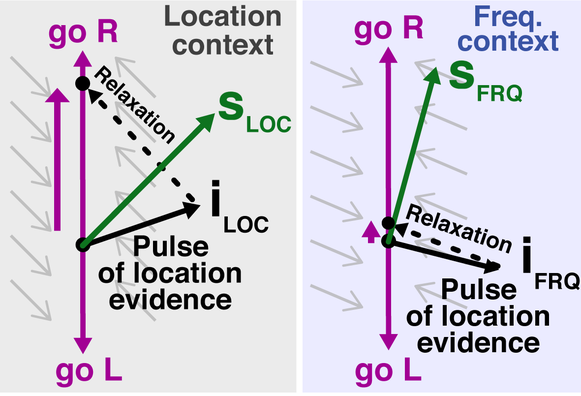
Yes!!! We developed a new analysis that leverages the high statistical power provided by our pulsatile stimulus to retrieve population trajectories evoked by single pulses of evidence!

7/16

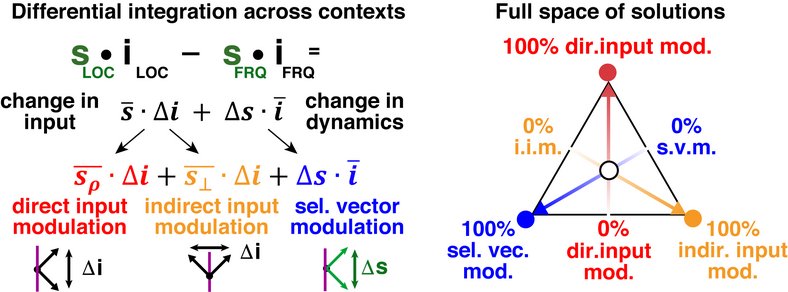
Rearranging the formula for differential evidence integration revealed that any network solving the task uses a combination of three distinct components, i.e. under assumptions supported by both monkey and rat data, a triangle constitutes the space of all possible solutions.

6/16

Then, we wanted to generalize this result, and study the entire space of possible network solutions, so we turned to math!🤓

Following the footsteps of Mante et al., 2013, we studied the properties of linearized system dynamics around fixed points.

5/16

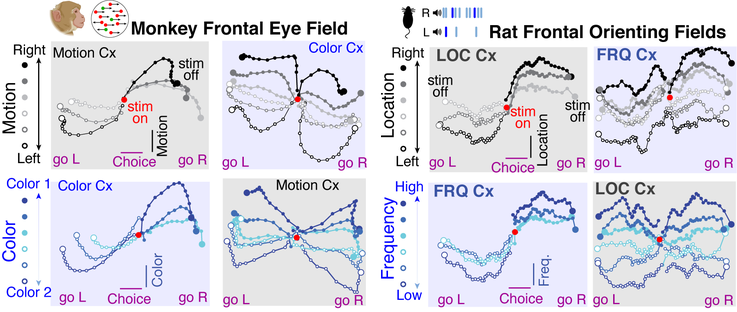
First, was neural activity in rats similar to monkeys, where irrelevant evidence was not gated before reaching the Frontal Eye Field?

The neural trajectories we observed in rat Frontal Orienting Fields were strikingly similar 🤯, leading us to the same conclusion!

4/16