Marino Pagan

@marinopagan
351 Followers
116 Following
27 Posts
Group Leader at the Simons Initiative for the Developing Brain and the University of Edinburgh studying the neural substrates of flexible decision-making, and how they are altered by genetic disorders. SCGB postdoctoral fellow and SFARI BTI fellow. (he/him)

What neural mechanisms underlie flexible decision-making? And how are these mechanisms altered by genetic mutations in neurodevelopmental disorders? To answer these questions, we study how rats solve tasks requiring flexible decision-making using electrophysiology, optogenetics and computational modelling. I am currently recruiting a PhD student at the Simons Initiative for the Developing Brain in beautiful Edinburgh! Please feel free to get in touch with any questions!
https://t.ly/SFc2s

Study of the neural mechanisms underlying cognitive flexibility and their alterations in rat models of autism at University of Edinburgh on FindAPhD.com

PhD Project - Study of the neural mechanisms underlying cognitive flexibility and their alterations in rat models of autism at University of Edinburgh, listed on FindAPhD.com

www.FindAPhD.com

New preprint, led by @marinopagan
(he's on the job market! he's awesome!), together with a great team of collaborators!

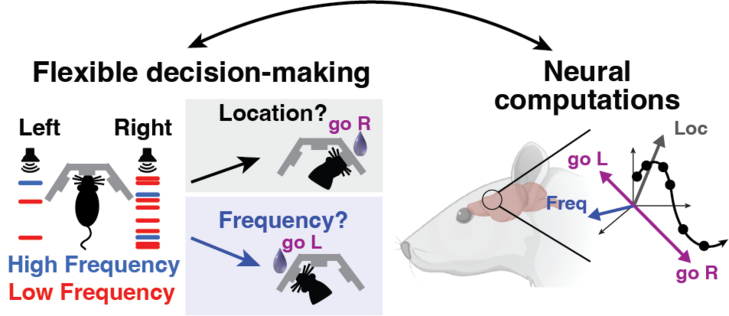
For flexible, context-dependent decision-making, the space of network solutions is much larger than previously appreciated.

Moreover, variability across and even within individuals on where they are in this space is the underlying variable that jointly explains neural and behavioral variability.

https://www.biorxiv.org/content/10.1101/2022.11.28.518207v1

1/
On the bird site, I said that Marino and the Brody lab’s paper is a major advance. @NicoleCRust asked why. I’m sure Marino and Carlos have their own bits that excite each of them the most. This thread explains what excites me the most, as a peripheral contributor.

In short, I’m super stoked on the work because it’s a significant *indirect* validation of the line attractor hypothesis for frontal cortices and for computation through neural population dynamics in general.

Here goes nothing!

Second, with the support of a SFARI Bridge to Independence Award, I am extremely excited to use this task, and these Systems and Computational approaches to study the role of genetic mutations in cognitive flexibility in rat models of autism!

https://sfari.org/2021/08/19/sfari-2021-bridge-to-independence-fellows-announced/

16/16

SFARI | SFARI 2021 Bridge to Independence fellows announced

SFARI is pleased to announce that it has selected six fellows in response to the 2021 Bridge to Independence Award request for applications.

SFARI

We are super excited about two future directions for this research.

First, we plan to use high-density probes to record large neural populations across brain areas as rats solve the task, and to directly study recurrent dynamics in simultaneously recorded neural populations using latent-based approaches (e.g. LFADS and PLNDE).

15/16

First of all, I can't thank enough my wonderful Mentor, Carlos Brody, for being an inexhaustible source of guidance, wisdom and support throughout this project! 🙏 🙏 🙏

Thanks also to Vincent Tang, Mikio Aoi, @SussilloDavid , Valerio Mante and Jonathan Pillow for a super-fun collaboration!

Finally, thanks to the Simons Collaboration on the Global Brain (SCGB) and the Simons Foundation Autism Research Initiative (SFARI) for supporting my research!

14/16

In conclusion, our results provide a new experimentally-supported theoretical framework to analyze biological and artificial systems performing flexible decision-making, opening the door to the study of individual variability in neural computations underlying higher cognition!

13/16

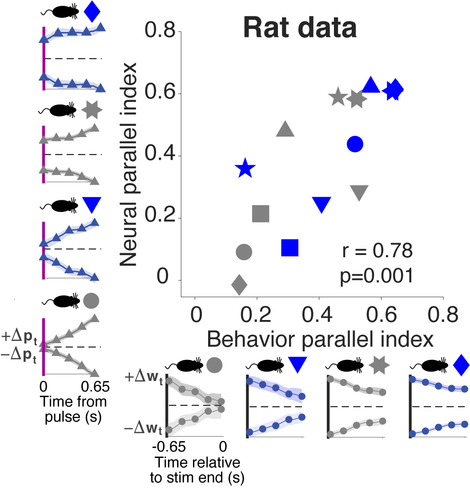
Remarkably, it works out also in rats! The variability of neural pulse-evoked trajectories is highly correlated with the variability of behavioral kernels, strongly suggesting that both measurements reflect the individual variability of the underlying mechanisms!

12/16

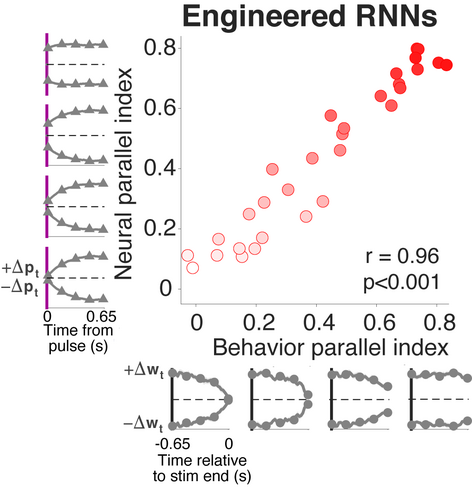
Our theory also predicts a specific behavioral “fingerprint”. The context-dependent behavioral kernels should be a reflection on the time axis of the pulse responses.

When measuring these behavioral kernels using logistic regression, that’s exactly what we observe in RNNs.

11/16

Ok, now that we have validated our analysis using RNNs, let’s apply it to data from rat brains!🧠

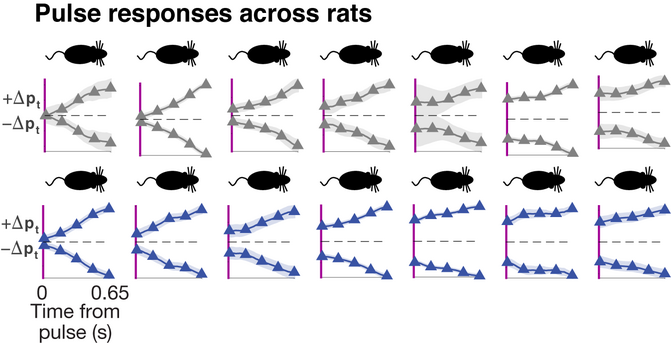
The result? Different individual rats display different pulse-evoked neural trajectories, very similar to those produced by RNNs implementing different mechanisms!🤯

10/16