Maren Mayer

31 Followers
16 Following
11 Posts
PostDoc at Leibniz-Institut für Wissensmedien, Tübingen | Interested in group decision making, group information sharing, crowd wisdom, cognitive modeling

Happy to announce my new preprint with
@Daniel_Heck : Modeling Dependent Group Judgments: A Computational Model of Sequential Collaboration

The developed model is consistent with previous findings and we also confirmed new prediction from the model!

https://osf.io/preprints/psyarxiv/yqc3r

OSF

Finally out at PNAS https://pnas.org/doi/10.1073/pnas.2220580120!

Lab-identified Super-Recognizers also excel at identifying perpetrators on real-world CCTV footage from actual crime scenes.

Thank you Meike for having me in this amazing project!

Finally, the last paper of my dissertation was published today 🥳! Thank you
@Daniel_Heck for being an amazing advisor!
Read more about the influence of expertise on contributions in sequential collaboration here: https://doi.org/10.1017/jdm.2023.3
Expertise determines frequency and accuracy of contributions in sequential collaboration | Judgment and Decision Making | Cambridge Core

Expertise determines frequency and accuracy of contributions in sequential collaboration - Volume 18

Cambridge Core

Congratulations to @marenmayer 🥳 The 2nd paper of her PhD is now published in the Journal of Mathematical Psychology:

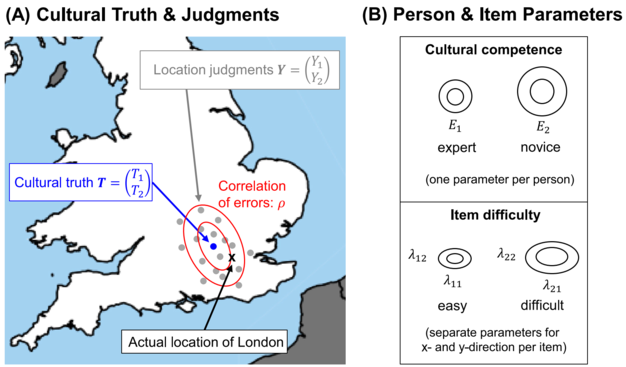
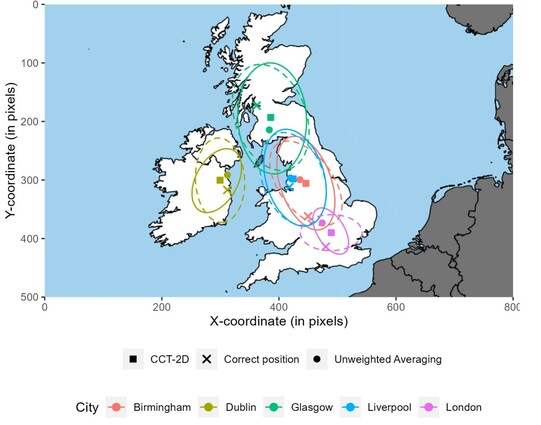
"Cultural consensus theory for two-dimensional location judgments"

Maren developed a Bayesian model for aggregating 2-dimensional judgments which infers:
(a) a group's consensus regarding the unknown locations for a set of targets (e.g., cities)
(b) the expertise of individuals

Free access to published paper:
https://authors.elsevier.com/c/1gSTY53naqDIZ

Preprint: https://psyarxiv.com/unhvc/

Welcome new arrivals #onhere. A few tips I learned:

1️⃣make a toot. Empty accounts are 😞
2️⃣ toot an Introduction. Whatever you want to say (work, personal, motivation for being here). Share Introductions. Pin it to your timeline 📍
3️⃣ boost generously 🎺 You are *not* on the 🐦site. No algorithm here. If you want others to see the toot, #boost
4️⃣ check out new folks; I found a lot of interesting new things.
5️⃣ Don’t auto crosspost from #twitter. It looks weird, no context.

HAVE FUN 🤩

Improving forensic perpetrator identification with Super-Recognizers https://share.osf.io/preprint/E01E8-733-788

Just published a preprint together with Meike Ramon (not yet on Mastodon):
Improving forensic perpetrator identification with Super-Recognizers

https://psyarxiv.com/9zq7j/

With 73 Super-Recognizers and 45 control participants, we show that SR are superior in perpetrator identification in authentic forensic CCTV footage. Moreover, SRs perform even better, the better their performance in tests and CCTV test sequences!

@marenmayer just submitted a revised paper:

Cultural consensus theory (CCT) for two-dimensional location judgments
https://psyarxiv.com/unhvc/

#CCT provides estimates of the shared, latent #consensus knowledge of a group of informants (similar to #WisdomOfCrowds), while accounting for heterogeneity in informant competence & item difficulty.

We develop a new CCT model for location judgments which are obtained when asking informants to locate a set of unknown sites on a map.

"Models are important for psychology. They help us to think better and prevent us from fooling ourselves into thinking that we have understood or explained something when we have not." from: https://www.nature.com/articles/s44159-022-00031-5.epdf?sharing_token=NwsSehqydHeSD1ZjFJTFENRgN0jAjWel9jnR3ZoTv0MO3p1qY43iWPwg3981-lS0fOef_wBy9Va1yGG9UNG_uwPZnQ0zfdAKyJ5W9Vep95xpaqh7v2olBnyAUZJjCH0LfYMUyFzj3J75qecBeTAT4-5mxHbqSOzLv2qfKC5_bBk%3D #psychology #modeling #theory #cogsci
Psychological models and their distractors | Nature Reviews Psychology

The lack of models in psychology hinders scientific progress. To start addressing this problem, we need a clear understanding of what models are and what they are not. The lack of models in psychology hinders scientific progress. To start addressing this problem, we need a clear understanding of what models are and what they are not.

Check out my work on sequential collaboration, the process online collaborative projects rely o, https://psycnet.apa.org/doiLanding?doi=10.1037%2Fdec0000193
the role of expertise in sequential collaboration https://psyarxiv.com/s7vtg/

and judgment aggregation in wisdom of crowds https://psyarxiv.com/unhvc/