 Lorenz Meyer ✅
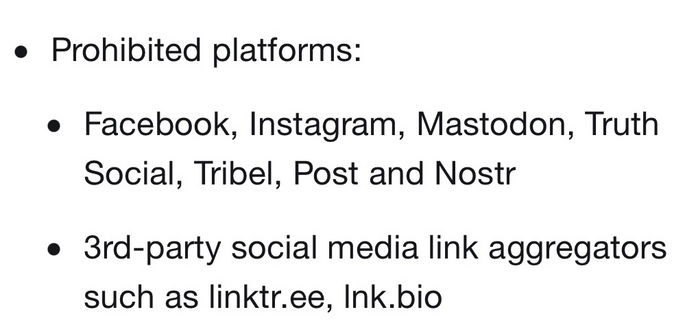
Unfassbar: Twitter will ab sofort Links zu anderen Social-Media-Netzwerken unterbinden… Langsam wird das dort zu einer billigen Nero-Nachverfilmung, in der ein schlechter Kaiserdarsteller mit Lyra und Benzinkanister durchs brennende Rom schwankt.

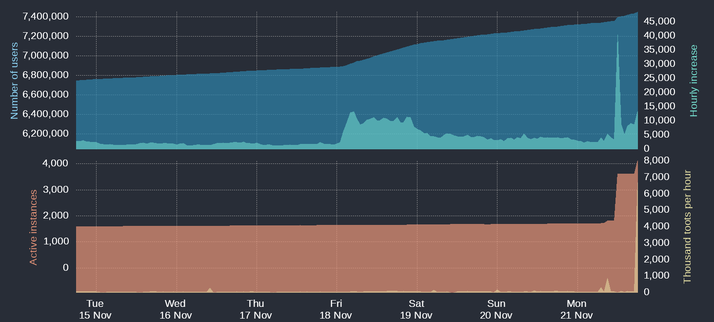
Also wenn die #NeuHier sind sich wundern, dass es derzeit manchmal hakt.
Hier ist der Grund:
7,449,985 accounts
+13,253 in the last hour
+149,130 in the last day
+706,066 in the last week
WOW!!! #Mastodon #Fediverse 🐘❤️
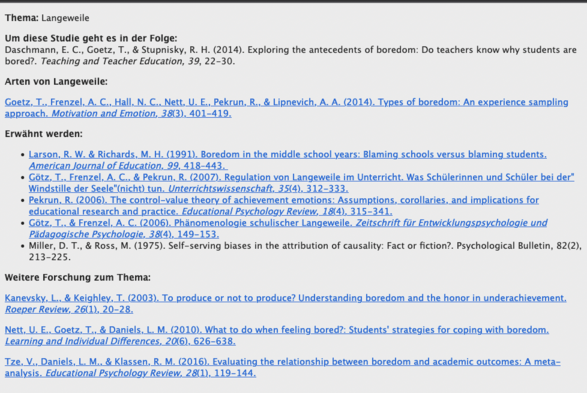

Thema: Langeweile Um diese Studie geht es in der Folge: Daschmann, E. C., Goetz, T., & Stupnisky, R. H. (2014). Exploring the antecedents of boredom: Do teachers know why students are bored?. Teaching and Teacher Education, 39, 22-30. Arten von Langeweile: Goetz, T., Frenzel, A. C., Hall, N. C., Nett, U. E., Pekrun, R., & Lipnevich, A. A. (2014). Types of boredom: An experience sampling approach. Motivation and Emotion, 38(3), 401-419. Erwähnt werden: Larson, R. W. & Richards, M. H. (1991). Boredom in the middle school years: Blaming schools versus blaming students. American Journal of Education, 99, 418–443. Götz, T., Frenzel, A. C., & Pekrun, R. (2007). Regulation von Langeweile im Unterricht. Was Schülerinnen und Schüler bei der" Windstille der Seele"(nicht) tun. Unterrichtswissenschaft, 35(4), 312-333. Pekrun, R. (2006). The control-value theory of achievement emotions: Assumptions, corollaries, and implications for educational research and practice. Educational Psychology Review, 18(4), 315-341. Götz, T., & Frenzel, A. C. (2006). Phänomenologie schulischer Langeweile. Zeitschrift für Entwicklungspsychologie und Pädagogische Psychologie, 38(4), 149-153. Miller, D. T., & Ross, M. (1975). Self-serving biases in the attribution of causality: Fact or fiction?. Psychological Bulletin, 82(2), 213-225. Weitere Forschung zum Thema: Kanevsky, L., & Keighley, T. (2003). To produce or not to produce? Understanding boredom and the honor in underachievement. Roeper Review, 26(1), 20-28. Nett, U. E., Goetz, T., & Daniels, L. M. (2010). What to do when feeling bored?: Students' strategies for coping with boredom. Learning and Individual Differences, 20(6), 626-638. Tze, V., Daniels, L. M., & Klassen, R. M. (2016). Evaluating the relationship between boredom and academic outcomes: A meta-analysis. Educational Psychology Review, 28(1), 119-144.
 Katharina König-Preuss
 The Secret Life of Plants 🌱♾️
 Norbert Forster