 hazchem 🏳️🌈 💛🤍💜🖤
Do you organise warehouse parties? Share your thoughts on alcohol policies and help a PhD candidate with their research.

I research workplace discourse analysis, with a particular interest in questions of power, discourse, and class struggle. This also informs my work as an EAP teacher and my activism as an NTEU union delegate and socialist.
I live on the lands of the Wangal people in so-called Sydney, and recognise the sovereignty was never ceded to the Australian colonial state. Therefore I will always support Indigneous struggles for justice and self-determination
| Pronouns | he/they |
| @lukeealexander |
Beautiful timelapse of Earth setting below the Moon's horizon captured by the Japanese lunar orbiter spacecraft Kaguya. ©JAXA/NHK
In the past week, medical students from Changsha, Nanjing, Kunming, Nanchang, Sichuan, Xuzhou, and Anhui have protested over inadequate working conditions as China goes from mismanaged lockdowns to faulty opening-up measures.
Media and activists should keep amplifying these.
今晚 长沙中南大学湘雅附二医院,医学专硕生游行
🐦🔗: https://twitter.com/whyyoutouzhele/status/1604868065434411008
“The Aldhani heist is lifted from an episode in the life of young Stalin, and Nemik is, in some sense, meant to be a “young Trotsky.” But does basing science fiction on real world events reflect back on the real world in any meaningful way? Or does it just strip them of context and turn them into blank, congenial abstractions (the way Lucas turned the National Liberation Front for South Vietnam into teddy bears with spears)? One might venture to ask, after all, just how continuous the last 3,000 years of “slavery, oppression, colonialism, bad behavior, betrayal, heroism” really are, and whether the Irgun, Continental Congress, Montagnard, and Bolsheviks have as much in common as Gilroy seems to suggest? One might even suggest that the things they precisely don’t have in common — specific attitudes towards capitalism and race, for example — might actually be somewhat important things. After all, weren’t the Irgun and the Continental Congress fighting to build the kinds of racist settler regimes that the Haitian revolutionaries and the ANC were fighting against? The Bolsheviks understood “revolution” in quite a bit more specific way than “shoot the bad guys,” and the Montagnard are as peculiar and specific a group of guerrillas for Gilroy to focus on as the Irgun are.
We should dig a bit deeper, then. Andor begins with a parable about how all cops are bastards and ends with a glorious brick-smashing and bomb-throwing riot. But if the Star Wars universe has cops and fascists — and if it knows that the thing good people do is fight them — does it know that the reason is race and capitalism? Andor is twice described as “a human with dark features” — by a police supervisor speculating as to why the corpos hassled him — but does Star Wars believe that Dark Featured Lives Matter? If Luthen is a Lenin figure, does he believe that the Empire is the highest stage of capitalism?
These are better questions than “is this show political?” For one thing, a kind of racial capitalism is threaded throughout the Empire as we see it in Andor: Narkina 5 and Kenari are clearly sacrifice zones, with racially marked inhabitants, while the Empire has a genocidal contempt for Aldhani’s pastoral highland residents, damming their sacred river and forcing them into “an Enterprise Zone [with] factories, new towns, Imperial housing.” While Skeen is not racially marked (as far as we know), the Imperial prefect that floods his brother’s pepper trees just reinforces the sense that the Empire is a destructively modernizing capitalist entity that steals people’s means of production: Preox-Morlana is the kind of corporate entity nestled into the imperial system that will be familiar to historians of European empire and American privatization alike. Finally, the show takes great care to demonstrate that Imperial prisons are productive complexes, factories for slave labor, and that when law enforcement is mandated to round up specific quotas of workers to fill them — Imperial Security Bureau CompStat appears to be mostly about maximizing detentions, and Dedra’s “numbers from Sev Tok” are reported to be good — the point is to clarify what the “order” was that Darth Vader proposed to bring to the galaxy in Empire Strikes Back.”
https://lareviewofbooks.org/article/police-and-thieves-on-tony-gilroys-andor/
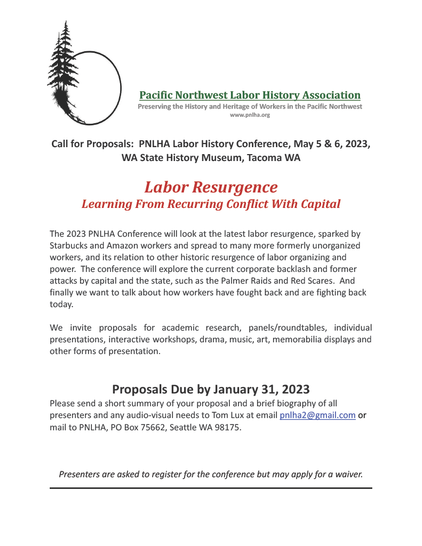
Call for proposals: we're putting together a great program for our May conference in #Tacoma, #Washington, and if you're working in #labor #history in the #PNW, we want you to be part of it! We are especially interested in hearing from folks doing nontraditional #organizing or with diverse historical perspectives you'd like to share. Non-academic speakers are encouraged.
Please boost to help us find amazing presenters we haven't met yet!
 Wonder of Science
 Michael Slezak
 promiseli
 prada meinhof
 PNW Labor History Association