Economist, formerly EPI, CEPR (DC), WCEG, and CEP (LSE).
#economics #unions #rstats #EconomicPolicy
| Economist | Washington, DC |
| Google Scholar | https://scholar.google.com/citations?user=huy9jEYAAAAJ |

Economist, formerly EPI, CEPR (DC), WCEG, and CEP (LSE).
#economics #unions #rstats #EconomicPolicy
| Economist | Washington, DC |
| Google Scholar | https://scholar.google.com/citations?user=huy9jEYAAAAJ |
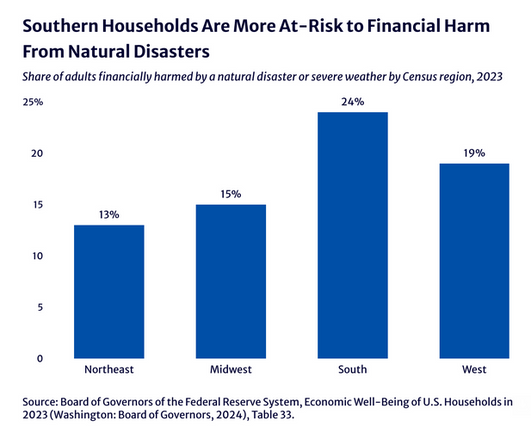
US State "Governors Need to Do More to Protect Their Low-Income Residents from Climate Change Especially in the South"
New from CEPR's Algernon Austin.
https://cepr.net/extreme-weather-2/
# economics #climate
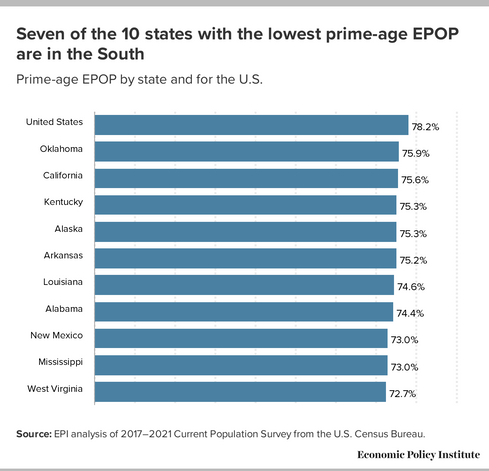
The Southern economic model fails Southern workers and their families: 7 of the 10 states with the lowest employment rates for 25-54 year olds (the population most tied to the labor market) are in the South.
See the latest Economic Policy Institute report by Chandra Childers.
"Tight labor markets are essential to reducing racial disparities -- and within the purview of the Fed’s dual mandate" by Economic Policy Institute economist Valerie Wilson
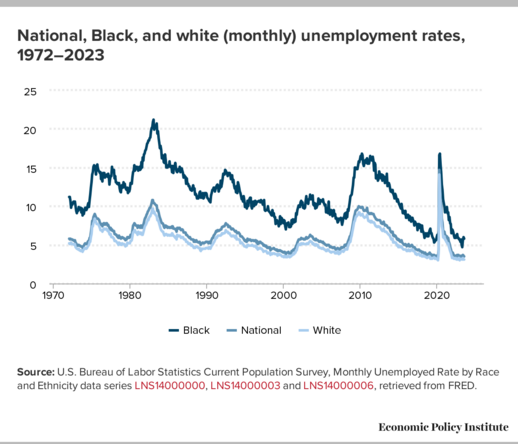

Download this article as a PDF This essay was originally published in the Point/Counterpoint section of the Journal of Policy Analysis and Management and can be accessed at https://doi.org/10.1002/pam.22545. Key findings Growing evidence shows that monetary policy decisions have a measurable impact on racial disparities in the labor market. This evidence challenges long-held beliefs about…
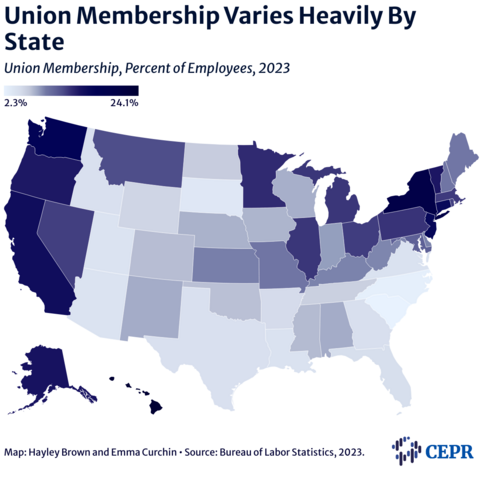
Maps of union membership levels, changes, shares, and composition across the US states.
Via Hayley Brown and Emma Curchin, Center for Economic and Policy Research
https://cepr.net/states-of-the-unions-the-where-of-the-us-labor-movement/
"In the past 2.5 years, more than 60 groups of student workers have filed petitions for representation elections...Notably, student workers have won every single election that has been held, and student workers have voted by overwhelming margins to unionize. On average, a whopping 91.3% of student workers have voted in favor of forming a union during their elections."
-Lynn Rhinehart and Margaret Poydock, Economic Policy Institute
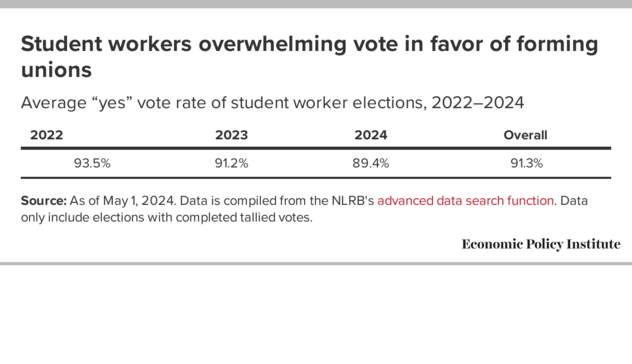

Nearly 45,000 student workers at private colleges and universities have formed unions since 2022, seeking to bargain with their employers over wages, health care, protections from harassment and discrimination, and other issues. These student workers include graduate student teaching assistants, undergraduate and graduate student resident assistants, and student dining workers. They are organizing across the…
"Building Worker Power as Anti-Monopoly: The Next Phase of the Modern Antitrust Agenda"
Friday, May 10 / 1pm - 4pm EDT
Register here:
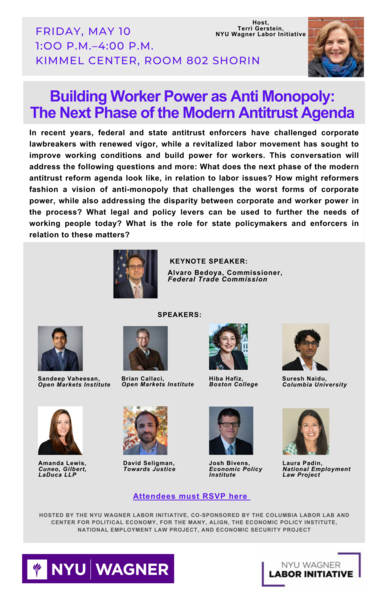

Presented by NYU Wagner Labor InitiativeIn recent years, federal and state antitrust enforcers have challenged corporate lawbreakers with renewed vigor, while a revitalized labor movement has sought to improve working conditions and build power for workers. This conversation will address the following questions and more: What does the next phase of the modern antitrust reform agenda look like, in relation to labor issues? How might reformers fashion a vision of anti-monopoly that challenges the worst forms of corporate power, while also addressing the disparity between corporate and worker power in the process? What legal and policy levers can be used to further the needs of working people today? What is the role for state policymakers and enforcers in relation to these matters? This event will feature leading experts, advocates, lawmakers, and enforcers operating at the nexus of labor and antitrust today, to discuss these and other important questions. The event is hosted by the NYU Wagner Labor Initiative, and co-sponsored by the Columbia Labor Lab and Center for Political Economy, For the Many, ALIGN, Economic Policy Institute, National Employment Law Project, and Economic Security Project.
The Economic Policy Institute's Lynn Rhinehart, Celine McNicholas, and Margaret Poydock review the recent history of the US National Labor Relations Board.
The "Biden administration has supported workers’ rights to form unions and engage in collective bargaining, standing in stark contrast to the Trump administration’s anti-worker record."
https://www.epi.org/publication/bidens-nlrb-restoring-rights/
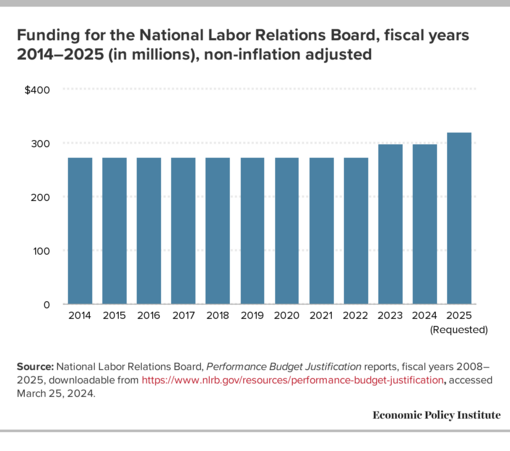

The National Labor Relations Board (NLRB) during the Biden administration has supported workers’ rights to form unions and engage in collective bargaining, standing in stark contrast to the Trump administration’s anti-worker record.
Economist Sylvia Allegretto on how the so-called "tip credit" in the US minimum wage "subsidizes employers and short-changes workers."
"It is past time that we rethink the subminimum wage and the tip credit allowance, especially in light of the deeply troubling racist history of post-Civil War employers who hired formerly enslaved workers but did not want to pay a living wage."
https://cepr.net/report/customer-tips-provide-lion-share-of-wages-to-tipped-workers/

New Economic Policy Institute report on artificial intelligence and the labor market, by Josh Bivens and Ben Zipperer.
"The root causes of sluggish wage growth for most workers are intentional policy decisions that have led to an extreme imbalance of power between employers and typical workers–technological advances, like AI, have little to do with this and are too frequently invoked as a distraction from these deeper problems."
https://www.epi.org/publication/ai-unbalanced-labor-markets/


The root causes of sluggish wage growth for most workers are intentional policy decisions that have led to an extreme imbalance of power between employers and typical workers–technological advances, like AI, have little to do with this and are too frequently invoked as a distraction from these deeper problems.


