 baskin
  🇵🇸
🇵🇸

Jesly Varghese
@jesly
- 17 Followers
- 294 Following
- 37 Posts
Mostly Swift & iOS things!!
I am having a hard time wrapping my head around MVVM with SwiftUI.
Whenever I use it, things feel wrong and hack-y. Unlike with UIKit.
In MVVM + SwiftUI, who owns the state ? Is it the ViewModel ? And who owns the ViewModel, the @State container ?
And how do you control the life time of your ViewModels ?
Feels like I am probably missing some good ideas around why it’s popular (other than an intermediate phase when codebases are migrating from UIKit).
 Matt Massicotte
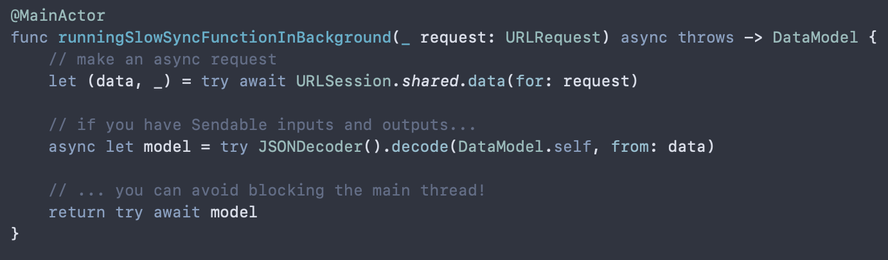
Here's a neat trick with `async let` I didn't realize. You can use it to avoid blocking on synchronous work.
 nixCraft 🐧
 Paul Cantrell
Any experienced programmer worth their salt will tell you that •producing• code — learning syntax, finding examples, combining them, adding behaviors, adding complexity — is the •easy• part of programming.
The hard part: “How can it break? How will it surprise us? How will it change? Does it •really• accomplish our goal? What •is• our goal? Are we all even imagining the same goal? Do we understand each other? Will the next person to work on this understand it? Should we even build this?”
 Baldur Bjarnason
“Building engineering” https://werd.io/2024/building-engineering

 Ole Begemann
@jaredsinclair Great post! Small clarification on explicit view identity: the .id() modifier acts in *addition* to the structural identity defined by the view’s position in the view hierarchy. So .id() can never make two non-identical views identical, only the other way around. These two views have different identity despite having the same .id():
if flag {
MyView().id("one")
} else {
MyView().id("one")
}
 Jared Sinclair
Be Careful When you Initialize a StateObject Property Wrapper — https://jaredsinclair.com/2024/03/14/state-object-autoclosure.html
There’s an easy pitfall to fall into, and it can totally undermine the reason you're using StateObject in the first place.
 Louie Mantia, Jr.
📝 New blog post on LMNT: “Lack of Vision” https://lmnt.me/blog/lack-of-vision.html
@nicklockwood @rhysmorgan Yeah it’s not the same, just similar.
But just wait until this proposal is accepted. They will become super powerful and I bet will be commonly used
https://forums.swift.org/t/pitch-inheriting-the-callers-actor-isolation/68391

[Pitch] Inheriting the caller's actor isolation
Hi. One problem we've been seeing with Swift concurrency is that there isn't an easy way for async functions to polymorphically share their callers' actor isolation. This makes it hard to use certain kinds of async abstractions from isolated contexts because technically the async functions in the abstraction have a different isolation, which means e.g. you can't share non-Sendable values with them. It also can have unwanted performance consequences. I've written a proposal which adds a handf...