
Jed Brown

@jedbrown
40 Followers
258 Following
34 Posts
Prof at #CU_Boulder developing fast algorithms, reliable software, and healthy communities for physical prediction, inference, and design #PhyPID | dad/alpinist/skier/runner | he/him
#PETSc #JOSS_TheOJ #libCEED #justice #OpenSource #CFD #FEA #HPC #RustLang #JuliaLang
#Boulder #alpinism #skimo #TrailRunning
Webhttps://jedbrown.org
GitHubhttps://github.com/jedbrown
GitLabhttps://gitlab.com/jedbrown
LocationArapaho, Cheyenne, & Ute lands
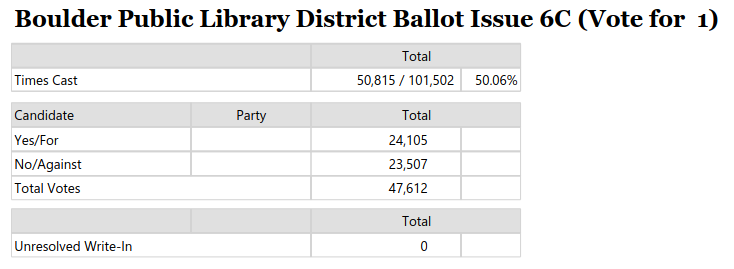
#Boulder #YesOn6C #FundOurLibraries pulls ahead! 👀
@likask Indeed, we aren't the audience, but my concern is that it's too abstract for most students who need to solve a specific problem. Maybe what's needed are debugging vignettes with a sequence of diagnostics/reductions and interpretation along the way to identify specific bugs. Sometimes "war stories" are more visceral and memorable than a diagram of abstract interactions.
@likask Fun. I think a more concrete guide is needed for specific software. I may be totally wrong, but I feel like the audience who can interpret the abstract stuff here and efficiently act on it using code/run-time diagnostics also knows most of these techniques. But it's great that papers like this are being written.
@Chanimal That entire server is blocked by much of the fediverse for "unmoderated racism" or "hate speech" (e.g., https://mastodon.social/about). Your (mas.to) server admins should block the whole domain (likely will if you report it), but you can block the domain now for yourself.
@hipsterelectron @crista Oh, fascinating. I'm curious how you demonstrated that (maybe conversation for a different modality), but that would mean they obfuscate, but only poorly. (Tim Davis' examples are so verbatim, I figured they must skip it.)
@jedbrown Postprocessing for source obfuscation would be equally embarrassing, not to mention upsetting open source devs. Same rules as those I use in my courses: copy-paste all you like; just don't omit the source, pay attention to the license, and (for students) show understanding of the code by explaining it to a TA. The AI hype is in need of a snap to reality, and this lawsuit may very well be it.

@crista To be sure, obfuscation would be deeply unethical.

But when hidden behind a proprietary algorithm, it would make it much harder to convince the courts of where the source material came from and that it was implemented as parrot | obfuscate instead of synthesize | create as they would like the world to believe "AI" does. Unless there was an internal leaker, but it's hard to imagine there weren't internal technical conversations about the plagiarism inherent to the current architecture.

@crista Yes, but admitting that would undermine the AI hype, risking an informed public and healthy regulatory posture.

I'd have expected them to swap synonyms and apply light control structure isomorphisms so it's not so obviously parroted. MOSS already exists to test how much obfuscation is enough. I'd love to hear an internal account about why that wasn't done; it would have made legal challenges much less compelling.

@crista I'd like to see this discussion center the concept of plagiarism.

If you give a human source material and they turn around and write a paragraph that's near-verbatim from the source material, that's plagiarism. Same for code. And the human can even *understand* what the computer has no concept of.

They could have followed clean-room reimplementation practices, with separate systems observing source material and generating output. But despite the AI mythology, that's too hard.

New expectations on DORA signatories from now on 👇

"1) to make a public statement explaining their commitment to DORA;
2) research-performing organizations to ensure their implementation of DORA is informed by ongoing dialogue with staff and students who are involved in research and research-enabling activities.

The policy also states the action that DORA will take should credible reports be received of a signatory organization not living up to these expectations."

https://sfdora.org/2022/11/07/doras-new-policy-on-engagement-and-outreach-for-organizational-signatories/

DORA’s new policy on engagement and outreach for organizational signatories | DORA

The Declaration on Research Assessment (DORA) recognizes the need to improve the ways in which the outputs of scholarly research are evaluated.

DORA