

James Galbraith

129 Followers
149 Following
46 Posts
Socialist, biologist and coffee addict. Postdoc at University of Edinburgh, opinions my own, he/him.
GitHubhttps://github.com/jamesdgalbraith

The strain on scientific publishing šŸ“„:

The publishing sector has a problem. Scientists are overwhelmed, editors are overworked, special issue invitations are constant, research paper mills, article retractions, journal delistings… JUST WHAT IS GOING ON!?

Myself, pablo, @paolocrosetto and Dan have spent the last few months investigating just that.
https://arxiv.org/abs/2309.15884

A thread🧵1/n

#AcademicChatter #PublishOrPerish #Elsevier #Springer #MDPI #Wiley #Frontiers #PhDAdvice #PhDChat #SciComm

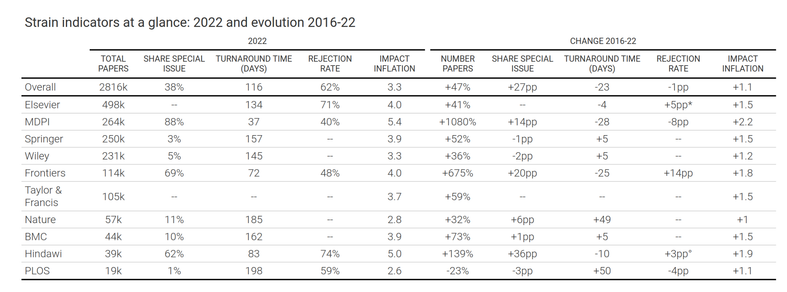
The strain on scientific publishing

Scientists are increasingly overwhelmed by the volume of articles being published. Total articles indexed in Scopus and Web of Science have grown exponentially in recent years; in 2022 the article total was approximately ~47% higher than in 2016, which has outpaced the limited growth - if any - in the number of practising scientists. Thus, publication workload per scientist (writing, reviewing, editing) has increased dramatically. We define this problem as the strain on scientific publishing. To analyse this strain, we present five data-driven metrics showing publisher growth, processing times, and citation behaviours. We draw these data from web scrapes, requests for data from publishers, and material that is freely available through publisher websites. Our findings are based on millions of papers produced by leading academic publishers. We find specific groups have disproportionately grown in their articles published per year, contributing to this strain. Some publishers enabled this growth by adopting a strategy of hosting special issues, which publish articles with reduced turnaround times. Given pressures on researchers to publish or perish to be competitive for funding applications, this strain was likely amplified by these offers to publish more articles. We also observed widespread year-over-year inflation of journal impact factors coinciding with this strain, which risks confusing quality signals. Such exponential growth cannot be sustained. The metrics we define here should enable this evolving conversation to reach actionable solutions to address the strain on scientific publishing.

arXiv.org

Can technology solve our sustainability problems, or do we just need to reduce our consumption?

In this #PLOSBiology Perspective, Navin Ramankutty argues that to achieve short-term and long-term success, the answer is both.

#sustainability #SDGs

https://plos.io/3rkEltd

Both technological innovations and cultural change are key to a sustainability transition

Can technology will solve our sustainability problems, or do we just need to reduce our consumption? In this Perspective, Navin Ramankutty argues that the answer is both, not just because it will be the most effective, but because they are needed for different timeframes and reasons.

A personal apology from our CEO to all workers: https://preview.mailerlite.io/preview/448398/emails/99349180176139697
A personal apology from the CEO

What tool performs best for multi sequence alignment of divergent amino acid sequences?
Clustal omega
27.8%
Mafft
33.3%
Muscle
22.2%
TCoffee
16.7%
Poll ended at .
Proposal: stop saying stuff like "we're destroying the planet" and change it to "they're destroying the planet", to pivot away from self blame when most of us don't have the power to change things and definitely would if we could, and towards laying the blame squarely on the elites propping up the fossil fuel industry so we can focus our collective anger on those actually responsible

As Twitter self-immolates, I am seeing people I know setting up on Bluesky.

I find this perplexing. Can people really not learn the lesson that a social network owned by a capitalist is a social network they don't control?

You can argue about whether Bluesky or Mastodon has the better technology, but what's 100% clear is that Mastodon is run BY users FOR users. And that difference is the only one that matters in the end.

"McKinsey is a management consulting firm. One of the services that management consulting firms provide is that they will sell you political capital. They provide a report generated by external experts that their customers can use as leverage within their organizations to justify change programs."

https://surfingcomplexity.blog/2023/09/03/on-productivity-metrics-management-consultants/

H/T @brohrer @norootcause

On productivity metrics and management consultants

The management consulting firm McKinsey & Company recently posted a blog post titled Yes, you can measure software developer productivity. The post prompted a lot of responses, such as Kent Bec…

Surfing Complexity
@Dogzilla @ct_bergstrom We care beyond Twitter because Musk is the richest guy in the world and that gives him an outsized amount of power. https://www.newyorker.com/magazine/2023/08/28/elon-musks-shadow-rule
Elon Musk’s Shadow Rule

Ronan Farrow reports on how the U.S. government came to rely on the tech billionaire—and is now struggling to rein him in.

The New Yorker
"Love Glasgow, Hate Racism"
Stencil seen in Glasgow, Scotland

Significant thanks for removing the veto power must go to Senator Dr. Mehreen Faruqi, who first introduced a Bill to do it back in 2018.

This led to a parliamentary enquiry which led, in no small part, to the #ARCreview which recommended removing the veto.

Thanks, Senator!šŸ‘

https://aus.social/@ARC_Tracker/110930581619759213

ARC Tracker (@[email protected])

Attached: 1 image It's happening, people! There'll be an ARC Board, & it will approve grants, not the Minister! ā—ļøThat's right: No more Ministerial vetosā—ļø* Finally, less politics in research grants! 🄳 (* Presumably there'll be space for national security-based vetos in the final legislation)

Aus.Social