
Graham Pullan

16 Followers
50 Following
18 Posts
Engineering Professor at University of Cambridge
webhttps://whittle.eng.cam.ac.uk/lab/team/graham-pullan/

[New Blog Post] The Lo-Fi Art and Human Tools Era

https://pketh.org/the-human-tools-era.html

The Lo-Fi Art and Human Tools Era

At the dawn of the industry, we needed big companies to deliver quality software. You’d buy version 1.0 because the way it worked was revolutionary, and it let you do amazing new things. You’d buy version 2.0 because it added helpful new features. Apple, Adobe, Microsoft, etc. became household names because software was hard to make, and even harder to box up and get on store shelves.


pketh.org

I wrote a little post about overlapping WebGL elements.

https://grahampullan.github.io/viz/2025/02/02/Overlapping-webgl-elements.html

Multiple overlapping threejs webgl elements

The problem with multiple WebGL contexts In web-based data visualisation applications, a common UX design is to have multiple cards (each card is a html <div> element) each containing a graphical representation of a different aspect of the data. If the plot is a view of a 3D surface, or involves thousands of data points, it is natural to use WebGL. This is most easily achieved by adding a <canvas> element as a child of the card <div> and making this a WebGL context. Unfortunately, browsers limit the number of available WebGL contexts (a limit of 16 is common), so, if you want more cards than that, another strategy is required.

gp10006
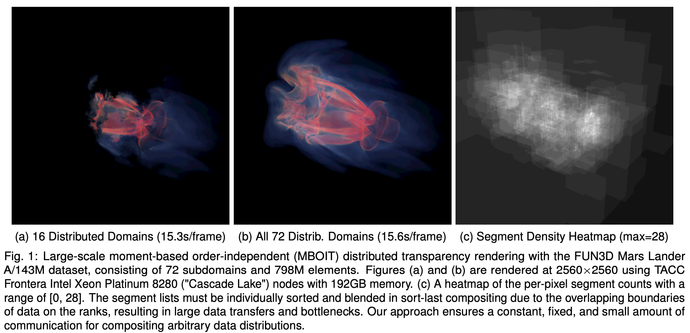
Our new paper, Approximate Puzzlepiece Compositing, applies OIT to data-parallel rendering to efficiently render overlapping, jigsaw puzzle-like data distributions, without repartitioning or expensive compositing. It'll presented at Pacific Vis 2025, check it out: https://www.willusher.io/publications/apc-pvis25/ !
Will Usher

I'm working on an interactive tool for prototyping energy systems.

You can have a go here:

https://grahampullan.github.io/viz/2024/09/22/Visual-energy-modeller.html

Interactive visual modelling for energy systems

Even small systems, comprised of simple components, can be hard to reason about. I’m interested in interactive visualisation tools that can help us to understand the behaviour of such systems. This post shows the current status of a prototyping tool that I am working on.

gp10006
★ Dynamicland's new website documents ten years of progress toward a humane dynamic medium. https://dynamicland.org
Dynamicland

Incubating a humane dynamic medium.

In addition to my day job I continue to produce academic papers because I have a passion for research.

I'm proud to announce that I am now a Senior Associate at the Cambridge Institute for Sustainability Leadership at the University of Cambridge.

Sorry Oxford (where I also have an affiliation) if this is unacceptable.

Dynamicland's new documentation space will go online on Sept 4.

As a prelude, here is a video about Dynamicland's precursor.
https://www.youtube.com/watch?v=uI7J3II59lc

Hypercard in the World, May 2016

For links, transcript, and annotations, see https://dynamicland.org/2016/Hypercard_in_the_World/A laser-powered live-programming environment for the real wor...

YouTube

Placemark: Play! A new, free, no-login-required map editor from Placemark

https://www.placemark.io/post/play-a-free-map-editor-from-placemark

Play: a free map editor from Placemark

A version of Placemark, for everyone!

I really enjoyed lecturing Vector Calculus to the second year Engineers again this year. I use interactive demos (@observablehq notebooks) to bring the great theorems of Gauss and Stokes to life! I thought this technique might be useful to others so I wrote about it here:

https://grahampullan.github.io/viz/2023/02/09/Gauss-and-Stokes.html

Visualising vector calculus

I teach vector calculus to the second year undergraduate engineering students here in Cambridge. There are over 300 students in the class so one way I have tried to more deeply connect those attending with a subject that I find both fascinating and elegant is by using interactive demonstrations. Using Observable I can write notebooks in JavaScript that students can immediately access on the phones. Not only does it break up the lecture, but it also creates a tactile, responsive connection between the course material and the students. I’ve done this for a few years now and the feedback from students has been really positive - most just enjoy playing with vector calculus but they can also, if they wish, edit and adapt the code themselves.

gp10006

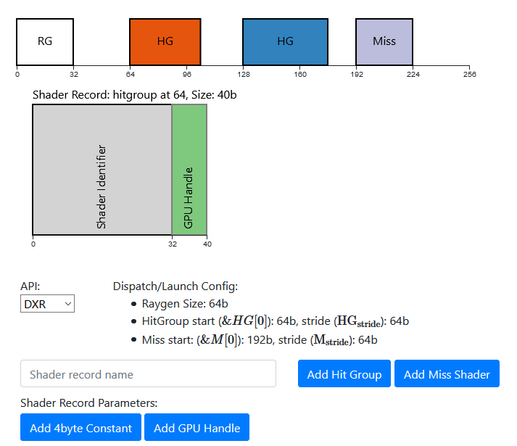
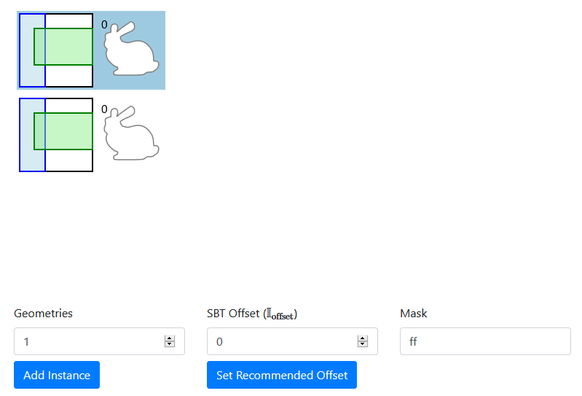
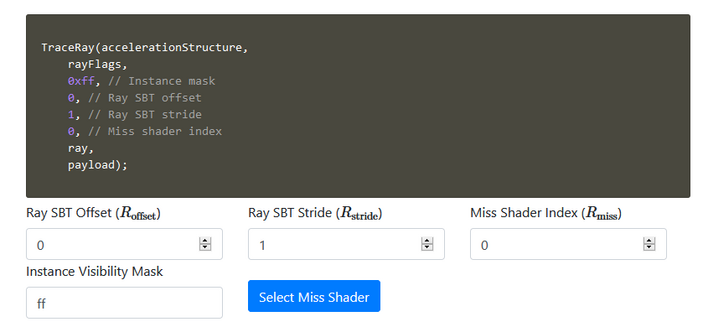
In 2019 I wrote a post & interactive tool on the #RTX shader binding table to explain it across #DXR / #Vulkan / #OptiX . It's still relevant today so I'm reposting it here: https://www.willusher.io/graphics/2019/11/20/the-sbt-three-ways . I extended this to a chapter in RT Gems 2 (Ch. 15) that talks about the SBT and some example configurations: http://www.realtimerendering.com/raytracinggems/rtg2/

With the tool you can setup an SBT, scene and call trace ray to see what shaders are called!

#raytracing #computergraphics

The RTX Shader Binding Table Three Ways