Ham Radio Outside the Box
Isn’t every quarter-wave antenna really a half-wave antenna?
It’s a bit early for April Fool’s jokes so this is a perfectly serious discussion. Just maybe, the distinction between a quarter-wave and a half-wave antenna is a bit more obscure than we thought. Which is better; a quarter-wave or a half-wave antenna? Does it even matter if indeed every quarter-wave antenna really is a half-wave antenna? The answer is not straightforward and we will explore why in this week’s post.
Let’s all use our noddles
An expert could be defined as somebody who knows at least a little more about a subject than most other people. I am not an expert, but I do have a very inquiring mind. Don’t accept anything you read here without question. Science is the process of submitting a hypothesis which can be challenged, refuted, updated or even discarded. New hypotheses can replace old ones as further studies are completed. Treat everything you read here as a hypothesis; it might be completely wrong, partially right or even brilliantly correct. Challenge it with your own critical thought because I thought I was wrong once – but I was mistaken 😉
How to improve the efficiency of an antenna by burying half of it in the ground
Sounds ridiculous doesn’t it? But isn’t that exactly what we do when we erect a ground-mounted quarter-wave whip with a set of radials? What role do the radials play? Do they reflect the signal away from the ground? “Experts” say no, so my hypothesis suggests that an efficient set of radials establishes a ground plane that is better (or worse) than the actual ground itself.
Current in a ground-mounted quarter-wave antenna. Green line represents ground.The Good Earth
The problem with “the good Earth” is that it isn’t always. It depends on the conductivity of whatever our antenna is mounted on. Seawater could be considered the best ground plane but it has an unfortunate habit of being a slightly unreliable support for antennas. Moving inland a little we have sand, nice firm sand. The sea is still close by and helps with antenna efficiency and directionality, that is if you wish to send your signal in the direction of where the sea is.
Unfortunately for me, the closest sea (James Bay in the near Arctic) is over a thousand kilometers to the north and is frozen for much of the year. So I have to rely on the conductivity of the soil in my area. I live in the Great Lakes region and I am surrounded on three sides by the waters of mighty Lake Huron. Pure freshwater is almost a perfect insulator, but I have the advantage of living on the Niagara Escarpment and water from my well contains over 2000 parts per million of dissolved solids. That may improve my soil conductivity for ham radio purposes but it cost me a small fortune in water treatment equipment to get rid of those dissolved solids to make the water drinkable.
Whenever I wish to deploy a ground-mounted antenna I have to rely on ground radials because sometimes my portable operations take me to locations where I set up on the ancient bedrock of the Canadian Shield, or sandy lakeside beaches where the ground conductivity is not so good.
How do ground radials really work?
I hypothesized earlier that radials establish a ground plane. Their purpose is to give the antenna – and it’s image in the ground – a zero reference point. If this ground plane is efficient (i.e. lots of radials) the current in both the ground and the antenna will increase. Higher current in the antenna means more signal is radiated. And what about that higher current in the ground? The earthworms will thank you for the extra warmth.
By the way, counterpoise or radials?
The two terms are often confused. When I use the term “counterpoise” I use it to mean “the other half of the antenna” which may be made up of a set of radial wires, or a blanket of Faraday cloth, or AA1AR, Bruce’s copper mesh.
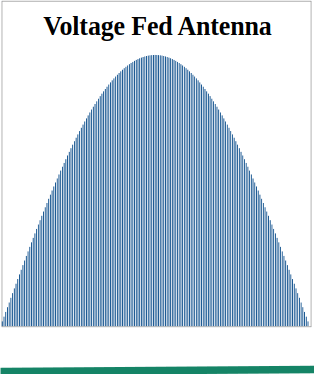
End-Fed Half-Wave antenna current distributionWhat’s to be done?
If half our signal is warming the winter nightcrawlers what can we do to redirect the crown joules in a more useful direction? First, let’s examine the current distribution in a half-wave antenna wire.
Let’s call it a “voltage-fed” antenna because a lot of half-wave antennas are end-fed. It could equally be a center-fed dipole which is also a half wavelength long. There are several different ways to erect an End-Fed Half-Wave antenna:
- Vertical
- Flat top
- Inverted-V
- Inverted-L
- Sloper
Notice that however we erect it, the entire antenna remains above ground. Some online advice suggests the ends of the wire can be placed close to the ground because there is almost no current there. Others disagree and note that the ends of a half-wave wire are high voltage points and should be kept above head height. And it isn’t just for safety reasons. What are the effects of placing a high voltage point close to ground? Could there be some ground interaction that affects the antenna performance. Any experts care to comment?
Enter the Dipole
A dipole or an EFHW can be erected vertically. Let’s talk about the dipole. It is a center-fed half-wave (a CFHW if you like acronyms). A vertical dipole could be described as a quarter-wave vertical antenna with a quarter-wave counterpoise. Can’t see it? Suppose the counterpoise section is tilted away from vertical. Now it looks more like quarter-wave with a counterpoise. But, the whole antenna is still a half-wave, isn’t it?
Bifurcate that counterpoise
A bifurcated counterpoise is a fancy way of saying split it in two, or in other words, duplicate it. Why? Well again, this is my personal theory. The lower half of a vertical dipole may come close to ground unless it is raised high enough. Ground effects may distort the radiation pattern. If we add an extra wire to the counterpoise section the antenna looks like an Inverted-Y and the current in the counterpoise is split between two conductors. If the current in each conductor is half that of a single conductor the resistive loss in the counterpoise section will be lower, and any ground interaction may be mitigated.
I have occasionally used an Inverted-Y for many years. It was one of the earliest antennas I ever built and performs well. An Inverted-Y built for 20m has to be erected at a height of at least 30 feet (~10m). At that height the feedpoint sits about 13ft above ground and the two radials must be spread at quite a wide angle to remain clear of the ground. I wonder whether we could make this antenna more stealthy? A 30ft mast in a busy public place tempts unwelcome attention from passers-by and park officials. Some ideas rattling around in my old, grey noddle are:
- Lower the apex by shortening the radiating element with a low-loss capacitance hat at the apex
- Reduce the length of the radiating element AND the radial wires using linear loading (folding the wires back on themselves with a small spacing)
Any other ideas from readers would be most welcome. Let me know what you think in the comments.
Help support HamRadioOutsidetheBox
No “tip-jar”, “buy me a coffee”, Patreon, or Amazon links here. I enjoy my hobby and I enjoy writing about it. If you would like to support this blog please follow/subscribe using the link at the bottom of my home page, or like, comment (links at the bottom of each post), repost or share links to my posts on social media. If you would like to email me directly you will find my email address on my QRZ.com page. Thank you!
The following copyright notice applies to all content on this blog.
This work is licensed under a Creative Commons Attribution-NonCommercial-NoDerivatives 4.0 International License.



 Jeffrey Roe

 HamChallenge Bot
 Onno (VK6FLAB)
 Fabian Kurz, DJ5CW/SO5CW
 Schrodinger