Dylan Festa

302 Followers
658 Following
12 Posts
🇮🇹 (he,his) Friendly Postdoctoral researcher in the field of Computational Neuroscience. | 🌱🍉
Homebase: Gjorgjieva Lab, Technical University of Munich (TUM), Freising, Germany.
Academic interests: neural dynamics, neural coding, development of connectivity structure, plasticity.
📚🍕🍷😴
GitHubhttps://github.com/dylanfesta/
ORC-IDhttps://orcid.org/0000-0003-3803-1542

Pleease ignore this message. I am just testing Bridgy to see if it synchs Mastodon and Bluesky. 😬

Mirrored Bluesky account: https://bsky.app/profile/did:plc:luaxaolz4huepcch4bjyld5b
or @dylanfesta.neuromatch.social.ap.brid.gy

Follow me there if you have Bluesky!

For more info: https://fed.brid.gy/

Dylan Festa (@dylanfesta.neuromatch.social.ap.brid.gy)

🇮🇹 (he,his) Friendly Postdoctoral researcher in the field of Computational Neuroscience. | 🌱🍉 Homebase: Gjorgjieva Lab, Technical University of Munich […] [bridged from https://neuromatch.social/@dylanfesta on the fediverse by https://fed.brid.gy/ ]

Bluesky Social

These same principles can also be used to get more complex connectivity structures. Starting with localized excitation, different interneurons specialize in either stabilizing activity or providing lateral inhibition.

For more details, check the full paper! (3/3)
https://www.biorxiv.org/content/10.1101/2024.10.12.618014

This works not only in small E/I motifs, but also in large recurrent neural network models (simulations in Brian2 @briansimulator , code available). Here are examples of learning purely mutual E/I connectivity, or purely lateral inhibition. 2/3

Tootprint! 📄 🤓 I am happy to share my latest preprint (along with some code!), a collaboration with Claudia Cusseddu and Julijana Gjorgjieva in the Gjorgieva lab. https://www.biorxiv.org/content/10.1101/2024.10.12.618014

Inhibitory neurons keep neural circuits stable, preserving the inhibition-stabilized dynamical regime we all like. But they can do more than just provide a blanket of inhibition – they can also form specific excitatory-inhibitory (E/I) connection patterns.

In this work we consider simple inhibitory spike-timing dependent plasticity (STDP) rules (the kind you can implement with a few lines of code in Brian2), and find out that one can achieve both network stabilization and the formation of E/I structures!

Depending on the STDP rule, we get either mutual connections (connecting to excitatory neurons that also connect to them) or lateral connections (targeting excitatory neurons without reciprocal connections). This selectivity depends on how we tune the rule and on the STDP shape. 1/3

Today I’ll be presenting my work on inhibitory plasticity, poster I-40 at the #BernsteinConference . Preprint & code will soon follow!
https://www.world-wide.org/bernstein-24/opposing-forces-inhibitory-spike-timing-dependent-874907a6/
Two opposing forces in inhibitory spike-timing-dependent plasticity differentially regulate network connectivity - Bernstein Conference 2024

Two opposing forces in inhibitory spike-timing-dependent plasticity differentially regulate network connectivity by Dylan Festa, Claudia Cusseddu, Julijana Gjorgjieva

@benjamingeer @NicoleCRust

This interview to Karikó ought to be mandatory reading for any scientist at any stage of their career.

And more child day care facilities please, at every academic institution. And less focus on papers and more on addressing research questions that advance our collective understanding. And more collaboration and less competition. I endorse every single statement. What a wonderful scientist and human being.

https://www.aargauerzeitung.ch/leben/interview-top-scientist-katalin-kariko-women-should-have-a-career-and-a-happy-family-ld.2352504

#academia

Katalin Karikó: «Women should have a career and a happy family»

Scientist Katalin Karikó’s work didn’t get the attention it deserved until the start of the pandemic in 2020, when suddenly her area of expertise, mRNA, became the most important subject of research worldwide. From one day to the next, Karikó became the star of the scientific community. Today she looks back on why her research was not funded, advocates for new role models and explains why she didn`t give up her career for her family.

Aargauer Zeitung

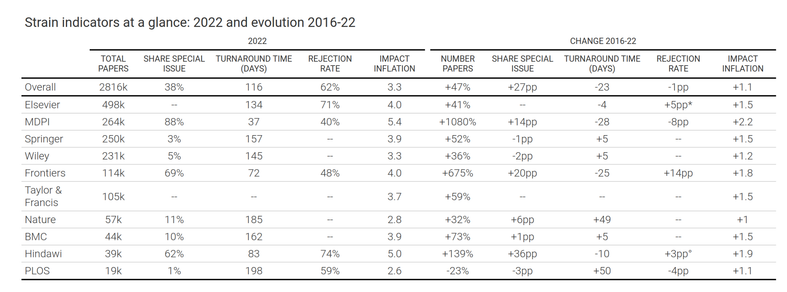
The strain on scientific publishing 📄:

The publishing sector has a problem. Scientists are overwhelmed, editors are overworked, special issue invitations are constant, research paper mills, article retractions, journal delistings… JUST WHAT IS GOING ON!?

Myself, pablo, @paolocrosetto and Dan have spent the last few months investigating just that.
https://arxiv.org/abs/2309.15884

A thread🧵1/n

#AcademicChatter #PublishOrPerish #Elsevier #Springer #MDPI #Wiley #Frontiers #PhDAdvice #PhDChat #SciComm

The strain on scientific publishing

Scientists are increasingly overwhelmed by the volume of articles being published. Total articles indexed in Scopus and Web of Science have grown exponentially in recent years; in 2022 the article total was approximately ~47% higher than in 2016, which has outpaced the limited growth - if any - in the number of practising scientists. Thus, publication workload per scientist (writing, reviewing, editing) has increased dramatically. We define this problem as the strain on scientific publishing. To analyse this strain, we present five data-driven metrics showing publisher growth, processing times, and citation behaviours. We draw these data from web scrapes, requests for data from publishers, and material that is freely available through publisher websites. Our findings are based on millions of papers produced by leading academic publishers. We find specific groups have disproportionately grown in their articles published per year, contributing to this strain. Some publishers enabled this growth by adopting a strategy of hosting special issues, which publish articles with reduced turnaround times. Given pressures on researchers to publish or perish to be competitive for funding applications, this strain was likely amplified by these offers to publish more articles. We also observed widespread year-over-year inflation of journal impact factors coinciding with this strain, which risks confusing quality signals. Such exponential growth cannot be sustained. The metrics we define here should enable this evolving conversation to reach actionable solutions to address the strain on scientific publishing.

arXiv.org

In which Adam Mastroianni argues that psychology is so poorly theorised than even outright fraud by hyperprolific research stars has causes no loss to our collective knowledge - almost like 100s of papers with 10,000s of citations don't represent true knowledge anyway

"The plane crashed and nobody checked the bodies", he says in a memorable phrase. Meaning, "everyone knows that many studies don't replicate, but exactly which ones doesn't seem to matter"

https://www.experimental-history.com/p/im-so-sorry-for-psychologys-loss

1/

I’m so sorry for psychology’s loss, whatever it is

The plane crashed and nobody checked the bodies

Experimental History
Presenting my poster on playing around with spike-timing dependent Inhibitory plasticity. #BernsteinConference
As a computational neuroscientist, I found the "IIT as pseudoscience" letter quite disheartening. I am certainly not an expert on IIT or theories of consciousness, but I have found this rebuttal by Erik Hoel (@erikphoel) that I wanted to share and spread around: https://www.theintrinsicperspective.com/p/ambitious-theories-of-consciousness
Ambitious theories of consciousness are not "scientific misinformation"

In defense of Integrated Information Theory

The Intrinsic Perspective