 Rian van der Merwe
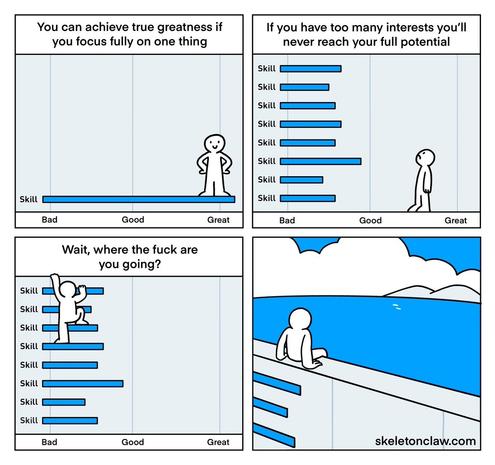
Oh, as a topic wanderer myself (I don’t like the word “generalist”), I love and endorse this comic.
(via @simondlr’s newsletter).
| ORCiD | https://orcid.org/0000-0003-2639-7520 |
| Team member of the Species File Group | https://speciesfilegroup.org/ |
| GitHub | https://github.com/debpaul |
Oh, as a topic wanderer myself (I don’t like the word “generalist”), I love and endorse this comic.
(via @simondlr’s newsletter).
Discover #TaxonWorksTogether 2024. Videos now posted https://youtube.com/playlist?list=PLPSu6w4rwUI6NbmJ_Nu8Uq_xoHwqKKvC2
Topics: #opensource #taxonomy #plazi #openrefine #dataquality #communityofcode #collectionmanagement #dataviz #api
Some Voices you'll hear: @coleopterasam @monotomidae
@mjy @dimus @thalassa @doering @BionomiaTrack
Shout outs: @gbif @idigbio @plazi_species @OpenRefine
and all who made this latest event possible.
See: Our online agenda https://together.taxonworks.org/
Inter-generational message here. Thanks to @debpaul there is a lot of juicy ("zesty" for the kids) new content at https://www.youtube.com/@TaxonWorks. So you can rewind, no, not the insulting "you failed, try again", but rather as the adults ("boomers") mean, "to repeat", the conference and enjoy some great conversations again, or for the first time. Highly recommend the #dataquality round-table, it had some great ("5-head/sigma") insights across the board.

We created and delivered a workshop and symposium series for biologists at all career stages focused on the skills and practices needed to sustain natural history specimen attribution and citation. The name of the workshop and symposium series, SISRIS, reflected our ultimate goal of effecting community-level change by sharing skills and practices that can support inclusive and sustainable (collections-based) research infrastructure for systematics. We report here the rationale for SISRIS, its learning objectives for participants and its results, including the assessment of outcomes from three iterations of the workshop held in 2023. The SISRIS workshops and symposia were held in person at the annual meeting of the Association for Southeastern Biologists in Winston-Salem, North Carolina and Botany 2023 in Boise, Idaho. A stand-alone SISRIS workshop was held online later to accommodate individuals who were unable to travel to the in-person events.

Stumbled on this super simple visualization that says so much about the nature of a Natural History Collection. Can you guess which hemisphere the INHS collection is given only this, the month at which the CollectingEvent started?
P.S. How's that for data quality on 1m + specimens ;).
Seed bugs of the world, rejoice! One of the original "Species Files" has finished migrating to TaxonWorks and we've added a TaxonPages front-end to it.
The Lygaeoidea Species File (LSF) is a taxonomic database of the world’s Lygaeoidea (seed bugs, milkweed bugs, or ground bugs, and related insects) both living and fossil. It has full taxonomic and synonymic information for all taxa, with complete taxonomic references, images, sound recordings, and specimen records.

https://www.inaturalist.org/blog/85698-update-on-taxon-frameworks.
Thanks #iNaturalist for working with us. We're particularly happy because it's TaxonWorks' external API that's meeting new needs. Our underlying foundation https://docs.taxonworks.org/develop/Data/ lets us quickly adapt to new uses, we'll need to converge to a 2.0 soon(ish) for stability, and increased semantics via #OpenAPI or similar.

iNaturalist works best as a tool for helping people collaborate around species identification when there is clarity about the taxonomy everyone is referring to. This also makes it easier for iNaturalist curators to maintain the iNaturalist taxonomy when it's clear what direction they should be curating in. Five years ago we introduced Taxon Frameworks as a tool to help provide this clarity by explicitly referencing taxa on iNaturalist to external taxonomic references. Since then, the number of Taxon Frameworks with external references has increased. The World Registry of Marine Species is now being used for nearly all Animal Phyla outside of Arthropods and Chordates. All Chordate taxa are linked to references such as the Reptile Database and Catalog of Fishes. Plants of the World Online is the reference for Vascular Plants. We still have no taxonomic references for Kingdoms such as Fungi and Chromista. For Arthropoda, the vast majority of groups lack references. But most of the few...
 TaxonWorks
 Greg Wilson