
Daniel Landau

17 Followers
133 Following
224 Posts

Instead of defending the use of LLMs for polishing up your writing, we could be advocating for unpolished writing. Blog posts with spelling errors and awkwardly repeated words. Emails that sound a bit less warm and professional because you forgot the preamble of "Apologies for the late reply, hope you're well! Thanks for the thing last week".

If there's no budget for a human editor, why should the text meet a "professional" (middle class, formally educated) standard? Dyslexic people can just write how they write and people can deal with it. Autistic people can just say what they mean to say and not waste energy on the double empathy gap.

We can learn to read for a more inclusive world, instead of wasting the planet's diminishing resources masking our differences.

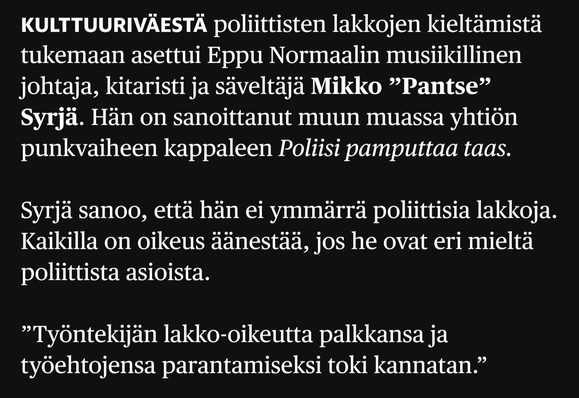
Sanon erikseen tästä "ei tarvitse lakoilla/osoittaa mieltä, riittää kun äänestää".

Hyvä herrasväki: vaaleissa valitaan ihmiset, joille mielenosoitukset kohdistetaan. Näiden asettaminen vastakkaisiksi on kategoriavirhe.

Yhtä hyvin voi sanoa, ettei liikenneinfraan tarvitse panostaa kun kaikilla on kuitenkin autot; unohtuu että autoilun laatu heikkenee jos tiet muuttuvat kinttupoluiksi, kaikilla ei ole autoa, ja sitä paitsi liikenneinfralla tehdään muutakin kuin helpotetaan yksityisautoilua.

Just released Island 🏝️, a sandboxing tool powered by #Landlock.
It auto‑confines processes according to the caller's context (e.g. CWD) and comes with slick Zsh integration, so you can use your terminal naturally without command prefixes. Feedback welcome!
https://github.com/landlock-lsm/island

This one is for the allies. Please boost to get wider reach.

I know you're upset about what's going on. Me too. And, like me, I bet you frequently have that feeling of wanting to throw your hands up and say, "But what can I do about it?"

Let me give you one of the most powerful tools you can use to help fight bigotry. And it's a tool that only you can use, because any marginalized person who uses it will be seen as aggrieved and immediately discounted.

What is this amazing tool? I call it

Dude. Not cool.

This phrase. Commit it to memory (or something like it that's more in character for you). Use it when someone around you is being a bigot. It's not an angry phrase, it's more one you deliver with bafflement, like you're confused the bigot just said what they said.

Simple social disapproval, particularly coming from peers, friends, or coworkers at the same level, is powerful. We all want to belong. Clearly but subtly voicing your disapproval (it has to be clearly understood by the bigot, for this to work) makes a real difference.

For it to really be effective, we need everyone to be doing it. If every bigot out there always caught shade every time they said some bigoted thing, they would stop doing it. So spread the word.

Use this simple tool to tap into millions of years of evolutionary social training.

Racism? Dude, not cool.
Misogyny? Dude, not cool.
Homophobia? Dude, not cool.

It works. It's low-risk (please don't use it if it feels dangerous to do so, though). It can change the world.

vibe working

vibe working

I am gone

Happy Petrov Day to those who celebrate. On September 26, 1983, Stanislav Petrov made the correct decision to not trust a computer.

The early warning system at command center Serpukhov-15, loudly alerting of a nuclear attack from the United States, was of course modern and up-to-date. Stanislav Petrov was in charge, working his second shift in place of a colleague who was ill.

Many officers facing the same situation would have called their superiors to alert them of the need for a counter-attack. Especially as fellow officers were shouting at him to retaliate quickly before it was too late. Petrov did not succumb.

I've attached a short clip from a reenactment of the situation in the documentary The Man Who Saved the World.

The computer was indeed wrong about the imminent attack and Petrov likely saved the world from nuclear disaster in those impossibly stressful minutes, by daring to wait for ground confirmation. For context one must also be aware that this was at a time when US-Soviet relations were extremely tense.

I've previously written about three lessons to take away from Petrov's actions:

1. Embrace multiple perspectives

The fact that it was not Stanislov Petrov's own choice to pursue an army career speaks to me of how important it is to welcome a broad range of experiences and perspectives. Petrov received an education as an engineer rather than a military man. He knew the unpredictability of machine behavior.

2. Look for multiple confirmation points

Stanislav Petrov understood what he was looking for. While he has admitted he could not be 100% sure the attack wasn't real, there were several factors he has mentioned that played into his decision:

- He had been told a US attack would be all-out. An attack with only 5 missiles did not make sense to him.
- Ground radar failed to pick up supporting evidence of an attack, even after minutes of waiting.
- The message passed too quickly through the 30 layers of verification he himself had devised.

On top of this: The launch detection system was new (and hence he did not fully trust it).

3. Reward exposure of faulty systems

If we keep praising our tools for their excellence and efficiency it's hard to later accept their defects. When shortcomings are found, this needs to be communicated just as clearly and widely as successes. Maintaining an illusion of perfect, neutral and flawless systems will keep people from questioning the systems when the systems need to be questioned.

We need to stop punishing when failure helps us understand something that can be improved.
Six classical composer styles, one song. This was delightful and made my morning coffee better.
https://youtu.be/yZi4Z1e5KO8
"All I want for Christmas is you", but in the style of 6 classical composers 🎹🎄

YouTube
Work outsourced out letter printing. The website we use has what I thought was a fancy AI chatbot that I enjoyed talking to about my problems. The conversation I just had with my boss and HR let me know it was a group of real people in an office who are very concerned about me.
God, this bubble burst is going to be so brutal
I don't see why I would need ChatGPT. As an academic, I can easily produce texts that are long, confident, and wrong myself.