Carlos Barth

@carloshb@sigmoid.social
358 Followers
114 Following
128 Posts

Post-doc researcher in #philosophy of #mind, #AI and #cognition.

Developer, i.e. a tool coffee uses to bring code to the world.

A #foss enthusiast who loves contributing to #privacy and #infosec projects with both code and feedback.

Sitehttps://cbarth.me
PGP Fingerprint3703 B0D6 22FF 6A52 FE04 F60A 0BCF CD2A EC25 4F41

This week, the #CLEA research group will host another online meeting on #cognitivescience.

This time, Nicholas Shea and Sarah Fisher will discuss elements from Shea's book Concepts at the interface.

Join us!

To know more and register, check:
https://clea.group

See you there!

@philosophy
@philosophyofmind

The #CLEA research group will host another online meeting on #cognitivescience.

Now we'll discuss the "hard problem of content" regarding #mentalrepresentation in #cognition.

William Ramsey (main speaker) is going to present his paper "The hard problem of content is neither" and Ian Robertson will be the commentator.

NEW DATE: December 18, 2 a.m. (Brasilia time)

To know more and register, check:
https://clea.group

See you there!

@philosophy
@philosophyofmind

CLEA

description

I am glad to let you known that the #CLEA research group will host another online meeting on #cognitivescience.

Now we'll discuss the "hard problem of content" regarding  #mentalrepresentation in #cognition.

William Ramsey (main speaker) is going to present his paper "The hard problem of content is neither" and Ian Robertson will be the commentator.

December 13, 2 a.m. (Brasilia time)

To know more and register, check:
https://clea.group

See you there!

@philosophy
@philosophyofmind

CLEA

description

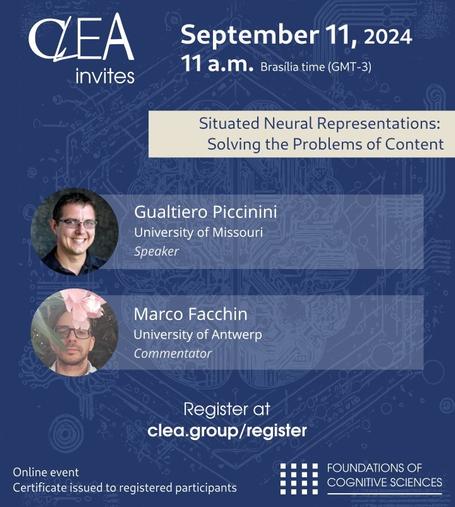
I am glad to let you known the #CLEA research group is hosting another online meeting on the foundations of #cognitivescience!

This time we will discuss the relation between the concept of #mentalrepresentation and #situatedness in #cognition and #embodiedcognition through the work of Gualtiero Piccinini (main speaker) and Marco Facchin (commentator).

To know more and register, please check:
https://clea.group

Hope to see you there!

@philosophy
@philosophyofmind

CLEA

description

This is going to be great!

On April 10th, the CLEA research group (#cognition, #language, #enactivism and #affectivity) will host the first online event of the series "the future of enactivism".

Russell Meyer and Guilherme Sanches will debate the distinction between Utopian and Scientific Enactivism.

If you're into #philosophy of #cognition, you don't wanna miss this!

Just send us an email and we'll send you the link!

Here's the outstanding program of the first webconference of the International Society for the Philosophy of the Sciences of the Mind (ISPSM).

https://www.neuralmechanisms.org/ispsm-conference.html

ISPSM Conference

We are delighted to announce the program of the first webconference of the International Society for the Philosophy of the Sciences of the Mind (ISPSM), organized by the Neural Mechanisms Online (&...

NEURAL MECHANISMS ONLINE

» more theoretical thinking and less (unthinking) #ml or less confusion between #machinelearning and theory

Then #AI can be a useful theoretical tool...

The thesis of #computationalism implies that it is possible in principle to understand human cognition as a form of computation.
However, this does not imply that it is possible in practice to computationally (re)make cognition «

https://psyarxiv.com/4cbuv

#philosophyofneuroscience
#systemsneuroscience
#neuroscience
#neurotheory
@cognition

Very nice paper. It seems like the #ai community is moving towards a debate that's similar to that between the contextualist and minimalist perspectives on @philosophy of language.

https://arxiv.org/abs/2301.06627

Dissociating language and thought in large language models

Large Language Models (LLMs) have come closest among all models to date to mastering human language, yet opinions about their linguistic and cognitive capabilities remain split. Here, we evaluate LLMs using a distinction between formal linguistic competence -- knowledge of linguistic rules and patterns -- and functional linguistic competence -- understanding and using language in the world. We ground this distinction in human neuroscience, which has shown that formal and functional competence rely on different neural mechanisms. Although LLMs are surprisingly good at formal competence, their performance on functional competence tasks remains spotty and often requires specialized fine-tuning and/or coupling with external modules. We posit that models that use language in human-like ways would need to master both of these competence types, which, in turn, could require the emergence of mechanisms specialized for formal linguistic competence, distinct from functional competence.

arXiv.org