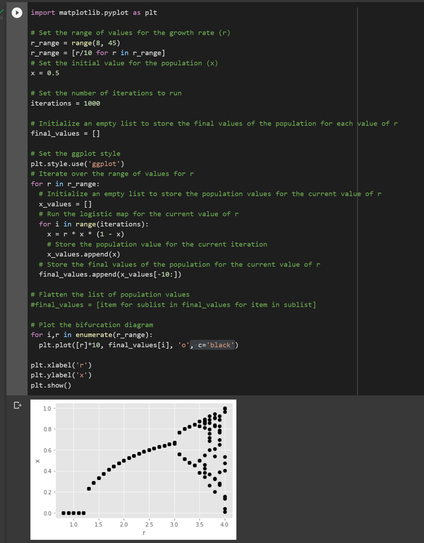

ChatGPT: "Write is a piece of code that will generate a bifurcation diagram of the logistic map in Python. The value for r run from 0.8 to 4.5. Plot the last 10 values in the iteration as dots using matplotlib with the ggplot theme."
Result below.
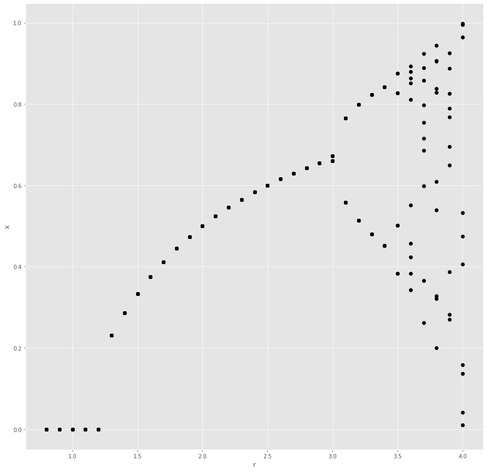
ChatGPT: "Write is a piece of code that will generate a bifurcation diagram of the logistic map in Python. The value for r run from 0.8 to 4.5. Plot the last 10 values in the iteration as dots using matplotlib with the ggplot theme."
Result below.
Environmental and ecological controls of the spatial distribution of microbial populations in aggregates
https://journals.plos.org/ploscompbiol/article?id=10.1371/journal.pcbi.1010807

Author summary Microbial communities are assembled by the interactions between microorganisms and the local environment. To fully understand and control the formation of microbial aggregates, we need to unravel the principles of both cell-cell, cell-environment and cell-space interactions. Until now, most studies have focused predominantly on single interactions between two microbes. However, microbial ecology is more complex than that, and multiple ecological interactions contribute to microbial community assembly. The identification of distinct spatial distributions of bacteria is a first step towards the understanding the underlying biological mechanisms that govern aggregate formation. Here, we show that it is possible to evaluate the influence of multiple ecological interactions and the environment on microbial community assembly through mathematical modelling. We have been able to distinguish interspecific segregation of communities in competition, and layered distribution in commensalism. When we considered more than one ecological interaction between populations, the resultant spatial distribution was identified as the one controlled by the most limiting substrate. Additionally, we defined a theoretical modulus that able us to predict the most probable spatial distribution under specific environmental conditions.
Modelling the evolution of novelty: a review
Abstract. Evolution has been an inventive process since its inception, about 4 billion years ago. It has generated an astounding diversity of novel mechanisms and structures for adaptation to the environment, for competition and cooperation, and for organisation of the internal and external dynamics of the organism. How does this novelty come about? Evolution builds with the tools available, and on top of what it has already built – therefore, much novelty consists in repurposing old functions in a different context. In the process, the tools themselves evolve, allowing yet more novelty to arise.Despite evolutionary novelty being the most striking observable of evolution, it is not accounted for in classical evolutionary theory. Nevertheless, mathematical and computational models that illustrate mechanisms of evolutionary innovation have been developed. In the present review, we present and compare several examples of computational evo–devo models that capture two aspects of novelty: ‘between-level novelty’ and ‘constructive novelty.’ Novelty can evolve between predefined levels of organisation to dynamically transcode biological information across these levels – as occurs during development. Constructive novelty instead generates a level of biological organisation by exploiting the lower level as an informational scaffold to open a new space of possibilities – an example being the evolution of multicellularity. We propose that the field of computational evo–devo is well-poised to reveal many more exciting mechanisms for the evolution of novelty. A broader theory of evolutionary novelty may well be attainable in the near future.
"Most plasmids are mobile. They just differ in the mechanism and in their degree of autonomy for transfer."
Cool study by @epcrocha and others! :)
https://doi.org/10.1093/nar/gkac1079
A wonderful combination of physics and evolutionary algorithms, and super fun to watch!
Introduction time! I am Bram van Dijk, a computational biologist. 🦠💻
With biology drowning in cool data, I try to integrate our knowledge into models to generate new hypotheses. I do this by building simulations of microbial ecosystems (see movie below), with which I experiment. I like to refer to these systems as "Virtual Laboratories". By studying these, our initially flawed intuition can be turned into a system-level understanding of biology.
#introduction 
www.bramvandijk.com
