Is archaeology a science? 🧪
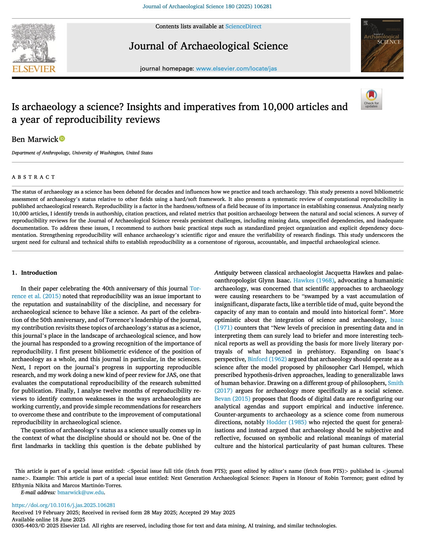
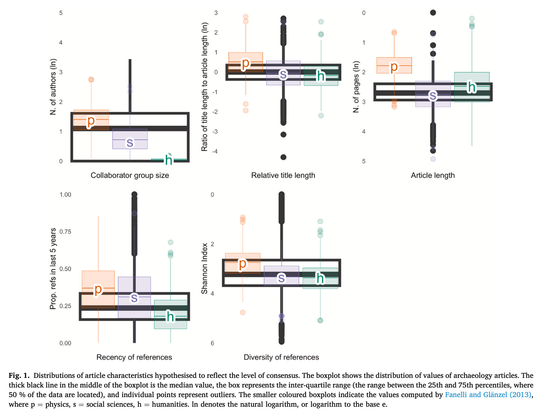
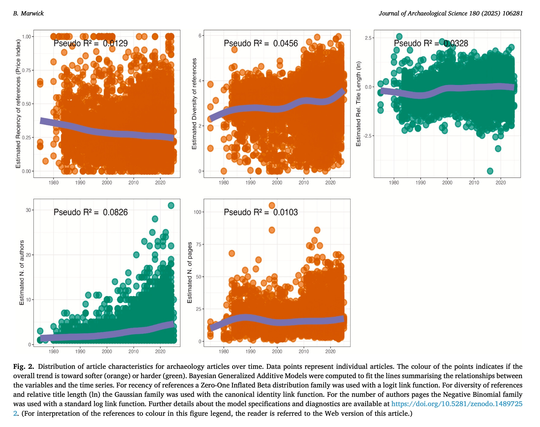
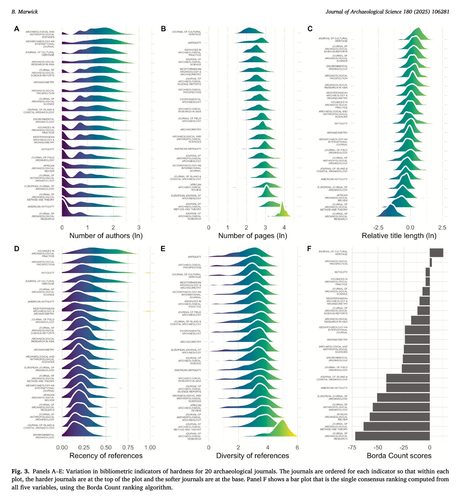
Here's my new paper that has a go at answering this question by analysing 10,000 journal articles:

#Rstats enthusiast, Professor of #Archaeology at the University of Washington
#Evolution, #ReproducibleResearch, #OpenScience, #Datascience
| Website | http://faculty.washington.edu/bmarwick/ |
| Pronouns | he/him |
| GitHub | https://github.com/benmarwick |
Is archaeology a science? 🧪
Here's my new paper that has a go at answering this question by analysing 10,000 journal articles:

Our new paper reports a complete Quina technological system in the 60-50 ka assemblage at Longtan, Southwest China
Here is our plain English summary: https://theconversation.com/stone-tool-discovery-in-china-shows-people-in-east-asia-were-innovating-during-the-middle-paleolithic-like-in-europe-and-middle-east-252868
Here is the paper: Ruan, Q. et al. (2025) Quina lithic technology indicates diverse Late Pleistocene human dynamics in East Asia https://doi.org/10.1073/pnas.2418029122
PDF with no paywall: https://faculty.washington.edu/bmarwick/PDFs/Ruan-et-al-2025.pdf
Data and code: https://doi.org/10.17605/OSF.IO/MZN9B

Discovery in China of tools called Quina scrapers suggests the people of East Asia were as inventive and flexible with technology during the Middle Paleolithic era as those in other parts of the world.


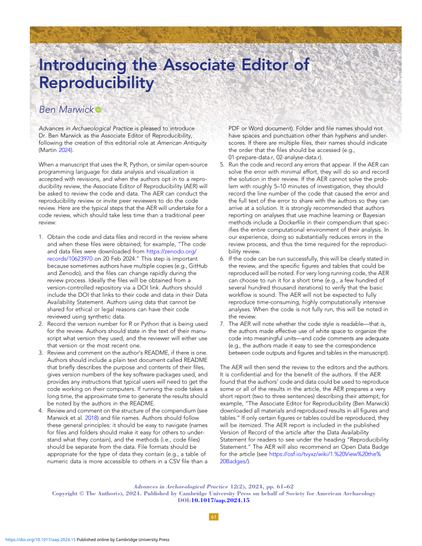
Introducing the Associate Editor of Reproducibility for Advances in Archaeological Practice https://doi.org/10.1017/aap.2024.15 @aap_saaorg
This initiative contributes to making archaeology more transparent and accessible and a source of trustworthy and reliable information about the human past.

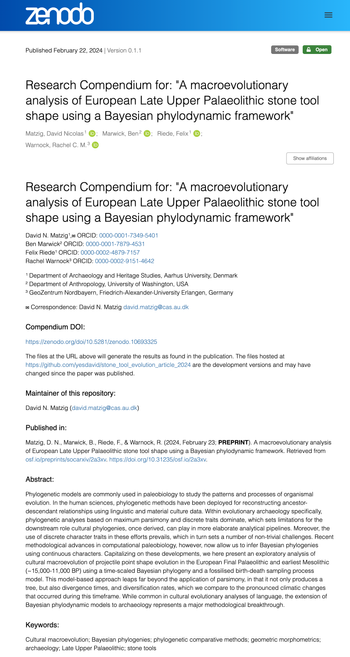
Research Compendium for: "A macroevolutionary analysis of European Late Upper Palaeolithic stone tool shape using a Bayesian phylodynamic framework" David N. Matzig¹,✉ ORCID: 0000-0001-7349-5401Ben Marwick² ORCID: 0000-0001-7879-4531Felix Riede¹ ORCID: 0000-0002-4879-7157Rachel Warnock³ ORCID: 0000-0002-9151-4642 ¹ Department of Archaeology and Heritage Studies, Aarhus University, Denmark² Department of Anthropology, University of Washington, USA³ GeoZentrum Nordbayern, Friedrich-Alexander-University Erlangen, Germany ✉ Correspondence: David N. Matzig [email protected] Compendium DOI: https://zenodo.org/doi/10.5281/zenodo.10693325 The files at the URL above will generate the results as found in the publication. The files hosted at https://github.com/yesdavid/stone_tool_evolution_article_2024 are the development versions and may have changed since the paper was published. Maintainer of this repository: David N. Matzig ([email protected]) Published in: Matzig, D. N., Marwick, B., Riede, F., & Warnock, R. (2024, February 23; PREPRINT). A macroevolutionary analysis of European Late Upper Palaeolithic stone tool shape using a Bayesian phylodynamic framework. Retrieved from osf.io/preprints/socarxiv/2a3xv. https://doi.org/10.31235/osf.io/2a3xv. Abstract: Phylogenetic models are commonly used in paleobiology to study the patterns and processes of organismal evolution. In the human sciences, phylogenetic methods have been deployed for reconstructing ancestor-descendant relationships using linguistic and material culture data. Within evolutionary archaeology specifically, phylogenetic analyses based on maximum parsimony and discrete traits dominate, which sets limitations for the downstream role cultural phylogenies, once derived, can play in more elaborate analytical pipelines. Moreover, the use of discrete character traits in these efforts prevails, which in turn sets a number of non-trivial challenges. Recent methodological advances in computational paleobiology, however, now allow us to infer Bayesian phylogenies using continuous characters. Capitalizing on these developments, we here present an exploratory analysis of cultural macroevolution of projectile point shape evolution in the European Final Palaeolithic and earliest Mesolithic (~15,000-11,000 BP) using a time-scaled Bayesian phylogeny and a fossilised birth-death sampling process model. This model-based approach leaps far beyond the application of parsimony, in that it not only produces a tree, but also divergence times, and diversification rates, which we compare to the pronounced climatic changes that occurred during this timeframe. While common in cultural evolutionary analyses of language, the extension of Bayesian phylodynamic models to archaeology represents a major methodological breakthrough. Keywords: Cultural macroevolution; Bayesian phylogenies; phylogenetic comparative methods; geometric morphometrics; archaeology; Late Upper Palaeolithic; stone tools Required software packages and their versions: The Bayesian phylogenies were inferred using BEAST v2.6.6, and the following packages: ORC v1.0.3, BDMM-Prime v0.0.32, BDSKY v1.4.8, MODEL_SELECTION v1.5.3, BEASTLabs v1.9.7, SA v2.0.2, FastRelaxedClockLogNormal v1.1.1, and contraband v0.0.1 (which is provided in the ./2_scripts/contraband.jar file). All further analyses were conducted in R v4.3.2 using the following packages: beastio (>= 0.3.3), coda (>= 0.19-4), cowplot (>= 1.1.1), data.table (>= 1.14.8), dplyr (>= 1.1.2), forcats (>= 1.0.0), ggplot2 (>= 3.4.3), ggpubr (>= 0.6.0), ggrepel (>= 0.9.3), ggthemes (>= 4.2.4), ggtree (>= 3.6.2), magrittr (>= 2.0.3), Momocs (>= 1.4.0), outlineR (>= 0.1.0), raster (>= 3.6-20), rcarbon (>= 1.5.0), readr (>= 2.1.4), RevGadgets (>= 1.1.0), rgeos (>= 0.6-2), rworldmap (>= 1.3-6), sp (>= 1.6-0), splitstackshape (>= 1.4.8), tibble (>= 3.2.1), tidyr (>= 1.3.0), treeio (>= 1.22.0). Licenses: Code: MIT http://opensource.org/licenses/MIT year: 2024, copyright holder: David Nicolas Matzig
As far as we know, such a comprehensive analysis conducted within a single Bayesian framework has never before been attempted, and marks a significant methodological milestone for the study of cultural evolution.
Given this innovative approach, we placed considerable emphasis on systematically exploring the impact of both data and models on the results. This is achieved by incrementally introducing complexity, thereby laying a robust foundation for future research in this direction.
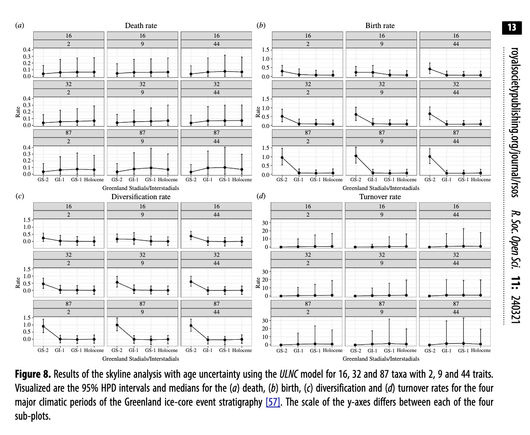
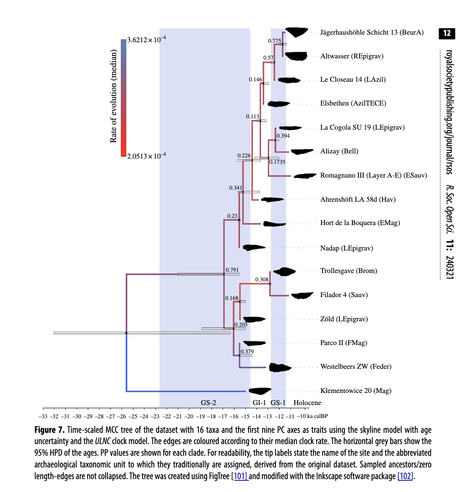
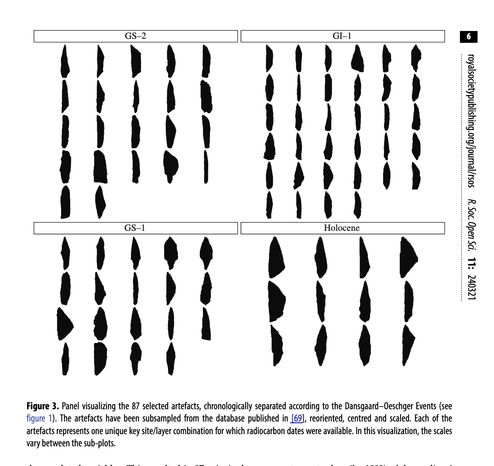
New paper! Led by David Matzig, we used a state-of-the-art Bayesian phylodynamic framework to explore the evolution of projectile point shapes during the European Final Palaeolithic and earliest Mesolithic (approximately 15-11ka BP).

 Alain Queffelec
 Adv in Archaeological Practice