
Ava Polzin

@avapolzin
400 Followers
108 Following
36 Posts
professional nerd/astrophysics PhD candidate at the University of Chicago
Websitehttps://avapolzin.github.io
Twitter@avapolzin
Bluesky@avapolzin.bsky.social

It's becoming increasingly clear to me that Reflect Orbital's fucking stupid giant mirror satellite, with absolutely NOTHING useful to offer, which will cause countless safety issues, ecological disasters, and destroy the night sky, is going to launch.

A bunch of astronomers and I have sent out a fact sheet about them to a bunch of journalists, but very few are going to write about this. So, let me try posting it all here.

Here's what I know about Reflect Orbital and all the downsides:

In the same vein as the below, and for talks/papers/posters or even March Madness, here’s a little package with >80 university-inspired matplotlib color palettes and colormaps :)

https://github.com/avapolzin/rahrah

#science #visualization #software

From: @avapolzin
https://mastodon.social/@avapolzin/110992373748257160

GitHub - avapolzin/rahrah: University-inspired matplotlib color palettes and colormaps.

University-inspired matplotlib color palettes and colormaps. - GitHub - avapolzin/rahrah: University-inspired matplotlib color palettes and colormaps.

GitHub

Paper day! I introduce a new all-in-one tool to generate and drizzle/resample space-based point spread functions for more accurate photometry ✨

https://arxiv.org/abs/2503.02288

Code here: https://github.com/avapolzin/spike

#Astrodon #astrophysics #astronomy #space #paper #science #physics

spike: A tool to drizzle HST, JWST, and Roman PSFs for improved analyses

A point spread function (PSF) describes the distribution of light for a pure point source in an astronomical image due to the optics of the instrument. An accurate PSF is key for deconvolution, point source photometry and source removal. Space-based telescopes can then pose a challenge because their PSFs are influenced by their complex construction, and the myriad of pointings and rotations used to capture deep images. These telescopes also capture the highest resolution images of astronomical sources, resolving stars in even relatively distant galaxies. Proper co-addition of PSFs at a specific source position for space-based imaging is then both critical and challenging. The library described in this work, spike, generates model PSFs and runs them through the same processing pipeline used to derive deep, co-added images, providing correctly co-added and resampled PSFs for images from the Hubble Space Telescope, the James Webb Space Telescope, and the Nancy Grace Roman Space Telescope.

arXiv.org

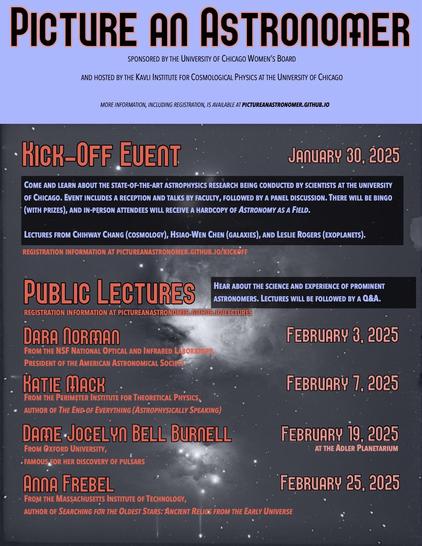
Our Picture an Astronomer series starts in just over a week! Free to attend (in person in Chicago and online) and an incredible opportunity to engage directly with the scientists behind cutting edge astrophysics research.

More info (including registration) at https://pictureanastronomer.github.io

#chicago #science #lecture #event #astronomy #space #physics #astrophysics #Astrodon

Picture an Astronomer

University of Chicago Women's Board | Kavli Institute for Cosmological Physics

@luism Nope! It's to directly measure emission from astrophysical neutral hydrogen sources.
@[email protected] Ha! Funding is always a challenge -- hard enough to get more sophisticated projects funded through official calls for proposal!
@GregorDeBalzac It's very low resolution -- the Rayleigh criterion gives a fairly good approximation for a single dish, and targeting a wavelength of 21cm with a 1m dish, you're looking at a roughly 15 deg beam.
@galaxy_map It's deceptive in appearance. The whole 21cm setup only costs ~$200. In principle, it could certainly be done at ground level; the only real contaminant will be RFI.

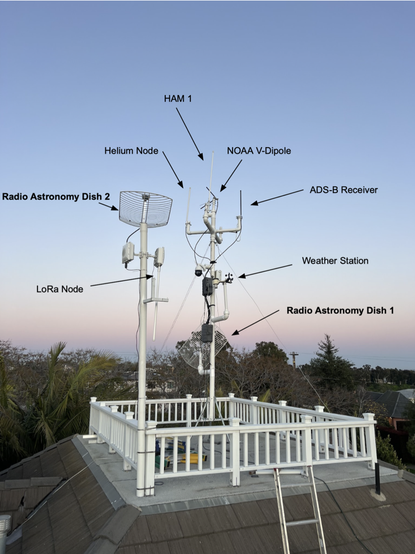
It got a bit lost with everything else going on this week, but my (high school!) research student, Jack, has been working with me on building a low-cost home radio telescope to map Galactic 21 cm features, and his tutorial for others to do the same is now up on arXiv:
https://arxiv.org/abs/2411.00057

#astrodon #astronomy #astrophysics #physics #engineering

Galactic Neutral Hydrogen Structures Spectroscopy and Kinematics: Designing a Home Radio Telescope for 21 cm Emission

This study presents the methodology for creating a cost-efficient radio astronomy telescope that can be used to detect 21 cm emissions (1420.405 MHz) and determine the distribution and kinematics of neutral hydrogen specifically in the Milky Way. By measuring the Doppler shifts of the 21 cm emission, the velocities of hydrogen clouds relative to Earth can be determined. This enables the identification of these clouds' movements, their positions within the galaxy's spiral arms, and their roles in the overall rotational dynamics of the Milky Way. The setup is designed to be accessible to amateurs, enabling others to conduct similar projects. The measurement apparatus consists of a 1-meter parabolic dish, a H1-LNA for 21 cm emissions, an SDR, and a Raspberry Pi. This paper also provides an overview of the data processing required to detect the hydrogen line and generate velocity profiles. Additionally, it examines RFI mitigation techniques, such as spectral filtering and instrument shielding, which enhance observational clarity even in urban environments like Los Angeles. This study also analyzes the observed velocities of different galactic arms, as well as measurements across the sky.

arXiv.org

Happy Women in #Physics Day! Perhaps more timely now than ever:

We are hosting a scientific symposium (among other events -- see pic) at UChicago, focused on promoting and retaining women in #astrophysics Symposium registration is open through Jan. 30 and we offer hybrid attendance.

More details and registration information at https://pictureanastronomer.github.io

Though all of the speakers are women, we encourage attendance from everyone!

#astrodon #astronomy #chicago

Picture an Astronomer

University of Chicago Women's Board | Kavli Institute for Cosmological Physics