Adam Kuczynski

@adamkuczynski
91 Followers
128 Following
11 Posts
Psychology intern at UW Medicine | PhD student @ UW | Loneliness | Interpersonal Relationships | Mental Health | Experience Sampling | Open Science | Founder @pingr EMA
Websitehttps://adamkuczynski.com
EMA Apphttps://pingr.co
R Traininghttps://adamkucz.github.io/psych548
Applying to grad school? Want to join my lab? I'm accepting students through Psychology (https://as.nyu.edu/psychology/graduate/phd-cognition-perception.html) or Data Science (https://cds.nyu.edu/phd-admissions-req/)! For more info and possible project areas, see below or check out my website 👉 http://lindsay-lab.github.io
Ph.D. in Cognition & Perception

Very nice discussion of modeling #IntensiveLongitudinalData in #QuantitudePod - a must listen! They discuss the importance of theory driven RQs, the need to account for residual autocorrelation and seasonality, how to deal with time trends, and differences between SEM and mixed effects models 👂

https://quantitudepod.org/s4e09-ild/

S4E09 Intensive Longitudinal Data: Be Careful What You Wish For – QuantitudePod

What are your favorite papers on feasibility of experience sampling designs across populations? Looking for evidence-based recommendations re: number of items per assessment, response scales, etc.
#preregistration and #replication are great and all, but they won’t save you from research mistakes (from flawed designs to silent errors in your testing/analysis code). This week during team meeting, we discussed research mistakes and how to catch them before they bite, using the great solution-oriented #preprint from @juliafstrand. Check it out!
https://doi.org/10.31234/osf.io/rsn5y
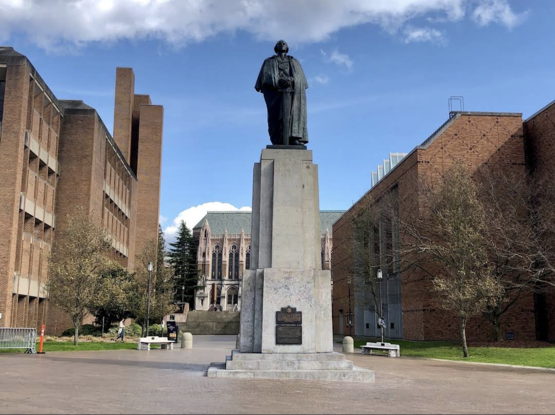
This has the be a picture of UW's (hippo)campus, right? 🧠🦛

Fantastic paper by @maikeluhmann, Susanne Buecker, and Marilena Rüsberg discussing macro- and micro-level predictors of loneliness. They highlight the likely complex interaction between macro- and micro-level factors and need for more robust measurement and research strategies. Such great nuance!

https://www.nature.com/articles/s44159-022-00124-1

Loneliness across time and space | Nature Reviews Psychology

People feel lonely when their social needs are not met by the quantity and quality of their social relationships. Most research has focused on individual-level predictors of loneliness. However, macro-level factors related to historical time and geographic space might influence loneliness through their effects on individual-level predictors. In this Review, we summarize empirical findings on differences in the prevalence of loneliness across historical time and geographical space and discuss four groups of macro-level factors that might account for these differences: values and norms, family and social lives, technology and digitalization, and living conditions and availability of individual resources. Regarding historical time, media reports convey that loneliness is on the rise, but the empirical evidence is mixed, at least before the COVID-19 pandemic. Regarding geographical space, national differences in loneliness are linked to differences in cultural values (such as individualism) but might also be due to differences in the sociodemographic composition of the population. Research on within-country differences in loneliness is scarce but suggests an influence of neighbourhood characteristics. We conclude that a more nuanced understanding of the effects of macro-level factors on loneliness is necessary because of their relevance for public policy and propose specific directions for future research. People feel lonely when their social needs are not met, which can lead to long-term health issues. In this Review, Luhmann et al. summarize empirical findings on differences in the prevalence of loneliness across time and space and consider macro-level factors that might account for these differences.

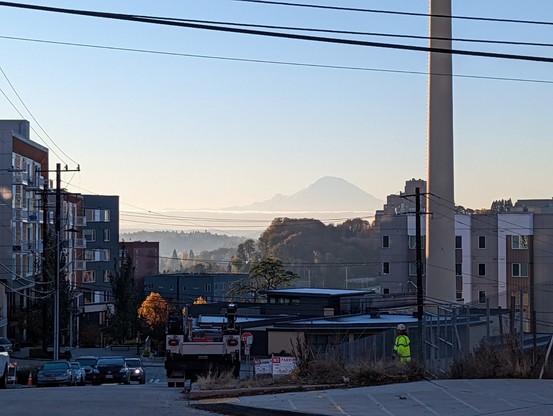
Nothing beats seeing #MountRainier on your way into work at #UWmedicine

Psych residency isn't so bad!

If an experience sampling app were to offer perks for #OpenScience research practices (hypothetically, of course 😉), what should the requirement(s) be? 🤔
Preregistration only
0%
Open materials only
0%
Other/combo (comment)
100%
👀
0%
Poll ended at .

Excited to announce that we'll be hiring a 3-year postdoc for our WARN-D project (www.warn-d.com). The postdoc's main tasks will include to help us build an early warning system for depression, based on the 2-year prospective dataset (including smartwatch & smartphone data) we're currently collecting in 2000 students.

Position should be online soon, I'll make sure to post it here! We have a massive & immensely challenging dataset, & are eager to further grow the team to avoid the below :)