
Aaron Bruhl

296 Followers
226 Following
18 Posts
Professor specializing in statutory interpretation, legislation, and civil procedure (especially appeals). I no longer post here but do post on Bluesky.
Biohttps://law2.wm.edu/faculty/bios/fulltime/apbruhl.php
SSRNhttps://papers.ssrn.com/sol3/cf_dev/AbsByAuth.cfm?per_id=648978

As with MQD, one could debate whether the Sagebrush Canon is new with Sackett. Both cite prior cases that make similar moves. Yet this canon probably has legs that the precursors didn’t. That has as much do to with the Court’s perceived receptivity to future invocations of it, and some lower courts’ willingness to run with it, than with anything different about the latest formula of words. Again, like MQD. Sagebrush is poised to be an importantly new canon, but we don’t know for sure yet.

3/3

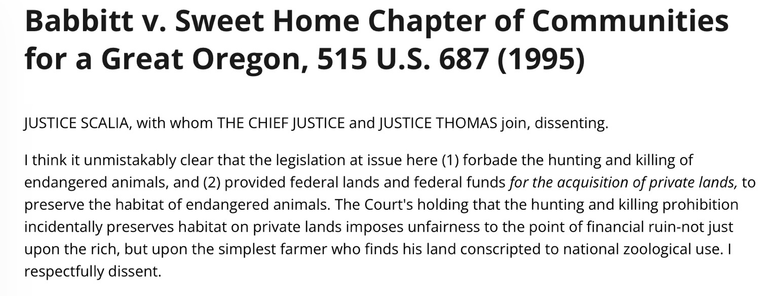
The unacknowledged ancestor of the Sagebrush Canon is Scalia’s dissent in Babbitt v. Sweet Home, an ESA case. Nowhere mentioned in Sackett, Babbitt is nonetheless a close parallel — except for the result. 1970s environmental statute, clash between statutory definition and historic usages, broad agency interpretation blessed by legislative amendment, property rights vs. green values. (Also, odd twist, the landowner is invoked by Scalia and Alito, not the Court’s Westerners.)

2/3

We need a name for the property-protecting canon the Supreme Court used in Sackett, the recent Clean Water Act case, and I propose calling it the Sagebrush Canon.

The name is inspired, of course, by the Sagebrush Rebellion, which admittedly more involved public lands as opposed to public regulation of private lands. But the vibes line up.

1/3
#LawProfs #SupremeCourt #AppellateTwitter #Legislation

Just posted: Chief Communications & Marketing Officer at William & Mary Law School, Virginia.

https://jobs.wm.edu/postings/52746

Join us!

#HigherEdComms

Chief Communications & Marketing Officer, Law School

Reporting directly to the Dean, the Chief Communications and Marketing Officer (CCMO) will:lead the Law School’s strategic communications and marketing efforts related to enrollment growth and faculty, staff and student activitiescollaborate with and provide strategic advice to the Law School’s Office of Advancement on engagement opportunitiesmanage internal communications processes, the Law School’s brand, crisis communications, and web/digital communications and platforms (including the website)develop and manage executive communications, including speeches, remarks, media statements, and community messages on behalf of the Deansupervise a staff that currently includes a Director of Communications and an Assistant Director of Communications but that may expand as the needs of the office grow.

I have posted an updated version of my short analysis of the Supreme Court Review Act proposed by Sens. Whitehouse and Cortez Masto. It would create a fast-track mechanism for bills responding to Supreme Court decisions. It would be a modest reform (especially compared to things like term limits), but in my view a worthwhile one.

Abstract and link below:

https://papers.ssrn.com/sol3/papers.cfm?abstract_id=4227162

Updating this thread to note that the draft is now posted on SSRN.

“Supreme Court Litigators in the Age of Textualism” examines 35 years’ worth of #SupremeCourt briefs to see how litigators’ use of interpretive tools has changed over time and how their practices compare to the Court’s practices.

Link here: https://papers.ssrn.com/sol3/papers.cfm?abstract_id=4339838

#appellatetwitter #appellatemastodon

Abstract:

(post 4 of 4)

I also looked at different kinds of litigants. Elite litigators seem to be a little more responsive to the Court’s shifting patterns compared to non-elites.

The Solicitor General has a high and pretty steady rate of citation of legislative history compared to other litigants, though it too emphasizes it less than in the past.

The paper isn’t on SSRN yet, but I’ll update this with a link when available.

(3 of 4)

Opinions citing only dictionaries are now common. Briefs cite both sources.

However, the briefs emphasize legislative history much less than they used to. See the picture below, which shows two different measures of emphasis. The panel on the left shows a drop in briefs that cite legislative history at least three times (dotted blue line). The panel at right shows references to legislative intent (blue) and plain meaning (red) in argument headings in tables of contents.

Also . . .

(post 2 of 4)

The time period is 1985 to 2020, and I have over 8000 briefs.
Both the Court’s opinions and the briefs cite textualist tools (dictionaries and textual canons) more than they used to, as one would expect. The Court cites legislative history less than it used to, but the briefs do not parallel the decline in the opinions’ use of that tool. See the image, which has corresponding charts for briefs (left) and opinions (right). Dictionaries are red lines, leg hist are blue.

. . .

Yesterday I had the privilege of presenting research at a virtual workshop organized by the AALS Legislation section and @jessecross. I discussed an empirical project on #SupremeCourt briefing practices. In particular, I've studied how litigants have changed their approach to arguing statutory cases during the era of the rise of textualism.

We don't have much systematic data on briefs.

A few key findings and figures are in the posts below.

#AppellateTwitter #AppellateMastodon #LawProfs