
Armin Schäfer

@VerglPolwi
804 Followers
292 Following
205 Posts
Professor for Comparative Politics @uni_mainz | Democracy | Political Participation | Inequality | Voter Turnout | Responsivness & Populism
Beigetreten30.10.2022
ORCIDorcid.org/0000-0002-2538-0092
WEBarmin-schaefer.de/en/welcome/

Should we adjust the ideal of #Democracy to institutional reality or should we try to bring reality closer to the ideal?

In a new paper 🎉 , @VerglPolwi and I argue that deliberative responsiveness constitutes a promise representative democracy can fulfill.

We show how contemporary democracies struggle to meet this standard and discuss three institutional innovations to improve deliberative responsiveness.

Open access link: https://doi.org/10.1007/s11158-023-09640-0
@politicalscience
@politicaltheory

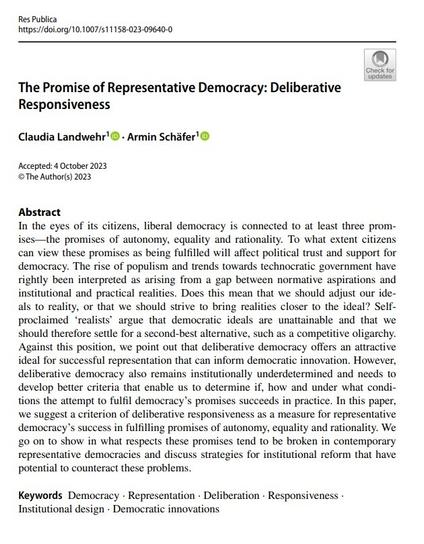
The Promise of Representative Democracy: Deliberative Responsiveness - Res Publica

In the eyes of its citizens, liberal democracy is connected to at least three promises—the promises of autonomy, equality and rationality. To what extent citizens can view these promises as being fulfilled will affect political trust and support for democracy. The rise of populism and trends towards technocratic government have rightly been interpreted as arising from a gap between normative aspirations and institutional and practical realities. Does this mean that we should adjust our ideals to reality, or that we should strive to bring realities closer to the ideal? Self-proclaimed ‘realists’ argue that democratic ideals are unattainable and that we should therefore settle for a second-best alternative, such as a competitive oligarchy. Against this position, we point out that deliberative democracy offers an attractive ideal for successful representation that can inform democratic innovation. However, deliberative democracy also remains institutionally underdetermined and needs to develop better criteria that enable us to determine if, how and under what conditions the attempt to fulfil democracy’s promises succeeds in practice. In this paper, we suggest a criterion of deliberative responsiveness as a measure for representative democracy’s success in fulfilling promises of autonomy, equality and rationality. We go on to show in what respects these promises tend to be broken in contemporary representative democracies and discuss strategies for institutional reform that have potential to counteract these problems.

SpringerLink
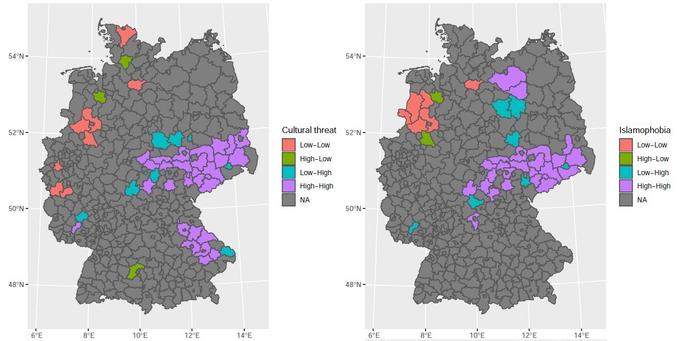
What does 'place' even mean for #farright politics, and how is it linked to populist radical right attitudes in #Germany & elsewhere? Glad that you asked, and super happy that EPSR has just published our answer (open access)
https://www.cambridge.org/core/journals/european-political-science-review/article/place-does-matter-for-populist-radical-right-sentiment-but-how-evidence-from-germany/7C639AAC5F6B1BC2F6324F7D57136827

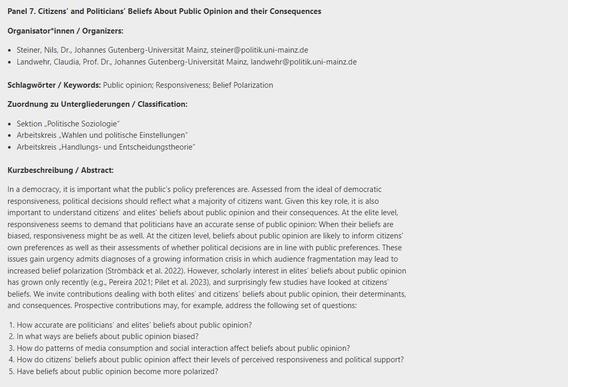
From Sept 24-27, 2024, the German Political Science Association (DVPW) will hold its Convention in Göttingen. #dvpw2024

A call for papers for 98 panels has now been published:
https://www.dvpw.de/en/dvpw2024

With Nils Steiner, I'm looking forward to paper proposals for a panel on "Citizens’ and Politicians’ Beliefs About Public Opinion and their Consequences".
#PoliticalScience @politicalscience

DVPW Convention 2024

Deutsche Vereinigung für Politikwissenschaft

Last month, Cristina Lafont and Nadia Urbinati presented their new book "Defending democracy against lottocracy" in Mainz and we had a wonderful and inspiring workshop together.

You can now watch their recorded talk here:
https://video.uni-mainz.de/Panopto/Pages/Viewer.aspx?id=10818ad2-8ab7-468f-ab54-b04c00db8f6e&start=126.998707

@politicaltheory
#Democracy #Representation

Cristina Lafont & Nadia Urbinati: Defending Democracy against Lottocracy

Panopto
"Steuern, Sparen, Scheitern": Die Buchdiskussion zu "Der erschöpfte Staat" von Ariane Leendertz, die im Februar am MPIfG stattfand, wurde bei Soziopolis nun in einem Dossier dokumentiert.
B. Rieger, T. Biebricher, W. Streeck und U. Schimank setzen sich kritisch mit jener "anderen Geschichte des Neoliberalismus" auseinander, die Leendertz anhand der Urban Policy in den USA erzählt. Eine Replik der Autorin rundet die Essaysammlung ab. https://www.soziopolis.de/dossier/steuern-sparen-scheitern.html
@sociology @politicalscience
Steuern, Sparen, Scheitern

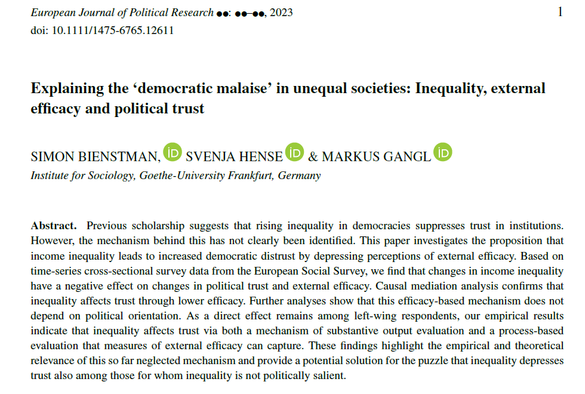
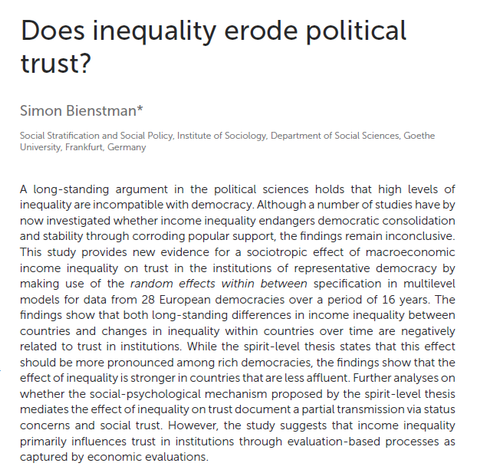
Two new papers by Simon Bienstman and colleagues find income inequality erodes political trust

https://doi.org/10.3389/fpos.2023.1197317

https://doi.org/10.1111/1475-6765.12611

Does inequality erode political trust?

A long-standing argument in the political sciences holds that high levels of inequality are incompatible with democracy. Although a number of studies have by now investigated whether income inequality endangers democratic consolidation and stability through corroding popular support, the findings remain inconclusive. This study provides new evidence for a sociotropic effect of macroeconomic income inequality on trust in the institutions of representative democracy by making use of the random effects within between specification in multilevel models for data from 28 European democracies over a period of 16 years. The findings show that both long-standing differences in income inequality between countries and changes in inequality within countries over time are negatively related to trust in institutions. While the spirit-level thesis states that this effect should be more pronounced among rich democracies, the findings show that the effect of inequality is stronger in countries that are less affluent. Further analyses on whether the social-psychological mechanism proposed by the spirit-level thesis mediates the effect of inequality on trust document a partial transmission via status concerns and social trust. However, the study suggests that income inequality primarily influences trust in institutions through evaluation-based processes as captured by economic evaluations.

Frontiers
Participatory budgeting process increase pro-poor spending and improve citizen’s quality of life https://journals.sagepub.com/doi/10.1177/00104140231178725

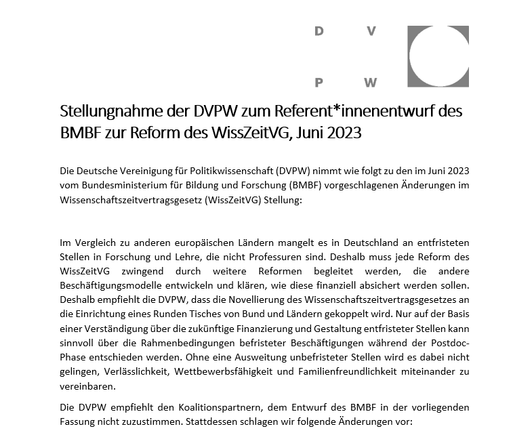
Stellungnahme der DVPW zur Novellierung des #WissZeitVG:

"Die DVPW empfiehlt den Koalitionspartnern, dem Entwurf des @bmbf_bund in der vorliegenden Fassung nicht zuzustimmen. Stattdessen schlagen wir folgende Änderungen vor:"

@GrueneBundestag

Die Stellungnahme wurde bereits am Freitag von der AG #WissZeitVG im Vorstand verabschiedet und ans @bmbf_bund übermittelt. Diese und frühere Stellungnahmen finden sich auf unserer Webseite:

👉 https://dvpw.de/wisszeitvg

Let’s give this a second try. Already enough political scientists and other experts on here to properly let me doomscroll? #polisci