Tony Cristofano

106 Followers
105 Following
40 Posts

@DrYohanJohn This one might be too wide ranging but take a look at:

The role of inhibitory circuits in hippocampal memory processing.

https://doi.org/10.1038/s41583-022-00599-0

A question for hippocampus experts. What are the best sources for data on primate hippocampal microcircuitry? I'm particularly interested in the variety, distribution and connectivity of local inhibitory interneurons.

(Note that I am looking for primate-specific data.)

#Neuroscience #Hippocampus

We're excited that Anna Kutschireiter's work on Bayesian inference in ring attractor networks in collaboration with Melanie Basnak and Rachel Wilson (neither on Mastodon?) is now out at PNAS: https://doi.org/10.1073/pnas.2210622120. Check it out!

We show that ring attractor networks - the canonical models for working memory of a circular variable, like head direction (HD) - can perform Bayesian inference if they are tuned to have slow attractor dynamics. Then, most of the interesting dynamics are actually happening away from the attractor state, where the network features dynamics that allow it to perform Bayesian filtering of sensory inputs.

Specifically we look at Bayesian HD tracking with absolute HD (e.g., landmark) and angular velocity inputs, and show that the ring attractor network can implement close-to-optimal Bayesian inference. It turns out that network connection don't need to be fine-tuned - the network can perform close-to-optimal inference for a wide range of connection strengths. Furthermore, we show how a more distributed network that matches the topology of the Drosophila central complex can perform the same inference as a simpler networks.

You can find more details in a tweet from Anna on the bird site (sorry): https://twitter.com/ankutschi/status/1628467331172114435


Delighted to say my paper with @andrea is now improved, polished, and published!

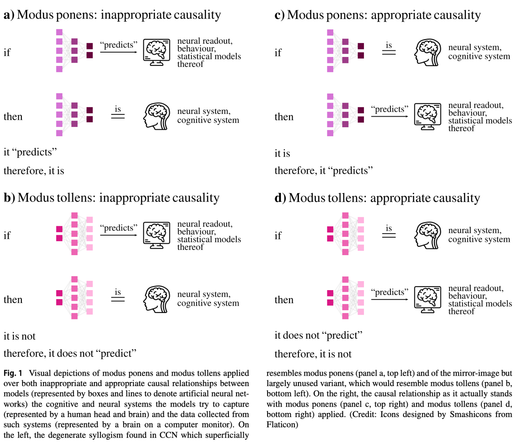
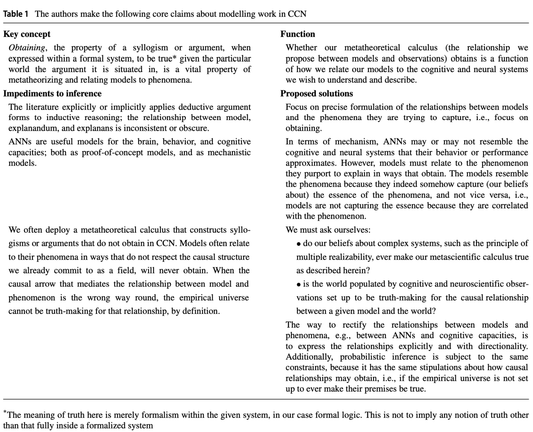
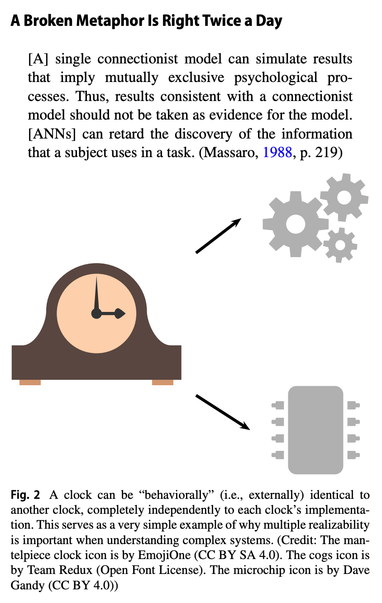
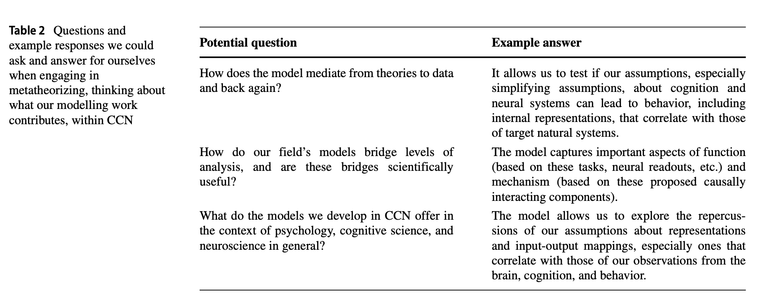
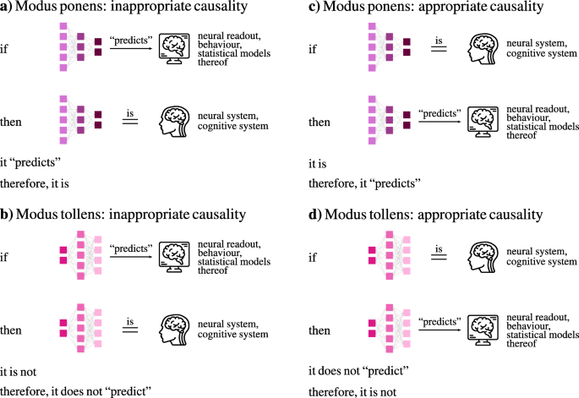
Guest, O., & Martin, A. E. (2023). On Logical Inference over Brains, Behaviour, and Artificial Neural Networks. Computational Brain & Behavior. https://doi.org/10.1007/s42113-022-00166-x

1/3

On Logical Inference over Brains, Behaviour, and Artificial Neural Networks - Computational Brain & Behavior

In the cognitive, computational, and neuro-sciences, practitioners often reason about what computational models represent or learn, as well as what algorithm is instantiated. The putative goal of such reasoning is to generalize claims about the model in question, to claims about the mind and brain, and the neurocognitive capacities of those systems. Such inference is often based on a model’s performance on a task, and whether that performance approximates human behavior or brain activity. Here we demonstrate how such argumentation problematizes the relationship between models and their targets; we place emphasis on artificial neural networks (ANNs), though any theory-brain relationship that falls into the same schema of reasoning is at risk. In this paper, we model inferences from ANNs to brains and back within a formal framework — metatheoretical calculus — in order to initiate a dialogue on both how models are broadly understood and used, and on how to best formally characterize them and their functions. To these ends, we express claims from the published record about models’ successes and failures in first-order logic. Our proposed formalization describes the decision-making processes enacted by scientists to adjudicate over theories. We demonstrate that formalizing the argumentation in the literature can uncover potential deep issues about how theory is related to phenomena. We discuss what this means broadly for research in cognitive science, neuroscience, and psychology; what it means for models when they lose the ability to mediate between theory and data in a meaningful way; and what this means for the metatheoretical calculus our fields deploy when performing high-level scientific inference.

SpringerLink

As always, an exceptional article by the inimitable Ted Chiang, comparing large language models (LLMs) like chatGPT to lossy compression (of jpeg, zip etc etc).

https://www.newyorker.com/tech/annals-of-technology/chatgpt-is-a-blurry-jpeg-of-the-web

The implications of using such technology for writing, education, or generating ideas are so deftly spelled out.

Is knowledge generation and communication a lossy compression or a lossless "mnemonic" (that can be expanded when necessary)? Can AI systems, however sophisticated, reach the mnemonic stage?

#TedChiang #LLMs #ChatGpt #AI

Last weekend New England was hit by temperatures as low as -30C. How did heat pumps perform? The Boston Globe asked people about their experience:

"More than 450 responded, and most said their pumps kept their living spaces as warm as they wanted."

🧵

https://www.bostonglobe.com/2023/02/08/science/heat-pumps-had-their-first-major-test-last-weekend-heres-how-it-went/

Heat pumps had their first major local test last weekend. Here’s how it went.

Heat pumps are considered crucial to the region’s response to climate change. But when temperatures plummet, are they up for the job?

The Boston Globe
The representational geometry of cognitive maps under dynamic cognitive control
https://www.biorxiv.org/content/10.1101/2023.02.04.527142v1

oh hello world, it's me, just posting from my BRAND NEW SHINY neuromatch mastodon account!

already loving the local feed much more than at my old server. now everybody in my "local" feed seems very highly relevant and interesting. tres cool to see the contrast so cleanly, and happy to be over here with all of you!

@hugospiers
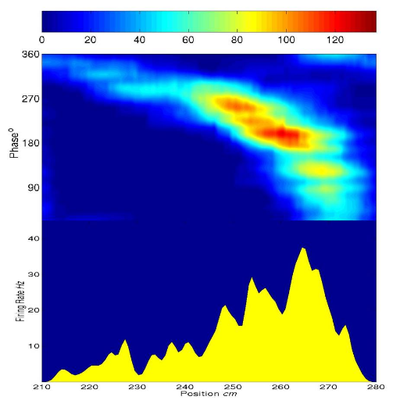
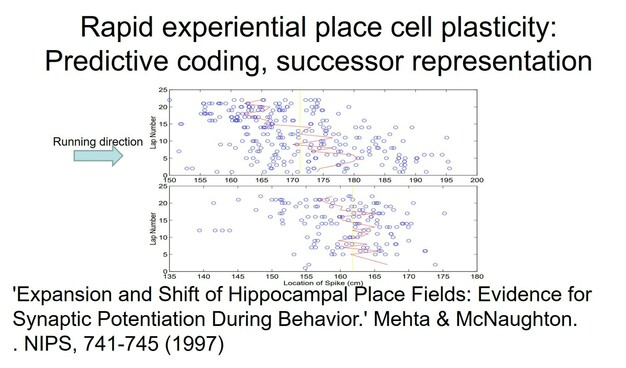
Nice to see a resurgence of predictive coding (now called successor representation). We discovered this in hippocampus 25 years ago! Remarkably, place cells develop predictive coding even in highly familiar environments, everyday! Also, some place fields turn on abruptly after a few trials, even when the rat did the same simple task, walkin on the same narrow linear track, for weeks!

https://link.springer.com/chapter/10.1007/978-1-4757-9800-5_115

Or get it free:
https://www.physics.ucla.edu/~mayank/hebb.pdf

Expansion and Shift of Hippocampal Place Fields: Evidence for Synaptic Potentiation during Behavior

Rat hippocampal neurons fire in a spatially selective fashion [1]. We show that place fields enlarge (by 75%) and shift (by 1.4cm) in a direction opposite to the direction of movement of the rat, within a few traverses of a route, even if the environment has been...

SpringerLink
@tuthill So wonderful to see—collaborative research for the win! And a standard for #connectomics.
#neuroscience #Drosophila