 Itai Yanai
There are - roughly speaking - two kinds of research labs: the artist colonies and the armies.

Sonali Majumdar, PhD
- 155 Followers
- 211 Following
- 27 Posts
 Anirban Mahapatra
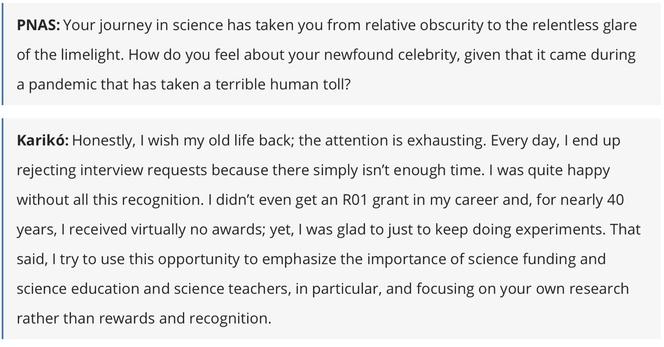
I was reading interviews of Katalin Karikó, who made key discoveries that led to the development of lifesaving mRNA COVID-19 vaccines. Her dedication in the midst of adversity struck me.
-She pushed on despite not having job security, NIH R01 research funding, or recognition.
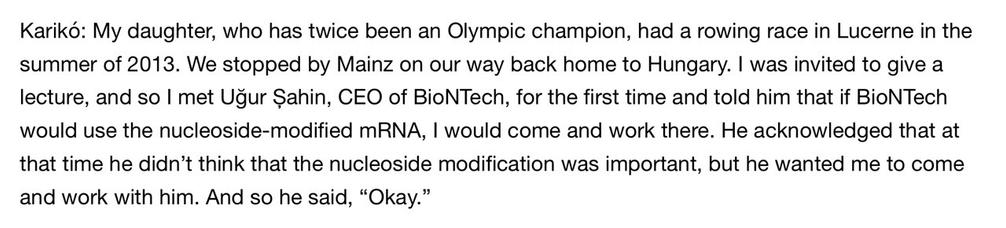
-A chance stop in Mainz led to her joining BioNTech.
-And her daughter is a two-time Olympic gold medalist!
More talk of dedicated scientists, less talk of narcissistic businessmen please.
(interviews in PNAS and JCI)
The revolution comes to science when we finally dethrone the hypothesis-driven mode as the only respectable form of scientific inquiry for grant and thesis proposals.
 lucksmith
@Sonali_M_19 once an RNA biologist, *always* an RNA biologist!!
It was such a busy day that I almost forgot.. 8 years ago, on Nov 21, I defended my PhD dissertation. #PhDone anniversary. Still recall the celebration organized by my PIs and lab mates . Time flies!


 Tim Stearns
The NIH Advisory Committee to the Director is starting a working group on “Re-envisioning NIH-supported Postdoctoral Training.” Slide deck here has some data and details: https://acd.od.nih.gov/documents/presentations/11032022_ACD_Working_Group_Postdoc.pdf
What would you like them to know? What would you like them to do?

 Jess Wade
“The disproportionate scientific productivity of elite researchers can be largely explained by their substantial labor advantage rather than inherent differences in talent.” #AcademicMastodon #ScienceMastodon https://www.science.org/doi/10.1126/sciadv.abq7056
 PLOS Biology
RT @oaggimenez
Awesome paper by @Brianne_Kent et al in @PLOSBiology showing that Early Career Researchers can change the research system & improve science 🤩 w/ important recommandations for ECRs & supporters.
https://doi.org/10.1371/journal.pbio.3001680
🧵by @T_Weissgerber https://bit.ly/3hCPXlY
🗞️#206-2022

Recommendations for empowering early career researchers to improve research culture and practice
Around the world, early-career researchers are working to improve research culture and practice by addressing systemic challenges. This consensus statement provides expert guidance for individuals involved in these projects, and stakeholders who wish to empower the next generation of scientific leadership.
 James M. Van Wyck ✴️
It wasn’t so when I was in #gradschool, but now are so many great #books that can help #gradstudents and those who work with them. Let me make a quick plug: /The Reimagined Phd: Navigating 21st Century Humanities Education/ is currently 30% off! Enter discount code RASHE22 in the shopping cart. The discount includes free freight in the USA. https://www.rutgersuniversitypress.org/the-reimagined-phd/9781978809116

‘The tipping point is coming’: Unprecedented exodus of young life scientists is shaking up academia
"NIH will soon launch a working group focused on better understanding the postdoc shortage- — what’s driving it, whether there have been measurable impacts on research productivity, and what NIH can do to better support postdocs. The group will offer initial recommendations to the agency’s director in June"
