
Simon Sadedin

17 Followers
19 Following
10 Posts

Head of #clinicalbioinformatics at the Murdoch Children's Research Institute and the Victorian Clinical Genetics Services.

Data scientist, bioinformatician, and software engineer/architect. Believer that software and #datascience together can transform the world to make it a better place. Currently working hard to achieve that in #genomics.

For those in Brisbane soon for #ABACBS2023 - we have a fabulous Clinical Informatics Symposium planned!

If you work in a clinically related setting, or if you ever just wondered how bioinformatics research makes it into real clinical use – this session is for you.

Hear from speakers who work every day in evaluating, validating and deploying new methods into clinical settings and chat with them directly in our meet and greet!

Registration through EventBrite:
https://tinyurl.com/abacbsCIS

Clinical Informatics Symposium - Building the genomics revolution in health

Join us as we explore the intersection of bioinformatics, clinical science, and transformative patient care.

Eventbrite

Significant new database documenting aberrant splicing - should make some impact in helping to understand the functional significance RNA events:

https://www.nature.com/articles/s41588-022-01293-8.epdf

Congrats to Sandra Cooper and team!

SpliceVault predicts the precise nature of variant-associated mis-splicing | Nature Genetics

Even for essential splice-site variants that are almost guaranteed to alter mRNA splicing, no current method can reliably predict whether exon-skipping, cryptic activation or multiple events will result, greatly complicating clinical interpretation of pathogenicity. Strikingly, ranking the four most common unannotated splicing events across 335,663 reference RNA-sequencing (RNA-seq) samples (300K-RNA Top-4) predicts the nature of variant-associated mis-splicing with 92% sensitivity. The 300K-RNA Top-4 events correctly identify 96% of exon-skipping events and 86% of cryptic splice sites for 140 clinical cases subject to RNA testing, showing higher sensitivity and positive predictive value than SpliceAI. Notably, RNA re-analyses showed we had missed 300K-RNA Top-4 events for several clinical cases tested before the development of this empirical predictive method. Simply, mis-splicing events that happen around a splice site in RNA-seq data are those most likely to be activated by a splice-site variant. The SpliceVault web portal allows users easy access to 300K-RNA for informed splice-site variant interpretation and classification. Re-analysis of published RNA-sequencing samples finds that unannotated splicing events predict, with high sensitivity, the activation of exon skipping and cryptic splicing by splice-site variants.

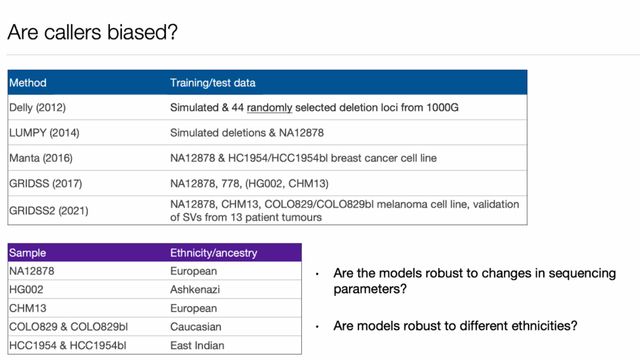
Tony Papenfuss illustrating lack of diversity / bias in training sets for SV detection in genomic data sets at #abacbs22

David Asher at #ABACBS2022 - speaking about tackling the tricky issue of enabling deeper machine learning models to predict impact of missense mutations based on better understanding of 3d interactions - lots of interesting tools available:

https://biosig.lab.uq.edu.au/tools

Publication bias a major issue!

Biosig | Tools

Do you have some great #bioinformatics and #software skills and are looking for something new?

We have a great opportunity to join our bioinformatics team at VCGS in an exciting project - piloting use of whole genome sequencing for screening of newborns for rare genetic disorders. To find out more about this transformational project, check out our job listing on LinkedIn:

https://www.linkedin.com/jobs/view/3348005731

Or alternatively, if you're at #abacbs2022 come and find me in person to learn more!