Shahab Bakhtiari

3 Followers
186 Following
203 Posts
postdoc in computational neuroscience and machine learning @Mila_Quebec - McGill || incoming assistant professor - University of Montreal || #NeuroAI || studying vision and learning in brains and machines
Twitterhttps://twitter.com/ShahabBakht
websitehttps://shahabbakht.github.io/

RT @[email protected]

New Jazlab work! When monkeys produce vectors on a map w/o visual feedback, an endogenously activated cognitive map in the entorhinal cortex reflects animals' knowledge about the (invisible) intervening landmarks. Exciting work by @[email protected] w/ @[email protected] http://doi.org/10.1101/2022.12.15.520640

๐Ÿฆ๐Ÿ”—: https://twitter.com/mjaz_jazlab/status/1603776949062537216

@tenzingContrib I love collaborating on studies about human visual perception and attention (new #OA book: https://tracking.whatanimalssee.com/intro.html#summary). The video shows an illusion discovered by Ryo Nakayama and I - the objects disappear when they are aligned with the vertical, but most people perceive them to disappear further on. #perception #vision #attention #visualperception @cognition #introduction
Chapter 1 Objects that move | Attending to moving objects

This book reviews some of the literature on multiple object tracking by humans.

This is the PsychoPy team's #introduction to Mastodon.

PsychoPy is an #opensource package to build and run experiments in #python and #js

PsychoPy is a widely used tool for the behavioural sciences like #psychology #linguistics #economics #neuroscience

This account will also tweet about other parts of the ecosystem like #pavlovia (it's like GitHub for behavioural science) and #PsychoJS

Looking forward to chatting with you here! ๐Ÿฅฐ๐Ÿ˜

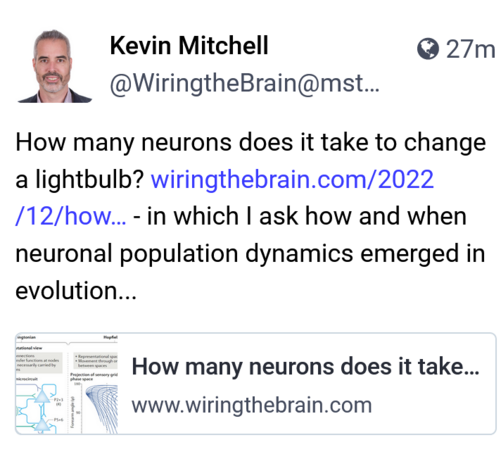
How many neurons does it take to change a lightbulb? http://www.wiringthebrain.com/2022/12/how-many-neurons-does-it-take-to-change.html - in which I ask how and when neuronal population dynamics emerged in evolution...
How many neurons does it take to change a lightbulb?

Iโ€™ve been reading this excellent paper by David Barack and John Krakauer, on โ€œ Two Views on the Cognitive Brain โ€, and it made me wonder ab...

๐—ฃ๐—ผ๐—ฝ๐˜‚๐—น๐—ฎ๐˜๐—ถ๐—ผ๐—ป ๐—ฐ๐—ผ๐—ฑ๐—ถ๐—ป๐—ด ๐—ฎ๐—ป๐—ฑ ๐—ป๐—ฒ๐˜‚๐—ฟ๐—ผ๐—ป๐—ฎ๐—น ๐—ฐ๐—ถ๐—ฟ๐—ฐ๐˜‚๐—ถ๐˜๐˜€ ๐—ฎ๐—ฐ๐—ฟ๐—ผ๐˜€๐˜€ ๐—ฒ๐˜ƒ๐—ผ๐—น๐˜‚๐˜๐—ถ๐—ผ๐—ป

Check this cool essay by Kevin Mitchell:
http://www.wiringthebrain.com/2022/12/how-many-neurons-does-it-take-to-change.html

#neuroscience

How many neurons does it take to change a lightbulb?

Iโ€™ve been reading this excellent paper by David Barack and John Krakauer, on โ€œ Two Views on the Cognitive Brain โ€, and it made me wonder ab...

Mind blown by the artificial rodent of @Neurograce presented at MAIN 2022. Artificial animals as the new wave of model organisms? ๐Ÿ€ ๐Ÿค– ๐Ÿคฏ
#main2022 @Neurograce presenting a research focus of her new lab - Visual representation learning embodied in a virtual rat - Super cool!

The #ChatGPT paper is now on arXiv https://arxiv.org/abs/2203.02155

EDIT: This is not a new paper, but it is the technique used to train ChatGPT and what is now apparently called GPT3.5

Training language models to follow instructions with human feedback

Making language models bigger does not inherently make them better at following a user's intent. For example, large language models can generate outputs that are untruthful, toxic, or simply not helpful to the user. In other words, these models are not aligned with their users. In this paper, we show an avenue for aligning language models with user intent on a wide range of tasks by fine-tuning with human feedback. Starting with a set of labeler-written prompts and prompts submitted through the OpenAI API, we collect a dataset of labeler demonstrations of the desired model behavior, which we use to fine-tune GPT-3 using supervised learning. We then collect a dataset of rankings of model outputs, which we use to further fine-tune this supervised model using reinforcement learning from human feedback. We call the resulting models InstructGPT. In human evaluations on our prompt distribution, outputs from the 1.3B parameter InstructGPT model are preferred to outputs from the 175B GPT-3, despite having 100x fewer parameters. Moreover, InstructGPT models show improvements in truthfulness and reductions in toxic output generation while having minimal performance regressions on public NLP datasets. Even though InstructGPT still makes simple mistakes, our results show that fine-tuning with human feedback is a promising direction for aligning language models with human intent.

arXiv.org
A nice day for #NeuroAI at the new UMontrรฉal MIL Campus #MAINmontreal22 https://www.main2022.org/
Look for our two posters with @ArayAlab @tyrell_turing @mrspaghetti
MAIN 2022

WELCOME TO MAIN 2022 Registration is now open!

Hello beautiful people! I'm a computational neuroscientist working on sensory-motor control. Lately, my lab has been working on recurrent neural networks and spiking nets (all still in the pipeline) and I'm here to exchange and learn about these and other topics.