Shahab Bakhtiari

602 Followers
277 Following
181 Posts
Assistant professor - University of Montreal || Previously postdoc at Mila Quebec AI Institute and McGill || || #NeuroAI || studying vision and learning in brains and machines
Twitterhttps://twitter.com/ShahabBakht
Websitehttps://snailab.ca

After perceptual learning, a subset of neurons in the auditory cortex increased their responses during a “difficult” perceptual task.

This didn’t happen during an “easy” version of the task.

The effect was also task dependent; didn’t happen during passive viewing.

Cool results!

Though I don’t quite understand why the authors framed this as a signature of task difficulty. It looks like a learned strategy to handle the more difficult conditions, but why would we call it a signature of task difficulty?

Link to the paper: https://www.science.org/doi/full/10.1126/sciadv.adp9816

If you're considering a life in academia it's worth watching this video and deciding if it's worth it to you or not. All of this is true.

https://www.youtube.com/watch?v=LKiBlGDfRU8

For me the answer is yes, despite all the problems, for two reasons.

Firstly, I'm lucky enough that I do have considerable freedom to work on the things that I'm interested in. If I was more interested in success or if I was on a 'soft money' position and forced to chase constant grants, I don't know if that would be true. But, such luck is rare.

Secondly, as a socialist I would feel very uncomfortable spending my creative energy on most of the non-academic things I'm qualified for: advertising and surveillance (i.e. tech companies), finance, or startups (making venture capitalists even richer). I could imagine academia getting bad enough that I'd make that choice, but for me it's not there yet. I completely understand that it is that bad for others and I mean no criticism of them.

In a way I suppose this is a sort of defence of academia, but it's a half hearted one at best. I think it's absolutely tragic and depressing that academia has become like this. Doing research should be one of the most joyful and creative things anyone could do with their lives.

Didn't know about this before posting and I think because of the interesting discussion that followed I'll leave my post up, but do see this comment since it seems the author of the YouTube video has some problematic views.

https://synapse.cafe/@axoaxonic/112225621387460997

My dream died, and now I'm here

YouTube

The representation of occluded image regions in area V1 of monkeys and humans https://www.sciencedirect.com/science/article/abs/pii/S0960982223010539 by @tylermorgan et al.; #neuroscience

"contextual influences rapidly alter V1 spiking activity in monkeys over distances of several degrees in the visual field, carry information about individual scenes, and resemble those in human V1."

Slowly, but surely, I am getting better at saying 'no'. It's not easy, though, and I'm still having to back-track occasionally.

To any new PIs out there, this is the absolute most important skill you have to learn!

#justsayno #academia

If you're at #CCN2023 and interested in multimodal processing, come and chat with us at our poster P-3B.68 with @marcusghosh from 1-3pm today in the Marquee.

https://2023.ccneuro.org/view_paper.php?PaperNum=1062

If you're not at CCN, check our thread/preprint and we'd be happy to discuss!

https://neuromatch.social/@neuralreckoning/110785811144218374

Technical Program: Paper Detail || CCN 2023 || 2023 Conference on Cognitive Computational Neuroscience || Oxford, UK || August 24 - 27, 2023

I'm at Cognitive and Computational Neuroscience 2023 (https://2023.ccneuro.org) in Oxford , and enjoying it.

Most of the time I work on synaptic and cellular stuff and a bit of neural population data analysis. So the cognitive and ML/AI angles at this meeting are out of my comfort zone, but also the reason I'm here... much easier to get up to speed on the gist of a research area by spending a few days at a meeting than trying to decipher what's going on reading papers at home on your laptop

Home || CCN 2023 || 2023 Conference on Cognitive Computational Neuroscience || Oxford, UK || August 24 - 27, 2023

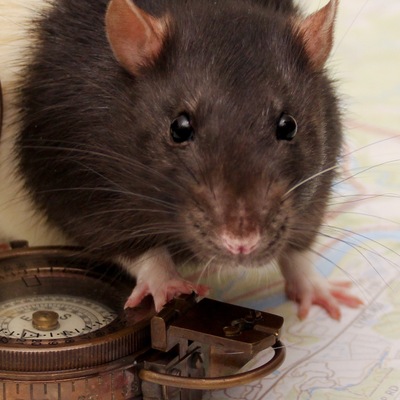
Anyone has a 3D design for Rat #Nosepoke (just the shape, no need for electronics) that they would be willing to share? 🐀🙏
Due to the details of their implementation, some cognitive phenomena will be best-explained from a Hopfieldian view while others will be best-explained from a Sherringtonian one.
Agree
57.1%
Disagree (only one)
14.3%
Disagree (neither)
28.6%
Poll ended at .

Our lab 🐌 now has a website and a logo: https://snailab.ca

Check out our website to learn more about our approach and research goals.

To give you a glimpse of the topics that interests us, we have also dedicate a page to the SNAIL Journal Clubs. We'll post summaries of the papers we read on this page: https://www.snailab.ca/home/journal-club

snail

We are a NeuroAI laboratory in the Department of Psychology at the Université de Montréal. We aim to understand the algorithmic and neuronal principles underlying animals' visual processing and learning. By leveraging these principles, we aspire to develop more brain-like artificial intelligence.

In preparation for our #CCN2023 @CogCompNeuro GAC next week, I’m going to do some polls here this week to take the temperature of the room. 🌡️

Very curious to see the range of answers so please pass it on 🔁🙏 and feel free to elaborate - we'll try to take any discussion into account at the workshop

📊🧵 #neuroscience #neurobuzz

https://gac.ccneuro.org/gacs-by-year/2023-gacs/2023-1

GACs - 2023-1

Reconciling the dichotomy between Sherringtonian and Hopfieldian views on neural computations Organizers & Speakers at CCN 2023: Dongyan Lin, McGill University Arna Ghosh, McGill University Jonathan Cornford, McGill University James Whittington, Stanford University Tatiana Engel, Princeton