If you're considering a life in academia it's worth watching this video and deciding if it's worth it to you or not. All of this is true.

https://www.youtube.com/watch?v=LKiBlGDfRU8

For me the answer is yes, despite all the problems, for two reasons.

Firstly, I'm lucky enough that I do have considerable freedom to work on the things that I'm interested in. If I was more interested in success or if I was on a 'soft money' position and forced to chase constant grants, I don't know if that would be true. But, such luck is rare.

Secondly, as a socialist I would feel very uncomfortable spending my creative energy on most of the non-academic things I'm qualified for: advertising and surveillance (i.e. tech companies), finance, or startups (making venture capitalists even richer). I could imagine academia getting bad enough that I'd make that choice, but for me it's not there yet. I completely understand that it is that bad for others and I mean no criticism of them.

In a way I suppose this is a sort of defence of academia, but it's a half hearted one at best. I think it's absolutely tragic and depressing that academia has become like this. Doing research should be one of the most joyful and creative things anyone could do with their lives.

Didn't know about this before posting and I think because of the interesting discussion that followed I'll leave my post up, but do see this comment since it seems the author of the YouTube video has some problematic views.


https://synapse.cafe/@axoaxonic/112225621387460997

My dream died, and now I'm here

YouTube

@neuralreckoning
Thanks for this. I watched. Good to discuss.

I don’t deny anyone’s experience. Thus story is horrible and I believe that all this happened to her.

That said, I’m worried about encouraging the next gen to watch this video as representative of academia and decide if they want to sign up. I certainly don’t agree that all the statements in the video about science at large are true!. Certainly if I experienced what she experienced, I would leave too. The thing I’d like to emphasize is that we aren’t all experiencing that (and this is why we stay; we’re not suffering hopelessly). I would go as far as to say with confidence that hers is an extreme case.

I acknowledge that I’m coming from a position of good fortune here, surrounded by other fortunate people. And we have to be careful about survivor bias, absolutely. But let’s also be equally careful about making academia sound like a horror show. (I suspect that wasn’t your intent here! But could be interpreted that way maybe?)

@NicoleCRust what would you say specifically doesn’t apply to a universal academic experience from the video?

Personally I think it’s important to expose the reality of the current academic system to anyone who might want to enter it. When I decided that what I wanted to do with my life was research, I thought the path to permanent researcher was straightforward: masters, Phd, permanent position. Haha.

Would I have not entered “academia” had I known how convoluted, compromise-based and basically unscientific getting a permanent position was - a position which doesn’t even involve doing that much research in most cases? I don’t think so personally but I know many others would go a different way if they had the full picture. Plus the general public is the one basically funding this system and should be made aware that it’s not going well and needs to be improved somehow!

@neuralreckoning

@elduvelle @NicoleCRust agreed that it's really better to talk about this stuff, both to potential researchers and members of the public.

@elduvelle @neuralreckoning

As a few examples:

Academia isn't about knowledge discovery; it's about money making.

Science is a money making machine in which students and postdocs are burnt out to bring in money for the institution.

Most of academic research that your taxes pay for is almost certainly bullshit.

...

I'm not claiming that she isn't raising some important issues about the scientific pipeline and how women/families are treated. These are important and we need to address them! But by mixing them in with these over-the-top (and I would say misleading and inaccurate) statements - I just don't see how that's productive.

@NicoleCRust @elduvelle the tax one is unfortunate because it's a freebie for the right who are quite happy to make academia even worse or destroy it entirely. It's true that most research is wrong and even wrongly concerned but I'd argue that's a necessary and unavoidable part of doing science. The other two points are kind of reasonable I think. Science isn't just those things, but it is partly those things. A significant part.

@NicoleCRust @neuralreckoning I see, yes these are a bit over-the-top, they would probably be more realistic if more nuanced…

In my experience (i.e. in my field) they definitely have some truth to them… the exploitation of postdocs and phd students… the pressure to get grants… the need to ask for funding for “cool & quickly feasible” projects that may not be the ones you’re actually interested in… the papers that get published with misleading or just wrong results because that’s what the “top journals” demand… 😕 I know that not all researchers submit to this system but there is no question that some do, I guess the question is: to what extend does this happen?

@elduvelle @neuralreckoning

Yes! These are important topics for conversation, absolutely. I agree. (In fact, earlier this week I had many of these on a slide in a talk). We are unified in wanting to pinpoint problems and find solutions, for sure.

@NicoleCRust @elduvelle @neuralreckoning Honestly, the first two of those statements strike me as completely accurate. At least, if you look at the institution of academia apart from the scientists.

Many individual scientists are not like that at all. They do excellent work and foster supportive cultures in their labs. They don't care about money, and insulate their students from those concerns so they can focus on the quest for knowledge.

The problem is, that seems to be the result of a mix of luck, privilege, and personality. They do these things because they can and because they choose to, despite the system being evolved for something else entirely. If you look at the system itself--the roles, the norms, the incentives--it is all oriented around the profit motive, and fundamentally exploitative, elitist, and resistant to change.

So there is a lot of good in academia. It's just contingent and precarious. That's what I think people need to know, and what we need to fix.

@ngaylinn @elduvelle @neuralreckoning
I'm curious to hear more, if you are willing. You have a unique perspective, coming from industry. And your perspective is different from mine, so I'd like to hear more about it.

Why do you see academia as a money making machine (as opposed to, say, a non-profit institution focused on a good cause like education/knowledge advancement)?

@NicoleCRust @elduvelle @neuralreckoning Yeah. This is something I'm still figuring out for myself, but the contrast with Google is very striking.

I keep thinking about the role of “grad student” and how it seems fundamentally unfair and exploitative to me. For obvious reasons, that’s the part I’m most familiar with. To understand, I think it helps to contrast my starting experience at UVM and at Google.

Google hired me straight out of undergrad. From day one, I was a software engineer. I was in the reporting chain. My manager gave me some visibility into how things were run, and I had some input, too. It was sort of a meritocracy, if not a very good one. I had job security, good opportunities for advancement, and solid pay / benefits. If I didn't get along with my manager, they'd find me a new one.

@NicoleCRust @elduvelle @neuralreckoning Starting as a grad student, I have 14 years of industry experience, but am often treated as if I'm straight out of undergrad. I am not a scientist, and that is made abundantly clear a dozen times a day. I make an inadequate living doing work for the university, but I’m not an "employee," either, and I get very limited benefits. I have no meaningful visibility or voice into how the university is run. I exist here at the whim of my PI. I have no job security, no path for advancement.

I won’t stick around here long enough for the university to invest in my wellbeing, or to change the university in any meaningful way. In order to “make it” in academia, I’ll need to luck into some solid findings in an area people are literally willing to invest in. The university supports good science, but they reward grants. The quality of the science only correlates with funding, and I feel like success is determined by the latter.

@NicoleCRust @elduvelle @neuralreckoning I want science to be a nurturing, growing community, oriented around helping as many people as possible understand the world and contribute to our shared understanding.

But on-boarding is 5 years of exhausting, undervalued labor as an outsider with limited access and respect. Then my career and my research agenda might just get dumped. If I can’t secure ongoing funding, they have no future. Doesn’t matter if I’m good at what I do, or if my ideas are important.

If we started over to design a system like the one I want, it wouldn’t have “grad students.” It would be different in many ways. I know this, because I was in management and used to design human systems. I know the principles, and I see them applied in perverse ways. Unfortunately, very few academics have that perspective.

@ngaylinn @elduvelle @neuralreckoning

Thank you for this! I get it. These thoughts are really important.

@ngaylinn @NicoleCRust @elduvelle how would you design it? Genuine question, I'm always interested in new ideas on this.

@neuralreckoning @NicoleCRust @elduvelle I don't know yet! I'm still making sense of what it means to "do science".

But, personally, I really miss the sense of belonging, development, and accumulation I had in industry.

I was part of a team and a company for the long term. We cared about each other in a very different way than in academia. We worked hard to make a good culture, where people could advance their career and manage their wellbeing, so folks would join and stay and work together over the long term.

We all grew together. Trainees would eventually become the next generation of leaders. We built things for each other. We had shared tools and documents and resources that made our lives better. We were working towards something, contributing to a collective effort.

For this reason, I'd design something a bit more like a job. Internship, hire, then a career in one place if you want it. I'm not sure how funding that works, but I also think part of the problem is we need vastly more public funding.

@ngaylinn @NicoleCRust @elduvelle that sounds like a beautiful vision. It's a sad commentary on the state of academia today that we have less solidarity than in a capitalist company.

@neuralreckoning @NicoleCRust @elduvelle Well, to be fair, I'm describing Google at its hayday. I'm fairly sure things are different now.

A big part of what made that possible was the explosive growth in profits and investments that made long-term growth thinking attractive. Now that internet and cell phone usage have reached saturation, and the company has switched into the mode of squeezing as much juice out of what they've captured as possible, I imagine the work culture is quite different.

That's another problem here: we really don't just want to emulate industry. They've got destructive profit-motive stuff, too. In some ways, much worse.

@ngaylinn @NicoleCRust @elduvelle no I agree we don't want to emulate industry. It's just striking to me that universities were forced to implement internal markets in an ideological attempt to make them more like capitalism and capitalism just doesn't actually work like that.

@ngaylinn @NicoleCRust @elduvelle @neuralreckoning Amen to that. And community (infrastructure) building takes time. Time very few want to invest.

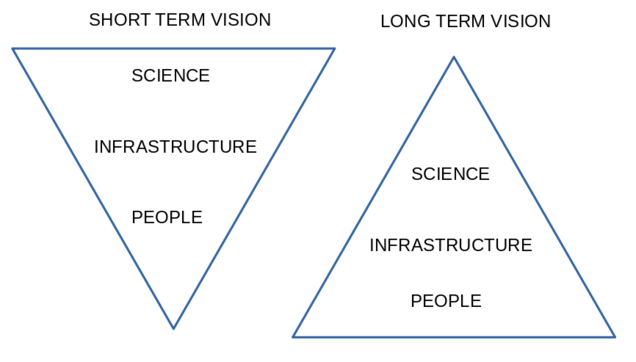
Institution and inexperience of TT lets people build unstable inverted triangle of labs (where the science burden gets bumped down, without a proper foundation to work from). Creating unhealthy work environments, abuse at worst.

I drew this graph during an internal review once to communicate this - I'm unsure it was ever taken to heart.

@koen_hufkens @NicoleCRust @elduvelle @neuralreckoning I love this diagram.

The only problem with it is that it looks like you're shrinking the science part of the pyramid, but this is the wrong way of thinking. When you invest more in people and infrastructure, their capacity expands, more people join, and you get growth. The whole pyramid expands. You would get more science by focusing on it less, at least in the long term.

Right now, by focusing solely on the science (and grants, and football), we're starving people and infrastructure, and we see science is struggling. Interest is dwindling, work is becoming more profit-driven, grad students are revolting, we have a reproducibility crisis, all because we're failing the people by focusing on short-term results.

@elduvelle @NicoleCRust @neuralreckoning That point about it all being funded by public money is incredibly important - in the end, can we look an average person on the street in the eye and tell them with a straight face that we are using these enormous sums of money in a responsible way in line with what society thinks they give them to us for?
I liked her video a lot also because I feel those sensibilities resonating - and I do believe it's a firstgen thing a bit.
@NicoleCRust I don't claim that everything that happened to her will or has happened to everyone, of course, but this stuff does happen and to be honest my impression from my own experiences, what I've been told by people I know, and from accounts I've read from people I don't know, is that it happens a lot. I don't think hers is actually an extreme case. And I think a lot worse happens too. What I don't want to do is give the impression that it's worse in academia than outside. I don't know enough to say whether that's true or not and I've heard some pretty hair raising stories from outside academia too, so a priori I've no reason to think it's better and wouldn't be at all surprised to find out it's worse.

@neuralreckoning
These are great (and fair) points. And absolutely - there's a lot we need to fix (inside and out). 💯​

It's these points we need to focus on, I think (and not obscure them in the other "bullshit").

@NicoleCRust @neuralreckoning

The bias is real and ever present: I feel the same, video comes across as an extreme case because my environment has been mostly populated by fortunate people who did the right thing at the right time and place. Took lots of effort too, so those living through it felt like they deserved it. About half of my lab members ended up as faculty.

@NicoleCRust @neuralreckoning agreed. Loved her, loved the video. But it doesn’t reflect my experience either. It’s not that I haven’t encountered the challenges, it’s that they haven’t played out in the same way for me. That’s largely good fortune, but maybe also some different expectations as I experienced other professional environments prior to academia. Much of the bad stuff strikes me as not unique - we just expect academia to be better (and we should hold it to that!).
@NicoleCRust @neuralreckoning no sooner had I watched the video and posted my comment that I scrolled on and found this https://synapse.cafe/@axoaxonic/112225621387460997
Holly A. Gultiano (@[email protected])

A lot of people are posting a video by Sabine Hossenfelder right now, and I'm not going to comment on the video or the points and discussion, but I wanted to post this video detailing her problematic views on trans issues, how she promoted (in a biased-centrist way) the harmful, TERF-associated, and unfounded view that gender affirming care for trans kids is a social contagion leading to "rapid onset of gender dysphoria," while making claims that transitioning before puberty is harmful https://www.youtube.com/watch?v=r6Kau7bO3Fw Also there's a line where she offhand belittles people who say early gender affirming care saves lives "Whether or not she meant to, she repeatedly used a misleading rhetorical device to elevate transphobic talking points to the same level as scientific evidence, and she did that in front of a very large audience"

Synapse Cafe
@UlrikeHahn @NicoleCRust I should have known someone with a million YouTube followers would be problematic.
@UlrikeHahn @NicoleCRust @neuralreckoning I also think that she goes well beyond personal experience when she says things like "unlike academia, what I do now is honest work" or that most academic work is bullshit (as if most od everything that people do is not bullshit).
@neuralreckoning This is about value and sexism, but it's also about community. When I hear people talk about that, there is almost always a story of being isolated, and not feeling understood by peers. This is not to say the reality of value capture does not exist, but if you have a peer group who respect you, you'll often find a way to make space for meaningful work, and that meaning will be validated through your community's eyes.
@neuralreckoning Another issue is that bullshit is common in the corporate world as well. I made the move to govt, and I do feel that my work is much less meaningful than in academia. Private corporate bureaucracies don't seem any better.
@locha I have less experience of that but it wouldn't surprise me at all to find out they're even worse.
@locha @neuralreckoning yes, but we should hold ourselves (meaning academia here) to a higher standard imho.
@neuralreckoning I agree with the content of the video but I think not enough blame is put on the governments. They are ultimately the ones driving the incentive structure which pushes towards temporary contracts and precarious workers in academia.
@marinbenc oh sure, the blame is a whole other question. As I understand it, a lot of this happened because of a conscious decision by right wing governments to force universities into a managed, market like environment that makes no sense. Sadly centrist governments since then have done nothing to reverse it.
@neuralreckoning Spot on. I'm a bit surprised by how much physics resembles biomedical sciences in this respect.
Personally, even though I have a stable academic job, I'm in a similar crossroad. I'm not sure I'll be able to work in the stuff I'm interested on, and the options I have are not interesting at all - to me. I even have some funding and a brilliant student who wants to work on it. Still, here we are. For the first time in my life I wonder whether leaving academia is the best option.
@neuralreckoning I mean I love science, and really like teaching. The problem - well described in the video - is that science become a grant, publication and promotions chasing endeavor. And we all know how we got here. The 'merit-based evaluation' discourse worked beautifully to turn science into a business-model for ideological reasons. But it goes totally against science principles. The optimist in me believes this can't last long, it's unsustainable. The optimist in me is often disappointed.
@JoseEdGomes @neuralreckoning
What resonated with me was how she described her disillusion, that moment when dreams gave way to drudgery, when grants aren’t just a means to an end but have become the end.

I think, in research a lot is wasted because the very system that is supposed to drive efficiency through metrics dulls people’s creative spark. I don’t think (in biomed) out-of-the-box proposals are unfundable, but the relentless Red Queen race drains people’s capacity to dream them up.
@neuralreckoning There is another side to this that got left out in her youtube post: the problems she describes are not unique to academia, the same general issues arise in any kind of work environment. The bottom line is that if you have a jerk for a boss, suffering will trickle down, no matter what the field.