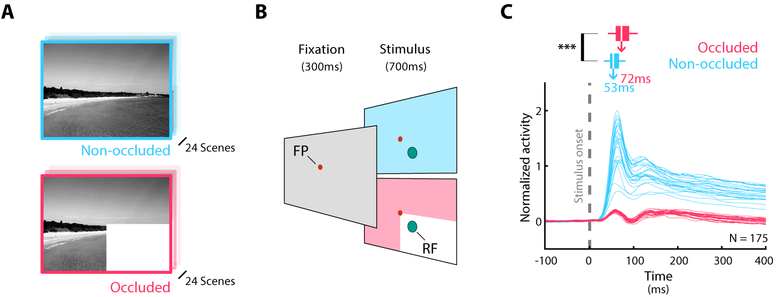
The representation of occluded image regions in area V1 of monkeys and humans https://www.sciencedirect.com/science/article/abs/pii/S0960982223010539 by @tylermorgan et al.; #neuroscience

"contextual influences rapidly alter V1 spiking activity in monkeys over distances of several degrees in the visual field, carry information about individual scenes, and resemble those in human V1."

Is there a way to selectively disable the influence of feedback signals from higher visual areas, e.g. by applying properly timed TMS to mask those feedback signals and see what that does to contextual influences?
(YouTube) The representation of occluded image regions in area V1 of monkeys and humans https://www.youtube.com/watch?v=QuEQXWRBR_s Partial occlusion causes completion in V1 through feedback from higher visual areas.
The representation of occluded image regions in area V1 of monkeys and humans

YouTube
The non-paywalled PDF of a preprint of the paper is available at https://www.biorxiv.org/content/10.1101/2022.11.21.517305v1 Feedback brings scene information to the representation of occluded image regions in area V1 of monkeys and humans
@seeingwithsound Doesn't much of the contextual processing come from the PPA? Somewhat difficult area to apply TMS to
@mdc Not sure, I'm not a neuroscientist. Perhaps temporarily knocking out V2 would also do the job, and if TMS would not work then perhaps tFUS - my question was intended to be quite open: whatever works to block feedback signals to V1.