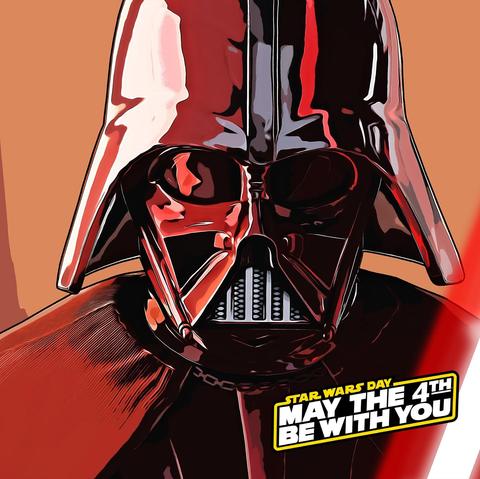
Even better than the fourth... Revenge of the Fifth is here! #StarWars #RevengeOfTheFifth

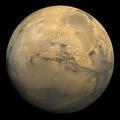
| Favorite Planet: | Mars |
| Tumblr: | https://ov099.tumblr.com/ |
| Goodreads: | https://www.goodreads.com/user/show/2682443-lois |
| Swagbucks Referral Link: | https://www.swagbucks.com/profile/OV099 |
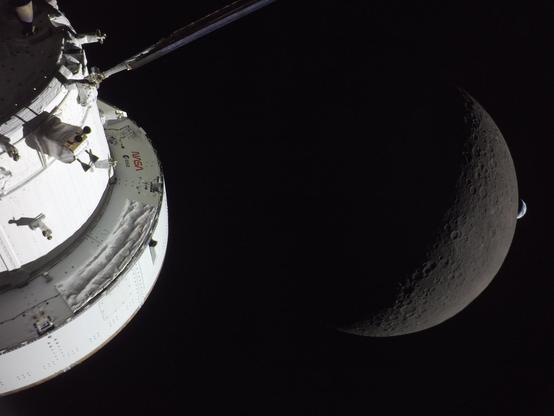
Artemis II: Flight Day 6
Image Credit: NASA, Artemis II
Explanation: On flight day 6 (April 6) the Artemis II mission achieved a historic lunar flyby. Rounding the lunar far side, the deep space maneuver marked humanity's first venture to the Moon since Apollo 17 in 1972. The Orion spacecraft Integrity reached a maximum distance of nearly 407,000 kilometers, and the Artemis II crew, Reid Wiseman, Victor Glover, and Christina Koch, and Jeremy Hansen, set the record for the farthest distance from Earth traveled by any human since the Apollo 13 crew in 1970. From behind the Moon on flight day 6, a solar array wing camera recorded this space age selfie, framing the spacecraft and lunar far side. Planet Earth, home to the Artemis II crew, is the small, bright crescent beyond the lunar limb. The crew safely returned home on Artemis II mission flight day 10.
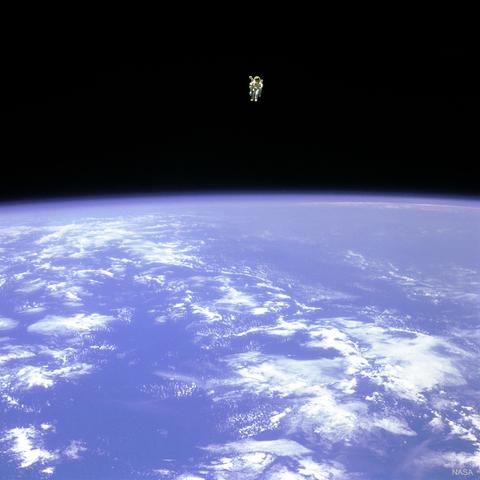
To Fly Free in Space
Image Credit: NASA, STS-41B
Explanation: What would it be like to fly free in space? About 100 meters from the cargo bay of a space shuttle, Bruce McCandless II was living the dream -- floating farther out than anyone had ever been before. Guided by a Manned Maneuvering Unit (MMU), astronaut McCandless, pictured, was floating free in space. During Space Shuttle mission 41-B in 1984, McCandless and fellow NASA astronaut Robert Stewart were the first to experience such an "untethered space walk". The MMU worked by shooting jets of nitrogen and was used to help deploy and retrieve satellites. With a mass over 140 kilograms, an MMU is heavy on Earth, but, like everything, is weightless when drifting in orbit. The MMU was later replaced with the SAFER backpack propulsion unit.
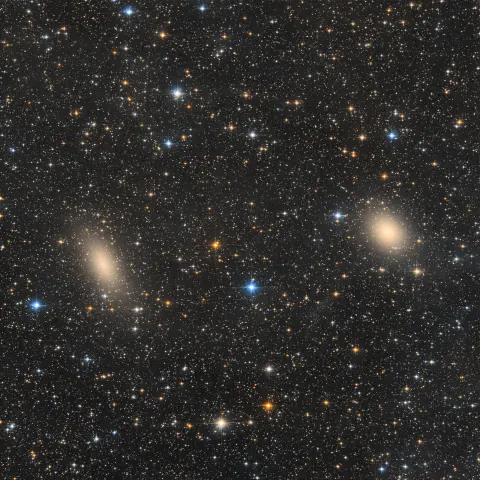
NGC 147 and NGC 185
Image Credit & Copyright: Chuck Ayoub
Explanation: Dwarf galaxies NGC 147 (left) and NGC 185 stand side by side in this deep telescopic portrait. The two are not-often-imaged satellite galaxies of M31, the great spiral Andromeda Galaxy, some 2.5 million light-years away. Their separation on the sky, less than one degree across a pretty field of view toward the constellation Cassiopeia, translates to only about 35 thousand light-years at Andromeda's distance, but Andromeda itself is found well outside this frame. Brighter and more famous satellite galaxies of Andromeda, M32 and M110, are seen much closer to the great spiral. NGC 147 and NGC 185 have been identified as binary galaxies, forming a gravitationally stable binary system. But recently discovered faint dwarf galaxy Cassiopeia II also seems to be part of their system, forming a gravitationally bound group within Andromeda's intriguing population of small satellite galaxies.
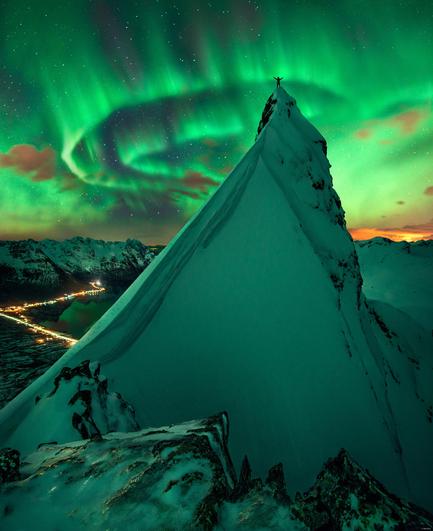
In Green Company: Aurora over Norway
Image Credit & Copyright: Max Rive
Explanation: Raise your arms if you see an aurora. With those instructions, two nights went by with, well, clouds -- mostly. On the third night of returning to same peaks, though, the sky not only cleared up but lit up with a spectacular auroral display. Arms went high in the air, patience and experience paid off, and the creative featured image was captured as a composite from three separate exposures. The setting is a summit of the Austnesfjorden fjord close to the town of Svolvear on the Lofoten islands in northern Norway. The year was 2014. This year, our Sun is just passing solar maximum, the peak in its 11-year surface activity cycle. As expected, some spectacular aurora have recently resulted.
 Astronomy Picture of the Day

 Lois
Lois