#genAI @academicchatter #AcademicChatter #PeerReview
Last week was incredible. I really enjoyed teaching my course on communicative efficiency at the Universidade Federal de Minas Gerais in Belo Horizonte, Brazil. The colleagues and students here are amazing - creative, open-minded and very warm. I've learned so much about the vibrant local culture and Brazilian Portuguese during the classes and get-togethers!
This is a satellite event in connection with the awarding of a honorary doctorate by Gothenburg University to Terry Regier. We bring together a number of leading researchers to discuss central questions at the frontiers of AI and the Cognitive Science of Language: * Computationa
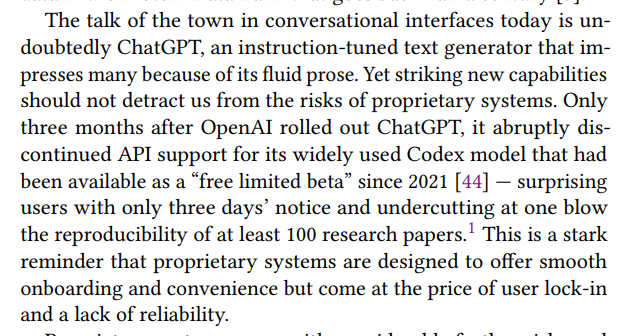
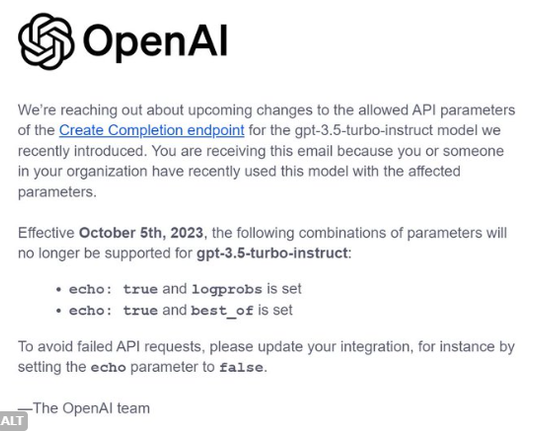
Some people were using OpenAI's advanced API parameters apparently to derive scientific insights about GPT3.5. This will break in under a week. Thank you OpenAI for making our point so eloquently and efficiently for us
(first image: introduction of our CUI'23 paper https://doi.org/10.1145/3571884.3604316 ; second image: OpenAI announces it will break getting information about prompt/output probabilities for whatever reason)
#OpeningUpChatGPT #proprietary #reproducibility #openscience
This week groups of students in my class did their own version of Liberman's 'On Crossing Kincaid': observational #EMCA fieldwork to study members' methods of navigating high traffic encounters on campus
Many intriguing observations, e.g. 'bikers may not give way but they do provide space'; methods for 'doing being a group' vs 'doing being alone'; & an apparent ranking of keep moving > avoid contact > avoid detours in how walkers navigate a fence with a straight and a zigzag way through
We present the Radboud Coregistration Corpus of Narrative Sentences (RaCCooNS), the first freely available corpus of eye-tracking-with-EEG data collected while participants read narrative sentences in Dutch. The corpus is intended for studying human sentence comprehension and for evaluating the cognitive validity of computational language models. RaCCooNS contains data from 37 participants (3 of which eye tracking only) reading 200 Dutch sentences each. Less predictable words resulted in significantly longer reading times and larger N400 sizes, replicating well-known surprisal effects in eye tracking and EEG simultaneously. We release the raw eye-tracking data, the preprocessed eye-tracking data at the fixation, word, and trial levels, the raw EEG after merger with eye-tracking data, and the preprocessed EEG data both before and after ICA-based ocular artifact correction.