
Those who shout the loudest about being “good Christians” are often the ones acting in complete opposition to what Jesus lived and died for.
That’s especially true when it comes to science and public health.
A thread🧵
1/
Head of Developer Experience | Developer Success Lab alumna | ultrarunner | writer | golfer
also on https://bsky.app/profile/kristen-fm.bsky.social
Background in language teaching pedagogy, Second Language Acquisition, and classroom-based research.
Passionate about integrating social and behavioral science into the tech world, particularly in enhancing how software teams and practitioners learn, work, and thrive.
@dr.andrealove 's Substack ImmunoLogic is one of the very few newsletters I read top to bottom these days. Could not recommend more if (like me) you sometimes (understandably!) lack the lexical precision to combat science disinformation and quackery.
New issue of the Developer Science Review is out, folks! My article choice and annotation is pretty dang personal for this one, where I ask the question:
"For whom does intellectual humility become disadvantageous?"
Thanks in advance for reading and (I hope!) sharing your thoughts, reactions & experiences.
https://dsl.pubpub.org/pub/intellectual-humility/release/2?readingCollection=818aa986
✨The Developer Science Review Infrastructure issue just dropped! In this issue we highlight research with a connection to infrastructure work. We cover
- The value of doing ethnography about “boring” things
- when intellectual humility goes wrong
- and mismatches in mental models of risk
We describe how each piece of research is relevant for software developers and those who study developer thriving.
https://dsl.pubpub.org/infrastructure-volume-2-issue-1-april-2025
I didn't realize I'd been waiting YEARS for Aubrey and Mike to take down that bulletproof guy until Aubrey and Mike took down that bulletproof guy.
https://maintenancephase.buzzsprout.com/1411126/episodes/16826150-the-bulletproof-diet
Meet the tech bro on a noble quest to double his lifespan, improve his productivity and irritate his waitress. Support us:Hear bonus episodes on PatreonWatch Aubrey's documentaryBuy Aubrey's bookListen to Mike's other podcastGet Maintenance ...
Hot off the press, y'all - new research from the folks at the Developer Success Lab. https://arxiv.org/abs/2503.05040v2
I'm copying and pasting from an email I wrote to @flourn0 after reading a draft of the now available "No Silver Bullets: Why Understanding Software Cycle Time is Messy, Not Magic."
Because I don't think I can advocate for the quality of and need for this work any better than I did in that email:
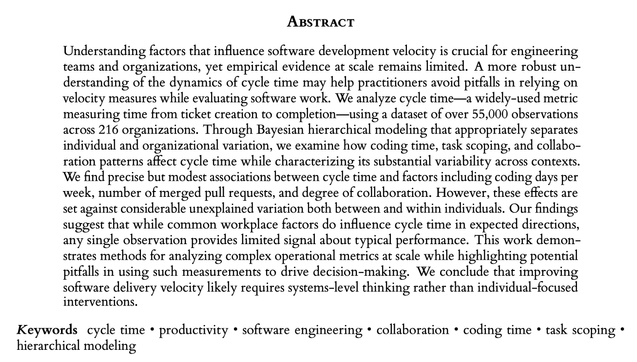
Understanding factors that influence software development velocity is crucial for engineering teams and organizations, yet empirical evidence at scale remains limited. A more robust understanding of the dynamics of cycle time may help practitioners avoid pitfalls in relying on velocity measures while evaluating software work. We analyze cycle time, a widely-used metric measuring time from ticket creation to completion, using a dataset of over 55,000 observations across 216 organizations. Through Bayesian hierarchical modeling that appropriately separates individual and organizational variation, we examine how coding time, task scoping, and collaboration patterns affect cycle time while characterizing its substantial variability across contexts. We find precise but modest associations between cycle time and factors including coding days per week, number of merged pull requests, and degree of collaboration. However, these effects are set against considerable unexplained variation both between and within individuals. Our findings suggest that while common workplace factors do influence cycle time in expected directions, any single observation provides limited signal about typical performance. This work demonstrates methods for analyzing complex operational metrics at scale while highlighting potential pitfalls in using such measurements to drive decision-making. We conclude that improving software delivery velocity likely requires systems-level thinking rather than individual-focused interventions.