Compared to thermocouples, RTDs generally provide what?
| Lower accuracy | |
| Better accuracy | |
| Lower stability | |
| Less repeatability |
Poll ends at .

| Website | https://instrumentationtools.com/ |
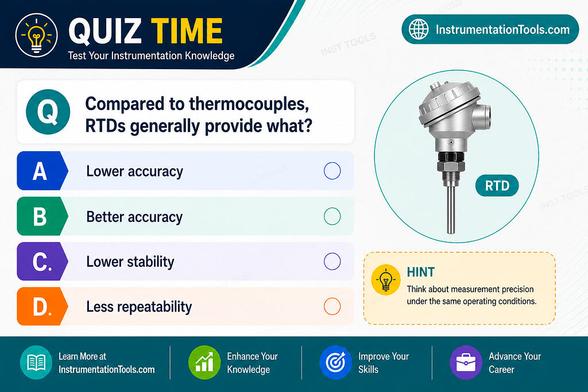
Compared to thermocouples, RTDs generally provide what? A. Lower accuracy B. Better accuracy C. Lower stability D. Less repeatability ▶ View Answer Explanation: RTDs (Resistance Temperature Detectors) generally provide better accuracy than thermocouples, making them a preferred choice for precise temperature measurement in many industrial applications. RTD Advantages Over Thermocouples ✅ Higher accuracy ✅ Better long-term stability ✅ ...
| Lower accuracy | |
| Better accuracy | |
| Lower stability | |
| Less repeatability |


Which parameter most affects RTD response time? A. Number of wires B. Sensor mass C. Ambient temperature D. Terminal type ▶ View Answer Explanation: The response time of an RTD is primarily affected by its sensor mass (thermal mass). Response time is the time required for the RTD to react to a change in process temperature and reach a specified percentage of its final value. Why Sensor Mass Matters Smaller sensing elements heat up and cool down faster. Larger sensing elements require...
| Number of wires | |
| Sensor mass | |
| Ambient temperature | |
| Terminal type |

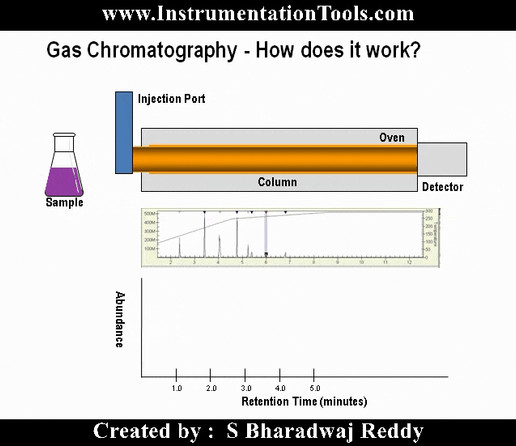
Gas Chromatograph Working Principle Basics of Gas chromatograph Working Animation Overview Gas chromatography is one of the most widely used techniques for analyzing hydrocarbon mixtures. Some of the advantages of chromatography are the range of measurement (from ppm levels up to 100 %), the detection of a wide range of components, and the repeatability of the measurements. Chromatography is used in the laboratory, in permanently installed online systems, and in the field with portable systems. No matter the location, style, or brand, all gas chromatographs are composed of the same functional components: the sample handling system, the chromatograph oven, and

Which RTD type is most common in process industries? A. Pt1000 B. Pt250 C. Pt500 D. Pt100 ▶ View Answer Explanation: The Pt100 is the most widely used RTD type in process industries due to its excellent balance of accuracy, stability, availability, and compatibility with industrial instruments. The term Pt100 means: Pt = Platinum sensing element 100 = 100 Ω resistance at 0°C Comparison of Common RTD Types Pt100 100 Ω at 0°C Most common industrial RTD Widely supported by PLCs, DCS...