Hans de Jonge

506 Followers
452 Following
176 Posts
(Managing) director Open Science NL part of the Dutch Research Council @nwonieuws | www.openscience.nl | http://orcid.org/0000-0002-1189… | Toots my own | X: @HLdeJonge
Open ScienceWww.openscience.nl
Open accesshttps://orcid.org/my-orcid?orcid=0000-0002-1189-9133

Congratulations to #CERN for hosting #OpenResearchEurope (ORE) and to ORE on backing from 16 national funders and research organizations. PKP is proud to be the developers of the #OpenInfrastructure #OpenJournalSystems (OJS) that ORE will be based on.

Learn more about CERN and ORE: https://home.cern/news/news/cern/cern-host-europes-flagship-open-access-publishing-platform

CERN to host Europe’s flagship open access publishing platform

In an important step for open science, CERN has been selected to host a new phase of Open Research Europe (ORE), an initiative supported by the European Commission and a new funding consortium of European national funding agencies and research organisations. Aligned with the Action Plan for Diamond Open Access (2022)[1], the initiative is a community-led alternative to traditional academic publishing. When the new ORE platform is launched later this year, authorship eligibility will be expanded to include researchers affiliated with institutions in the countries that participate in the consortium. Publishing will remain completely free for both European Commission-funded researchers and authors from participating countries. The aim is to promote equity, diversity and transparency in scholarly communication while maintaining high standards of quality and integrity. The ORE funding consortium currently comprises members from Austria, France, Germany, Italy, the Netherlands, Norway, Portugal, Slovenia, Spain, Sweden and Switzerland[2]. The European Commission participates as a permanent observer in the governance body and provides dedicated financial support. CERN will provide the technical and operational infrastructure for the platform, built on the open source software Open Journal Systems (OJS), while governance and editorial oversight will remain the responsibility of the ORE consortium. ORE follows the innovative publish–review–curate model, which promotes rigour and transparency in the publishing of research. Articles are first checked for integrity and compliance, then published and peer-reviewed openly. Peer-review reports are made public, and articles that successfully pass review are curated into subject-specific collections. This approach combines quality assurance with openness, while also enabling post-publication review. Launched by the European Commission in 2021 to provide beneficiaries of EU research programmes with a no-fee open access publishing platform[3], ORE was designed to make publicly funded research more transparent, accessible and sustainable through an innovative publishing model. In the five years since its launch, the platform has seen steady growth and uptake across the research community, with more than 1,200 articles published and over 6,300 authors from more than 3,000 institutions worldwide taking part. CERN’s role in operating ORE builds on its long-standing experience in developing and maintaining open science infrastructures and community-governed services for the global research community. By hosting ORE, CERN will provide a neutral, reliable and sustainable environment, drawing on expertise gained through flagship open science initiatives such as Zenodo, Invenio and SCOAP3. “For CERN, hosting Open Research Europe is a natural extension of our commitment to an open, community-led scientific infrastructure,” said Mar Capeáns, CERN Director for Site Operations. “The platform supports the rapid sharing of research, while reinforcing Europe’s ability to shape the future of scholarly communication.” “Open Research Europe is a strong example of a shared commitment to fostering the free flow of knowledge across the European Research Area and beyond”, stated Marc Lemaître, Director-General for Research and Innovation (DG RTD), European Commission. “By ensuring open access to high-quality research, ORE facilitates the circulation of the latest research findings and amplifies public trust in science. Today, as European research funders and research organisations join forces to support ORE, we open a new chapter, one that strengthens open access scholarly publishing and improves research practices across Europe”. Beyond the technical infrastructure, the initiative is expected to deepen collaboration between CERN, the European Commission, national representatives and research organisations. Working in partnership with the OPERAS Research Infrastructure, outreach and engagement activities will be expanded across Europe to attract eligible authors to the platform. ORE is expected to support a growing number of research outputs each year, making publicly funded science more accessible and transparent while setting a benchmark for equitable publishing initiatives in Europe and beyond. More information on the future platform at: https://ore.eu    [1] https://scienceeurope.org/our-resources/action-plan-for-diamond-open-access/ [2] Austrian Science Fund (FWF), European Organization for Nuclear Research (CERN), French National Research Agency (ANR), French National Centre for Scientific Research (CNRS), German Federal Ministry for Research, Technology and Space (BMFTR), Italian Ministry of Universities and Research (MUR), Dutch Research Council (NWO), Research Council of Norway (RCN), Foundation for Science and Technology, Portugal (FCT), Slovenian Research and Innovation Agency (ARIS), Swedish research funders (Forte, Formas and the Swedish Research Council), Spanish Foundation for Science and Technology (FECYT), Spanish National Research Council (CSIC), Swiss National Science Foundation (SNSF) [3] Current platform (operational till fall 2026):  https://open-research-europe.ec.europa.eu  
CERN

Happy to share our new piece (w/ @MsPhelps) on #metadata completeness in @crossref and submission systems was published by #PLOSone. All data, code and peer review openly available. We'd be delighted to continue the conversation with publishers and submission system vendors:

👆🏾https://doi.org/10.1371/journal.pone.0345417.

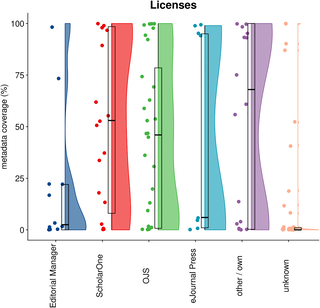
Manuscript submission systems and metadata completeness in Crossref: Patterns and associations

The importance of open research information, particularly publication metadata, is widely recognised. Crossref is one of the most important infrastructures for registering open metadata as part of DOI record registration. It is widely known, however, that the metadata of many publications is far from complete, with many publishers making certain metadata openly available, but failing to do so for other metadata elements. Publishers’ ability to register this metadata with Crossref depends on their capacity to capture and retain this data in their production workflows. Manuscript submission systems are an important, yet largely overlooked, factor in the extent to which publishers make metadata available through Crossref. In this paper, we present the results of an analysis investigating the relation between the level of metadata that publishers deposit with Crossref and the submission systems that they deploy for their journals. We have looked at the 153 publishers with the largest amounts of publications in Crossref and concentrate on the four most commonly used systems: Editorial Manager, ScholarOne, Open Journal Systems (OJS) and eJournalPress. We show that some submission systems appear better suited to capturing certain metadata elements. However, there are always cases where publishers using the same system differ widely in the level of metadata they register, suggesting that technology is not the only prohibiting factor and other considerations are at play.

📯Volgende week bespreekt de Tweede Kamer een voorstel om websites makkelijker te laten archiveren door erfgoedinstellingen. Dat is een verstandig plan want elke dag verdwijnt een stukje digitaal Nederland. Alleen stelt de minister voor om eerst nóg meer onderzoek te doen. Hierdoor duurt het nog minimaal 4 (‼️) jaar. Dat is echt onnodig en daarom roepen we vandaag bij NRC op om gas te geven op deze wetgeving zodat ons digitale verleden ook bewaard blijft voor de toekomst https://www.nrc.nl/nieuws/2026/01/15/kattenfilmpjes-zijn-ook-onderdeel-van-onze-cultuur-bescherm-de-nederlandse-online-identiteit-a4917790?gift_token=4917790%7E1769112951%7EbxhlVgbARy2rUKwVWtQ8Ig%7EsEcrwP2VQjIZmL9T6s0liutNzRrLnRjLgyhzVZaTMZk

The disclosure of who funds research is an important way of building trust in published findings.

Commenting on recent interventions by the Committee on Publication Ethics (COPE) and the International Science Council (ISC), @HLdeJonge @KatharinaRieck Zoé Ancion (co-chairs of the Barcelona Declaration working group on funding metadata) argue that to be truly effective funder metadata should be made openly accessible to all beyond the level of individual publications.

https://blogs.lse.ac.uk/impactofsocialsciences/2025/12/11/open-funder-metadata-is-essential-for-true-research-transparency/

Open funder metadata is essential for true research transparency - Impact of Social Sciences

Funder metadata is vital to understanding where research comes from & how it is used. But, to be truly effective it needs to be open to all.

Impact of Social Sciences - Maximizing the impact of academic research

🏛️ On 14 November 2025, an international community convened in Pisa, Italy, to advance coordinated reform in publishing and research assessment.

Co-hosted by @ASAPbio, CWTS, @DORAssessment, and the International Science Council, the meeting marked an important step in building momentum toward a more coordinated and impactful approach to reform across research assessment and publishing.

@RoRInstitute @LudoWaltman @andrebrasil

https://www.universiteitleiden.nl/en/news/2025/12/international-community-convenes-in-pisa-to-advance-coordinated-reform-in-publishing-and-research-assessment

International community convenes in Pisa to advance coordinated reform in publishing and research assessment

On 14 November 2025, representatives from several organizations across the publishing reform and research assessment reform communities gathered in Pisa, Italy, for a workshop aimed at identifying and advancing joint actions to strengthen both movements.

Leiden University

We @OpenScienceNL proudly present the new work programme for 2026–2027. 13 funding instruments to strengthen #openscience in the Netherlands.
Structured around 5 themes:
🔹infrastructure
🔹capacity
🔹communities
🔹incentives
🔹monitoring

https://www.openscience.nl/en/news/work-programme-2026-2027-the-netherlands-takes-the-next-step-towards-open-science

The slides of my presentation on Resilience of (open) science at a recent @cwts workshop are now permanently available in Zenodo: https://doi.org/10.5281/zenodo.17558232. In it I propose 10 resilience strategies to inspire and be applied by academic stakeholder groups. We have to stop breakdown of science by authoritarian regimes, skepticism and big commercial and political interests enshitting the internet

The release of the 2025 Leiden Ranking marks an series of critical steps towards a more open research information system.

It is great to see the Open Edition placed side by side with the traditional version of Ranking. Debates continue on the qualities and risks of moving to fully open research information systems. Putting the evidence together is key to having an informed conversation.

But perhaps more exciting for me is the opportunity it illustrates to expand the Ranking and make it more inclusive.

My main criticism of the Leiden Ranking methodology has always been that it excludes non-English and diverse outputs that don't fit into the definition of "core" journals.

Now we can see how that inclusion shifts the picture. And as always the work and the data from the @cwts shows the highest standards of technical quality and transparency.

This is a great step forward and demonstration of what can be done with Open Research Information

https://www.leidenmadtrics.nl/articles/the-cwts-leiden-ranking-2025-more-open-more-inclusive-more-informative

The CWTS Leiden Ranking 2025 - More open, more inclusive, more informative

The release of the CWTS Leiden Ranking 2025 marks a next step toward more open and more inclusive research analytics for universities. This post highlights the most significant developments.

Jeroen Sondervan (@jeroenson.bsky.social)

Just got home from the Netherlands #OpenScience Festival at the @rug.nl medical center. It was a wonderful edition, with more people attending than ever. So many are working on such great things. It’s really inspiring! #NOSF2025 But hey, who doesn’t want a sign like this in the garden?

Bluesky Social

Moving funding metadata forward: key takeaways from our Barcelona Declaration round table (co-organised with @crossref)
🟣 🟡

New blog by @HLdeJonge drawing on work from Working Group 3 (Funding metadata).

• ~25% of Crossref records include funding info
• 45 funders using Grant IDs (250k+ links)
• Openness broadly valued; publishers face tech hurdles
• Standardised statements + coordination will speed progress

🔗 https://barcelona-declaration.org/news/20251023_community_roundtable/

#FundingMetadata #OpenResearchInformation

Moving funding metadata forward: key takeaways from a Barcelona Declaration round table

On October 2, 2025, funders, publishers, submission system providers and infrastructure organisations came together for a focused discussion on improving the collection and sharing of open funding metadata.

Barcelona Declaration on Open Research Information