 Ricki Yasha Tarr
You don't need to excel or be the best. You don't need to conquer or be elite. It's fine to just exist in the world, it's fine to just enjoy something, and not compete or monetize.

Doctorrazo
@DoctorRazo
- 0 Followers
- 2 Following
- 61 Posts
Software engineer, aspiring game developer, always a work in progress, neurodiverse, rather asocial, depression, anxiety, he/they, into tech, the list goes on......but not a real doctor.
For some time now I've been planning on setting up a chill gaming community dedicated to asocials and introverts over 30, as well as one for the neurodiverse who may be looking for a less demanding environment. So I've made a survey for anyone interested to have an early influence: https://forms.gle/D6x2mZQddsDL1BzT6
You don't need to be logged into Google to take this. #newgaminggroup #newgamingcommunity #over30gamers #loners #chill #lowstresscommunity #gaminggroupsurvey
New gaming group/community survey
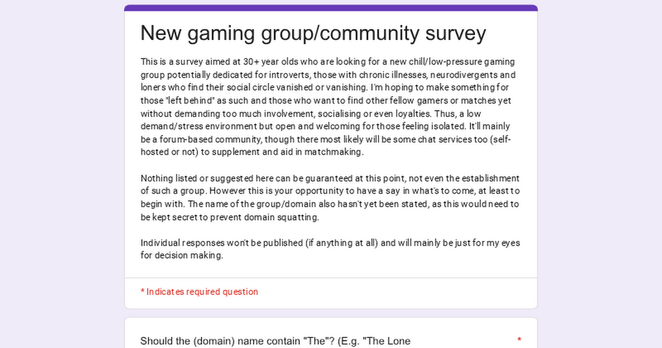
This is a survey aimed at 30+ year olds who are looking for a new chill/low-pressure gaming group potentially dedicated for introverts, those with chronic illnesses, neurodivergents and loners who find their social circle vanished or vanishing. I'm hoping to make something for those "left behind" as such and those who want to find other fellow gamers or matches yet without demanding too much involvement, socialising or even loyalties. Thus, a low demand/stress environment but open and welcoming for those feeling isolated. It'll mainly be a forum-based community, though there most likely will be some chat services too (self-hosted or not) to supplement and aid in matchmaking. Nothing listed or suggested here can be guaranteed at this point, not even the establishment of such a group. However this is your opportunity to have a say in what's to come, at least to begin with. The name of the group/domain also hasn't yet been stated, as this would need to be kept secret to prevent domain squatting. Individual responses won't be published (if anything at all) and will mainly be just for my eyes for decision making.
I'm still alive.
Still alive....
Still alive. 🍰
 Corey S Powell
You've probably heard that "we are stardust," but this graphic breaks it down further & tells you what kind of stars your dust came from--and which elements didn't come from stars at all.
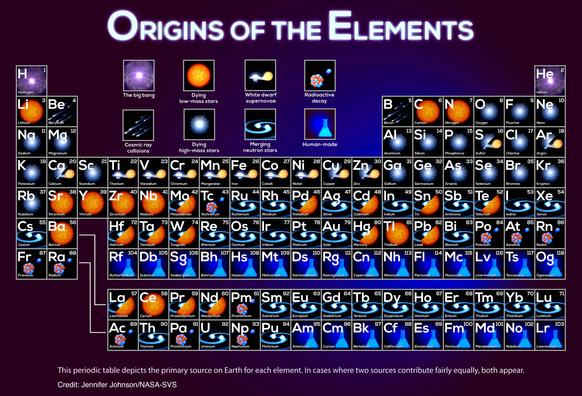

NASA Scientific Visualization Studio | Periodic Table of the Elements: Origins of the Elements
The periodic table organizes all the known elements by atomic number, which is the number of protons in each atom of the element. This version of the table, which draws on data compiled by astronomer Jennifer Johnson from Ohio State University, shows our current understanding of how each element found on Earth was originally produced. Most of them ultimately have cosmic origins. Some elements were created with the birth of the universe, while others were made during the lives or deaths of stars. The Nancy Grace Roman Space Telescope will help us understand the cosmic era when stars first began forming. The mission will help scientists learn more about how elements were created and distributed throughout galaxies.The related Tumblr post is here. ||
The BBC will have you believe your IP address can be deleted as well as stolen. Next they'll say it rotates depending on the direction of your device in order to "point" to it. 🙄
@nixCraft Odd, I found OVH dead easy, since 2019. I even pay only via PayPal. Each server took more than 120 seconds though. (I'm in the UK while renting a server in Canada.)
 David Bisset
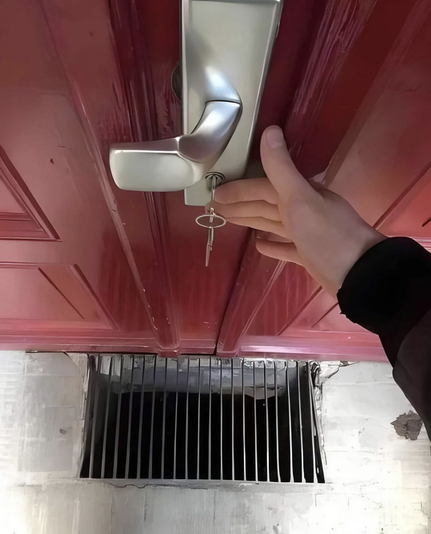
Designer: "Let's put the login button next to a delete button (that doesn't confirm)".
 nixCraft 🐧
Knock knock.
Who’s there?
SYN flood.
SYN flood who?
Knock knock.…
Who’s there?
SYN flood.
SYN flood who?
Knock knock.…
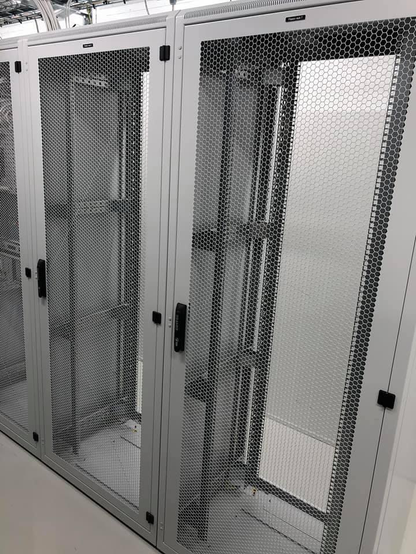
I think I found a serverless data center that developers use to create serverless apps 😂🧑🏻💻 I knew it. 😏