Daniel Heck

@Daniel_Heck
1,096 Followers
479 Following
212 Posts

Now published online in the Journal of Personality and Social Psychology 🥳

"Cheat, cheat, repeat: On the consistency of dishonest behavior in structurally comparable situations"

Journal: https://doi.org/10.1037/pspp0000540
Preprint: https://osf.io/preprints/psyarxiv/ntg6c

Happy to announce my new preprint with
@Daniel_Heck : Modeling Dependent Group Judgments: A Computational Model of Sequential Collaboration

The developed model is consistent with previous findings and we also confirmed new prediction from the model!

https://osf.io/preprints/psyarxiv/yqc3r

OSF

🚨 Vacancy for Lecturer in Cognitive Science and AI at @Radboud_uni

Deadline for application: 28 April

(Please RT 🔃 for wider reach 🙏)

https://www.ru.nl/en/working-at/job-opportunities/lecturer-in-cognitive-science-and-ai 1/n

(cc @olivia @johankwisthout)

Lecturer in Cognitive Science and AI | Radboud University

Working as a lecturer in Cognitive Science and AI at the Faculty of Science? Check our vacancy here!

an amazing story

https://www.theguardian.com/environment/2024/feb/22/i-discovered-a-way-to-identify-millions-of-species-on-earth-using-dna-barcoding-aoe?CMP=twt_a-environment_b-gdneco

I discovered a way to identify the millions of species on Earth after a lightbulb moment in the supermarket

I discovered a way to identify the millions of species on Earth after a lightbulb moment in the supermarket

I developed DNA barcoding in my back yard using a UV light and a white sheet to collect the moths of my childhood. I believe it could help discover all life on the planet

The Guardian

New paper by my PhD student Oliver Schmidt 🥳

The relevance of syntactic complexity for truth judgments: A registered report https://doi.org/10.1016/j.concog.2023.103623 (Open Access)

"As predicted by fluency theories, simple statements were more likely judged as true than complex ones, while this effect was small."

Most important learning this year:

I won't always be able to finish everything by the end of the day. It will feel shitty, but it is not the end of the world. It is a necessary evil of the type of work I do. I can be super organized and it will happen anyway.

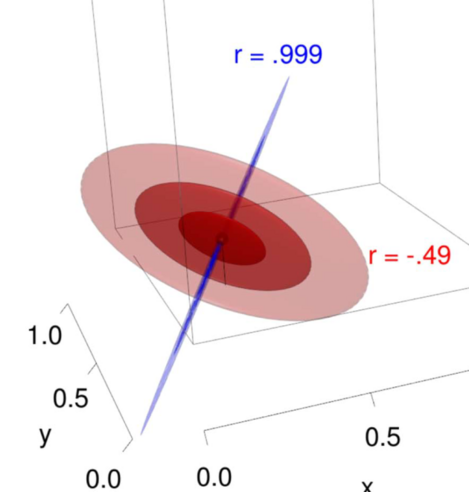
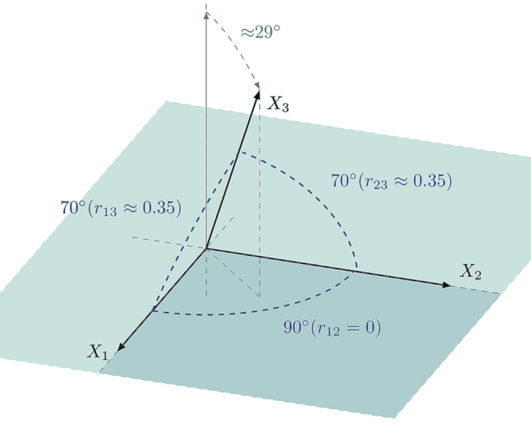
This reminds me of a paper of mine about the most extreme correlation matrices of individual (per-person) effect sizes that are mathematically possible: https://psyarxiv.com/ca8z4/

a) All correlations are as large as possible (1-factor model)

b) All correlations are as negative as possible (weird model)

Great paper: "Impossible Hypotheses & Effect-Size Limits"
https://journals.sagepub.com/doi/10.1177/25152459231197605

1) The correlation matrix of all population effect sizes must be positive definite.

2) Hence, there is a lower/upper limit to each effect size that is possible (even if we study only a subset of effects)

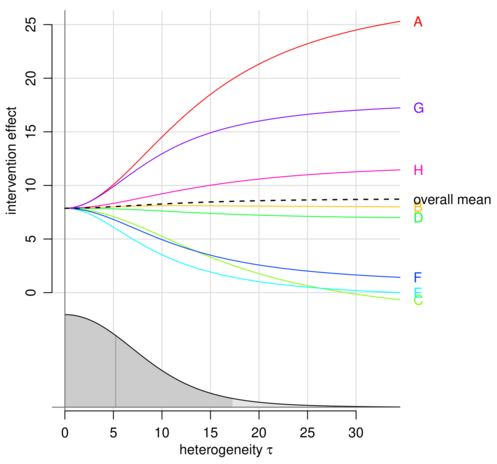
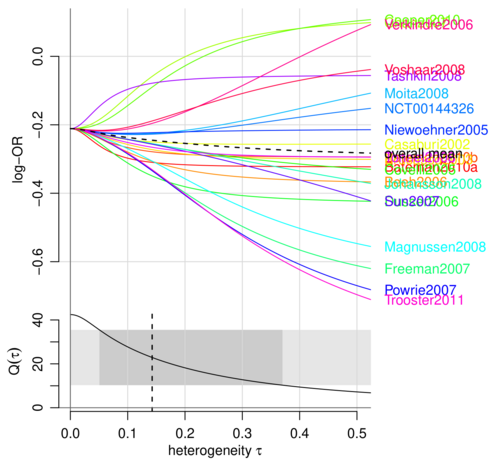
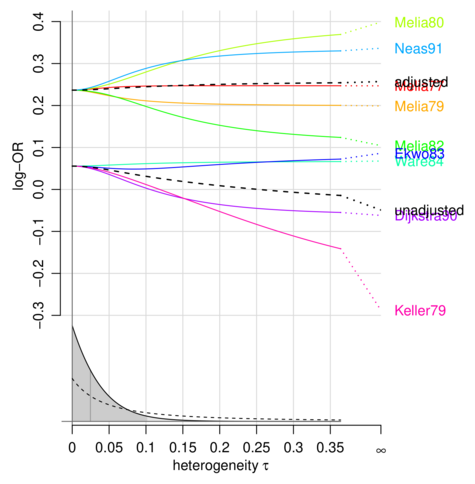
❓ Have you come across TRACE PLOTS for meta-analyses?
They have been around since the 1980s, and they can be quite useful for understanding/illustrating the inner workings of a (random-effects) meta-analysis.
Here's how they work:
➡️ https://arxiv.org/abs/2306.17043
(Joint work with David Rindskopf and @friede1)
#MetaAnalysis #MedStatGoe
How trace plots help interpret meta-analysis results

The trace plot is seldom used in meta-analysis, yet it is a very informative plot. In this article we define and illustrate what the trace plot is, and discuss why it is important. The Bayesian version of the plot combines the posterior density of tau, the between-study standard deviation, and the shrunken estimates of the study effects as a function of tau. With a small or moderate number of studies, tau is not estimated with much precision, and parameter estimates and shrunken study effect estimates can vary widely depending on the correct value of tau. The trace plot allows visualization of the sensitivity to tau along with a plot that shows which values of tau are plausible and which are implausible. A comparable frequentist or empirical Bayes version provides similar results. The concepts are illustrated using examples in meta-analysis and meta-regression; implementaton in R is facilitated in a Bayesian or frequentist framework using the bayesmeta and metafor packages, respectively.

arXiv.org

Want to learn about dynamic modeling for daily diary, experience sampling, ecological momentary assessment data?

Check out our e-learning course that starts in March 2024:
https://utrechtsummerschool.nl/courses/social-sciences/modelling-the-dynamics-of-intensive-longitudinal-data-online-course

Teachers: Ellen Hamaker, Laura Bringmann, Oisín Ryan, Rebecca Kuiper, Noémi Schuurman.

Modelling the Dynamics of Intensive Longitudinal Data (online course) | Utrecht Summer School

This online course covers how time series models can be used to model the dynamics of intensive longitudinal data (ILD).