This promises to be a fabulous workshop (hybrid) at Vanderbilt University where historians and other social scientists showcase their work on maps and mapping, some using computational tools.
If you want to attend the sessions, please fill this Registration form: https://forms.gle/95eeYrsffY3R1J2S6
Scan the QR code in the poster to get full details of the papers, schedules, etc.
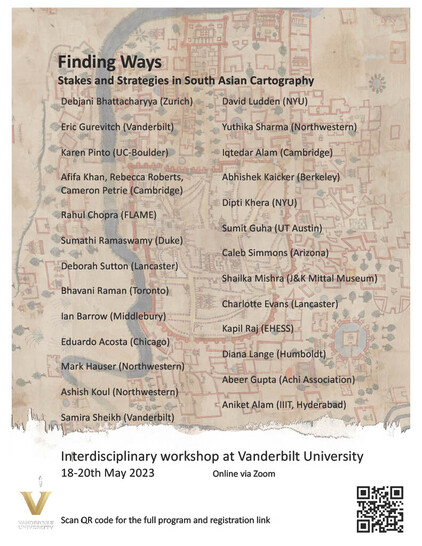

"Finding Ways: Stakes and Strategies in South Asian Cartography" Registration Link
The workshop will run from 8 AM - 12 AM CT (9 AM - 1PM ET/6:30 PM - 10:30 PM IST/2 PM - 6 PM GMT/3 PM - 7 PM CEST) from May 18th - May 20th. Please scroll down and add your name and affiliation. We will send you the Zoom link shortly before the workshop. Full Program (All times below are in local Nashville time (CT)) Thursday, 18th May 8-8:30 Introduction and welcome, Samira Sheikh 8:30-9:30 Maps and margins (Chair: Samira Sheikh) Debjani Bhattacharyya (University of Zurich) "Drawing Margins: Inscriptions, Sketches and Marginalia in Pattahs and Titles" Eric Gurevitch (Vanderbilt University) "Cosmograms, Centers of Calculation, and the Creation of the Many-Headed Knower: Maps in the Historiography of Science" Karen Pinto (University of Colorado, Boulder) “South Asian Connections with Islamicate Cartography 9:45-10:45 Access and heritage (Chair: Stacy Curry-Johnson) Afifa Khan, Rebecca Roberts, Cameron Petrie (University of Cambridge) “Introducing MAHSA: the Mapping Archaeological Heritage in South Asia project” Rahul Chopra (FLAME University) "Towards an open access platform of maps of India" 11-12 Digital experiments (Chair: Stacy Curry-Johnson) Sumathi Ramaswamy (Duke University) "Going Global in Mughal India" Deborah Sutton (Lancaster University) "(M)apping Strategies for Digital Heritage: The Safarnama App Framework" Friday, 19th May 8-9 Fluid boundaries (Chair: Calynn Dowler) Bhavani Raman (University of Toronto) and colleagues "Drawing the Language of the Sea: How Fisher Science Unsettles Weather Maps" Ian Barrow (Middlebury College) "Finding Time in Colonial-Era Maps of South Asia: Possibilities for Teaching and Research" Eduardo Acosta (University of Chicago) "Fluvial Temporalities: Thinking Time through Early Colonial Maps" 9:15-10:15 Envisioning the land (Chair: Daniel Genkins) Mark Hauser (Northwestern University) "A Tale of Two Maps: Colonial Cartography, the Archaeological Record, and Agrarian Transition” Ashish Koul (Northwestern University) "Reimagining a geography of conflict" David Ludden (New York University)"Mapping South Asia as Mobile Historical Space" 10:30-11:30 Representing Delhi (Chair: Bhavani Raman) Yuthika Sharma (Northwestern University) "Manuscripts to Maps: Cartography as a model of artistic change in eighteenth-century Mughal South Asia" Iqtedar Alam (University of Cambridge) "GIS-based Modelling of Shahjahanabad’s Hydrological Landscape: Challenges in Interpretation of Pre-Colonial Maps of Delhi (1750-1850)" Abhishek Kaicker (University of California, Berkeley) "A first look at the Delhi Canal map" 11:30-12 Discussion Saturday, 20th May 8-9 Space and place (Chair: Eric Gurevitch) Dipti Khera (New York University) "Drawing Together Maps and Moods: Localizations of Knowledge, Power, and Emotions, Udaipur, c. 1700" Sumit Guha (University of Texas, Austin) "Symbolic Geography, Pragmatic Geography and Visual Representation" Caleb Simmons (University of Arizona) “Territorial Dominion/Cartographic Dominance: Colonial Mapping and the Work of Creating Space and Making Place” 9:15-10:15 Coloniality and beyond (Chair, Aniket Alam) Shailka Mishra (Jagdish and Kamla Mittal Museum, Hyderabad) "Maps and Mapping in the Courts of Rajasthan: Production, Collection and Consumption" Charlotte Evans (Lancaster University) "Using the digital humanities to map water histories in the Kaveri catchment: methodologies and considerations" Kapil Raj (EHESS, Paris) " Epistemic Divides and the Faculty of Translation: Rendering Space Intelligible in 19th-Century South Asia" 10:30-11:30 Himalayan ways (Chair: Samira Sheikh) Diana Lange (Humboldt University) "Tibetan Mapping and the Mapping of Tibet" Abeer Gupta (Achi Association) “Global-digital cultural construction, agency, and the formal-informal archives of knowledge” Aniket Alam (IIIT, Hyderabad) "Mapping the Himalayas through Historical Texts: An NLP and GIS Approach" 11:30-12 Closing Discussion
 Charles Seife
 Sophie
 Bastian Allgeier
 Tim Chambers
 Erik Moeller
 Dan moved, see pinned toot
 meghnad
 Amrita Ghosh