Angerman 🦅

114 Followers
166 Following
55 Posts
Infosec enthousiast since 1999, Threat Intelligence & Hunting, Hacking, Sci-Fi, Astrophotographer (beginner), petrol head, husband, dad of 2, hybrid personality, little weird, loves life.

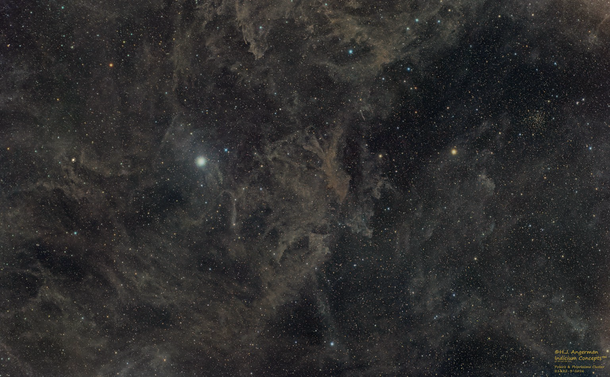
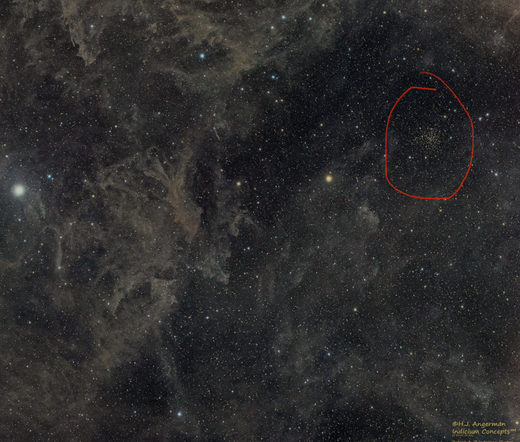
🔭 Hobby update! Polaris & NGC 188

Polaris: the North Star.

For centuries, the fixed point in the sky used for navigation. Reliable, constant… almost boring, until you look a bit deeper.

In the same field lies NGC 188, one of the oldest known open clusters in our galaxy (~6–7 billion years old), quietly orbiting the Milky Way while Polaris guided travelers on Earth.

But what makes this region really challenging is something far more subtle: IFN (Integrated Flux Nebula). The dust part.

This faint, dusty structure is not illuminated by nearby stars, but by the combined light of the entire Milky Way. It’s extremely dim, easily drowned by light pollution, and requires careful processing to even reveal.

A guiding star, an ancient cluster… and barely visible interstellar dust connecting it all. Insane, isn’t it?

Technically one of the more challenging fields I’ve captured; not because of complexity, but because of how little signal there actually is. And ok; framing and alinging, and keeping track is … complicated, if you know. You know. Aligning on Polaris is like aiming at a coin from tens of kilometers away; we do that before every shoot.

But there’s always more in the frame; if you push the data far enough and keep track on an asset that basically doesn’t move. 😬

Technical:
• Telescope: William Optics MiniCat 51
• Camera: ASI2600MC Pro
• Filter: Baader Sky & Moon 2”
• Mount: AM3

#astrophotography #astronomy #space #polaris #deepsky

Hobby update #part 2 - Thor’s Helmet 🔭

A recent astrophotography project: NGC 2359, better known as *Thor’s Helmet*, an emission nebula located in the constellation Canis Major, about 12,000 light-years from Earth and roughly 30 light-years across.

The nebula is shaped by the extreme stellar winds of the Wolf–Rayet star WR7 at its center. These rare, massive stars are incredibly hot and lose huge amounts of material through powerful winds. WR7 is believed to be in a relatively short-lived evolutionary phase before eventually ending its life as a supernova. 💥

The distinctive “helmet” shape forms where those winds collide with surrounding gas and a nearby molecular cloud, creating the curved bow-shock structures visible in the image.

*Imaging details*

• Telescope: ZWO FF80 APO
• Mount: ZWO AM5N
• Camera: ZWO ASI585MC-P (Gain 200)
• Filter: Altair Ha/OIII Dual 4nm
• Guiding: ZWO ASI220MM mini
• Control: ASIAir Pro

Captured on 8 March
Integration: 55 × 180s (2h45m)
Calibration: 15 Darks, Flats, Dark Flats
Processing: AstroPixelProcessor

Some frames were discarded due to satellite trails, trees entering the field of view, and a few tracking artefacts - a fairly typical part of deep-sky imaging sessions. 🥹

Enjoy 😊

#astrophotography #astronomy #deepsky #space #science #hobby

#hobby update post 🔭

Another recent hobby project I finally had some time to process. It’s been a while since my last; busy, no good conditions and some other stuff.

This is Jones-Emberson 1 (PK 164+31.1), also known as the Headphone Nebula. It’s a very faint planetary nebula in the constellation 🌌 Lynx, located about 1600 light-years away.

Planetary nebulae are the final stage of medium-mass stars like our Sun. The outer layers are expelled while the core collapses into a hot blue-white dwar, which in this case is an extremely faint 16.8 magnitude central star.

What makes this target interesting for astrophotography is its very low surface brightness. Even though the nebula spans a relatively large area of the sky, the emitted light is extremely faint, making it a challenging object to capture and process.

Always amazing to realize that the light captured here started its journey around the time the Roman Empire was still expanding. 🌌

#space #deepspace #astrophotography #nebula

#hobby update

Battling today’s challenges, whether is #greenland or #eu or #us or … list goes on. One needs a break.

Yeah; so, I like challenging stuff. It makes me tick. Some (not many 😅) have asked “how”, okay, so … nerd stuff (short; see comments for the full story and hi-res);

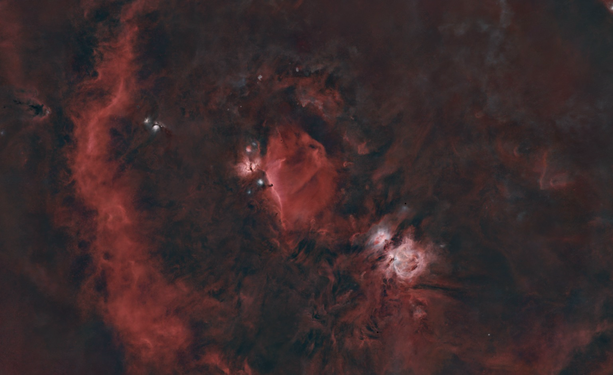
Today I had an intensive processing day working on my Orion mosaic with M42 and the Horsehead (B33). The main goal was to maintain maximum control over the dynamic range of M42, so that the Trapezium core would remain well preserved while still revealing the much fainter surrounding nebular structures.

For M42 I therefore deliberately went fully HDR. For Ha, OIII and Tri-RGB I used multiple exposure times and first combined them per channel, panel-locally, into HDR masters (HDRComposition). This resulted in three solid base images for M42: HDR Ha, HDR OIII and HDR RGB (64-bit), each with a large dynamic range and no clipping in the core.

The Horsehead panel was less critical in terms of dynamic range, but was built with the same care in Ha, OIII and RGB so that both panels would match well in content and appearance.

I then processed each panel completely separately in PixInsight. Both panels went individually through the full workflow:
In PixInsight, for all Ha/OIII/RGB data: BlurX, STF, StarX, Curves; and for the RGB set specifically: SPFC, MGC, SPCC, HDRMT and LHE, Curves, etc. (Yah; easy man)

After that, PixelMath was used (controlled blending of Ha and OIII into RGB), resulting in two fully finished RGBHOO panels, processed independently. After this, the stars were added back, the images were solved again, and finally GradientMergeMosaic was applied, followed by another ABE and the corrections that were needed.

With respect to PixelMath, I approached it as follows: processed, starless masters for Ha, OIII and RGB. From the RGB image, a Luminance image was extracted. The factor (1 − L) suppresses Ha/OIII in the bright core; this was also the reason for not using a simple MAX operation or similar when recombining the stars.

\(Red: $T[0] + M42_Ha * 0.6 * (1 - M42_B33_Mosaic_L) Green: $T[1] + M42_OIII * 0.22 * (1 - M42_B33_Mosaic_L) Blue: $T[2] + M42_OIII * 0.12 * (1 - M42_B33_Mosaic_L)

Once each panel was finished individually, the stars were added back and the panels were solved again.

By merging the two fully processed panels with GradientMergeMosaic, the HDR structure was much better preserved and the transition between M42 and B33 became clean and natural. Ha was suppressed again to some extent, but this was easily corrected with ABE (and can always be refined further…), followed by some S-curves mainly on red, which fortunately brought everything back in line with the individual panel result. The core of M42 is slightly less pronounced in the mosaic than in the standalone panel, but it looks natural and well balanced with the rest of the image.

Enjoy.

#astrophotography #space

Christmas and rosettes 🏵️
HaRGB only, no stars

#hobby update! (Again)

During the Xmas days skies were clear, automated shizzle was done. Magic happened.

I did several projects in tandem, this is the first to truly see edited fotons.

In the comments I’ll also post the framing and shoot on the Christmas Nebula, with rosettes 🏵️ nebula.

This one here is a 3 night special in hydrogen alpha (red) and combined with RGB data for the stars; that are heavily reduced for contrast on the nebula.

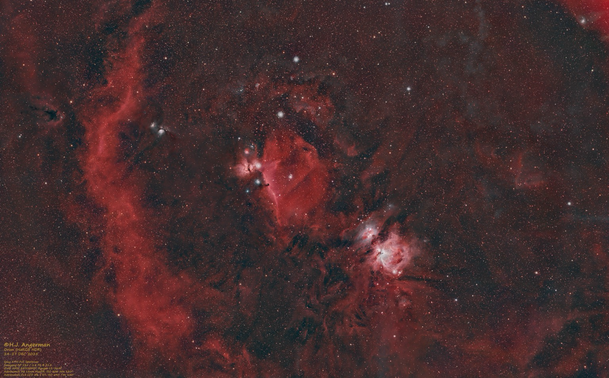
Orion is magic. It’s an object that can be seen with binoculars with the naked eye under darks skies (the #netherlands are proud (not) to be masters in sky and light pollution <-fact).

Anyway, Orion consists of M42, a bright nebula and the horse head nebula. On the left is Barnard's Loop.

The sheer violence of gasses, stars born and what not over several light years is amazing.

Shot with a full spectrum modified Sony A7III, Samyang 135mm f1.8 at f2.8. HDR session in Ha and RGB.

Enjoy. #space #astrophotography

First attempt on the “mineral moon” approach. About 50 2:40 video’s, 50% stacked in autostakkert4! (64 min stacked an joined in astrosurface). Post edit in pix and photoshop.

Redcat 61wfid, asi2600mc pro. Altair 3-rgb.

Enjoy. #moon #space #astrophotography

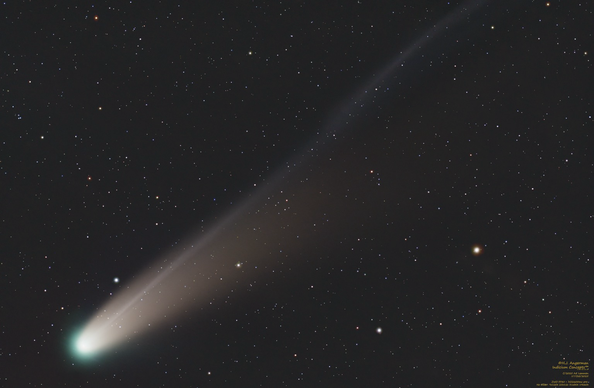
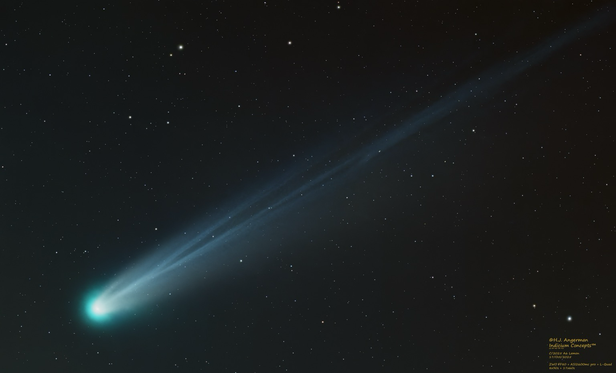
Another day, another ad-hoc shoot because no clouds all of the sudden. I did remind myself not to use a filter. No basic polar align, just using the eye. Aaand; got lucky again:

Yesss, onto it! Running, flying, and blood, sweat, and tears. Long story; the weather isn't really cooperating. So shot during a very narrow timeframe.

C/2025 A6 (Lemmon) is a non-periodic comet discovered by the Mount Lemmon Survey in images obtained on January 3, 2025. It has an inbound orbital period of about 1,350 years.

So, the next chance is around 3175. So, let's be nice & healthy for our planet 🌍, then it should be doable. Incidentally, it can still be seen this week, in the northwest in the evening and the northeast in the morning.

Enjoy 😉 #comet #astrophotography #space #solarsystem #c2025a6 #c2025a6lemmon