@APC

1.3K Followers
341 Following
1.6K Posts
The Association for Progressive Communications is a worldwide network supporting the use of internet and ICTs for social justice and sustainable development.
APC websitehttps://www.apc.org/

Connectivity is more than access. In #Kenya, communities are using community-owned infrastructure to support climate resilience, environmental monitoring and local knowledge sharing.

Read the story: https://www.apc.org/en/blog/how-kenyan-communities-are-shaping-connectivity-environmental-resilience

LocNet-supported initiatives demonstrate how community-centred connectivity can help communities generate and use hyperlocal data, strengthen digital sovereignty, and build resilience.

#CommunityNetworks #DigitalSovereignty #ClimateJustice #EnvironmentalJustice

How Kenyan communities are shaping connectivity for environmental resilience

With current technological shifts and a deepening climate crisis, the concept of community-centred connectivity is a vital form of grassroots community ownership of tech. At its core, a community-centred connectivity initiative (CCCI) is where local people – rather than large commercial providers – build, own and maintain their own digital infrastructure to meet their specific needs. By taking control of the technology, these communities are not just going  online, but they are also securing their survival in an increasingly volatile environment, and doing so in their context and urgency. The intersection of climate justice and community-centred connectivity decentralises digital infrastructure and empowers communities to gather the hyperlocal data necessary to anticipate climate shocks, thereby transforming passive connectivity into active, community-led resilience. This approach treats digital access not as a luxury, but as a tool for environmental self-determination.To support this, the Local Networks initiative (LocNet), a collaboration between the Association for Progressive Communications (APC) and Rhizomatica, has been instrumental in fostering digital autonomy. In line with LocNet’s strategic plan across various regions and countries, microgrants are offered to address urgent community needs. This includes a catalytic initiative designed to provide small, strategic funding to CCCIs for the 2025-’26 grant cycle in Kenya. These catalytic grants are specifically tailored for grassroots groups that have deep community roots but require the resources to bridge the gap between simple internet access and impactful, technology-driven climate action. This year, four Kenyan organisations were selected to work in environment resilience and climate justice with digital connectivity as an enabler. These groups demonstrate that when you place the tools of technology into the hands of local stewards, the impact is profound.Why focus on climate justice?For many communities, the climate crisis is not a distant dystopia: it is a daily reality. From unpredictable rainfall patterns disrupting agriculture to coastal degradation affecting traditional livelihoods, the environment, which is the bedrock of local existence, is undergoing profound change. Climate justice acknowledges that those who have contributed the least to the global climate crisis often bear the brunt of its most severe consequences. Focusing on the intersection of climate and connectivity is essential, and without access to real-time information, early-warning systems or tools, marginalised populations are left exposed to environmental shocks. By integrating climate action into community networks, these initiatives address systemic inequalities, ensuring that the transition to a sustainable future is equitable. Technology becomes more than just a convenience; it becomes a tool for justice that amplifies local voices, protects natural resources and builds the resilience necessary to adapt to a changing planet. The five initiatives supported this year demonstrate this in practice. Operating in an area prone to floods, the team from Digital Rurals developed an AI-powered prediction and alert platform in Mavoko, working with local residents who are often the first to experience the impact of extreme weather. Through community co-design workshops, they mapped flood zones and drainage issues while validating platform features with local volunteers. The resulting multi-channel system uses SMS and WhatsApp and is now scaling through an MoU (memorandum of understanding) with the Kenya Meteorological Department (Kenya MET) to integrate hyperlocalised data into national early warning systems. To maintain accuracy, they employ community champions and an admin dashboard to validate reports and prevent false alerts.In Ugunja, Kijiji Yeetu is serving communities disproportionately affected by mining and poor waste management, through environmental transparency. Their Mtandao Hewani project consists of an IoT (Internet of Things) sensor. Central to this project are net wardens spread across villages, who drive digital literacy and help residents use mobile phones as instruments of civic power. They also published a technical brief on their process for other networks to learn from. Kijiji Yeetu's technical brief, developed to share its learnings with other community networks. Bahari CBO is a women-led initiative works in coastal regions where seaweed farming is a primary livelihood. Because seaweed is sensitive to fluctuating water temperatures, the project deployed sensors to track sea temperatures. This helps women avoid time poverty, a condition where environmental uncertainty forces them to spend excessive time checking on the state of the seaweed. This allows them to reclaim their valuable time for other purposes. They have since presented a policy brief to the Kenyan Ministry of Fish and Blue Economy with hopes of turning this data into bankable information.Athi Community Network in Igembe South, Meru, is bridging the information poverty gap. Using low-power Raspberry Pi servers, they host an offline-first library of climate-smart agricultural information available in the local Kimeru language. This allows farmers to access credible, high-bandwidth climate information without incurring heavy internet costs, effectively serving as an information hub for rural resilience. AthiCN developed a climate-resilience information database that delivers climate and resilience information in the Kimeru language. Photo: AthiCN The role of technical accompanimentA challenge for many community groups is the gap between vision and execution. While they possess the knowledge and the drive to solve pressing problems, the technical expertise gap often hinders effective execution to turn those ideas into functioning systems. By offering mentorship, technical training and collaborative space, these grants empower organisations to move beyond the traditional tech-for-tech's sake approach, ensuring their work is sustainable, locally owned, and ready for long-term policy integration. This year's microgrant took an approach that allowed pre-learning, accompaniment through mentorship, and a post-grant showcase and learning event. All the four grantees received technical support from Wireless Planet, including training on IoT and sensor systems. Simultaneously, Kungu Labs led them through a training on human-centred design (HCD) at the very inception, ensuring the technology was co-designed with local communities to address real-world vulnerabilities like flooding and time poverty. Wireless Planet acted as the technical mentor for all the grantees. Their involvement went far beyond equipment deployment; they provided training on IoT systems and sensor technology, demystifying hardware for the community teams. Wireless Planet conducted on-site visits to each implementation site. This hands-on mentorship allowed them to provide personalised guidance, troubleshoot physical infrastructure challenges in real time, and tailor technical solutions to the unique geography and needs of each community. By meeting the grantees where they were, Wireless Planet turned intimidating technical hurdles into manageable steps, proving that for community-centred projects to thrive, they must be supported by a bridge between grassroots wisdom and expert engineering. Wireless Planet led a technical capacity-building session focused on leveraging the Internet of Things and Artificial Intelligence for climate resilience and environmental justice. Photo: Wireless Planet By working with technical experts like Wireless Planet and design mentors at Kungu Labs, these grantees proved that climate justice is inherently linked to how we build our digital infrastructure.Blueprint for community-centred connectivity and environmental resilienceThroughout these projects, we learned that technology is only as effective as the community it serves. We learned that climate justice from a CCCI lens provides hyperlocal data that national systems often overlook. Digital Rurals showed us that sensors coupled with citizen science can provide information needed to save property and lives. We also learned that connectivity is a vital tool for gender equity; by monitoring water temperatures, Bahari CBO demonstrated that data can directly combat the time tax that climate change imposes on women. Kungu Labs’ human-centred approach is built on two core pillars: storytelling and ethnography, and participatory design. Photo: Kungu Labs True digital sovereignty means ensuring technology amplifies, rather than replaces, Indigenous knowledge. By hosting content in Kimeru, Athi CN proved that language and culture are central to technical adoption. Perhaps most importantly, we learned that the most innovative technology is useless if it is not designed with the user in mind. Through the HCD approach led by Kungu Labs, the grantees factored in the trap of digital exclusion at the very onset of their plans, ensuring that their systems worked for everyone, regardless of their level of digital literacy.Finally, these projects taught us the power of bankable data. By presenting their findings to government bodies like the  Ministry of Fish and Blue Economy and signing MoUs with the Kenya Meteorological Department, these community-led initiatives transitioned from experiments to legitimate, trusted sources of truth that can now influence national infrastructure funding and climate insurance policies.The road aheadThis initiative has provided a blueprint for how community-centred connectivity can serve as the backbone for environmental resilience. But this is just the beginning. The success of these microgrants has already sparked interest in further cycles, with plans to expand the scope and connect these local networks into a broader use of the date to influence climate action. As these organisations continue to refine their models, they are proving that communities have the knowledge and context, and understand the urgency needed to build the foundation for a more resilient, equitable future.Rebecca Ryakitimbo is a feminist technologist and researcher working at the intersection of AI, gender justice and digital equity. She supports feminist tech spaces such as the African Women School of AI, and curates the Gendering AI conference. As part of the Local Networks (LocNet) initiative, she supports community-centred connectivity initiatives by facilitating communities of practice and researching community-centred connectivity and local services for equitable, locally led digital ecosystems.

Association for Progressive Communications

As DRAPAC26 concludes, our latest Seeding Change story by @APC and @EngageMedia looks back at DRAPAC25 and the role of communities of practice in strengthening digital rights movements across Asia-Pacific.

📖 Read the story: https://www.apc.org/en/blog/seeding-change-building-collective-power-digital-rights-across-asia-pacific

From fostering new connections to building collective responses to shared challenges, the Assembly shows how collaboration and solidarity help sustain movements over time.

#DRAPAC #DigitalRights #InternetGovernance

Seeding change: Building collective power for digital rights across Asia-Pacific

How do we build collective understanding of rights-respecting technologies in a way that drives change and strengthens digital rights movements? It requires more than technical expertise or isolated acts of advocacy. Meaningful and sustainable change calls for communities of practice, which means spaces where activists, technologists, researchers and policy makers can come together to understand shared challenges, exchange knowledge and imagine different futures. This was precisely the motivation behind the Digital Rights Asia-Pacific Assembly, which has been held annually since 2023.With increasingly complex digital rights environments and contexts, DRAPAC provides a consistent space where challenges can be discussed collectively and where frameworks can be developed through regional cooperation. “The DRAPAC Assemblies have primarily been a space for human rights defenders working in the Asia-Pacific to work on collaborative, co-created solutions to shared digital rights challenges in the region,” explains Sara Pacia, Digital Rights Asia-Pacific (DRAPAC) Project Lead at EngageMedia.As DRAPAC26 draws to a close in Manila (Philippines), bringing together more than 500 digital rights activists, policymakers and academics from across the region, a look back at the event's previous edition with APC member EngageMedia highlights how this is an ongoing learning process. Creating spaces for collective learning and actionOganised by EngageMedia together with Architects of Diversity, the Centre for Independent Journalism, the Initiative to Promote Tolerance and Prevent Violence, and Sinar Project, with the support of APC, the 2025 Digital Rights Asia-Pacific Assembly (DRAPAC25) brought together hundreds of participants in Kuala Lumpur, Malaysia. The three-day gathering reflected the growing urgency and complexity of digital rights work across Asia-Pacific. Topics of note included governance of artificial intelligence, platform accountability, digital security and movement sustainability.For the APC network, DRAPAC has become an important gathering each year to strengthen connections across the region. APC and its members contributed to 20 sessions during DRAPAC25, sharing experiences and approaches while learning from the many communities working at the intersection of technology and social justice. The value of the network extends beyond financial support and includes “expertise and willingness to collaborate and co-create,” affirms Pacia. “The APC network members have always been generous in sharing their work and their time with DRAPAC's attendees, and this continued engagement (especially with advocates and attendees newer to digital rights advocacy) is so important in strengthening and expanding the movement.” This high level of engagement was mirrored in the newly concluded 2026 edition.Growing a diverse, intergenerational movementA central feature of DRAPAC25 was the commitment to expanding participation within the digital rights movement. While the Assembly remains a gathering for human rights defenders working on digital issues, organisers have increasingly sought to welcome participants whose work intersects with technology in different ways. This included journalists, environmental advocates, labour organisers, technologists, policy makers and younger advocates entering the field. Of the 531 people who attended in person, 162 were aged 30 or under, representing a significant increase compared to the previous year. “In our efforts to expand the digital rights movement, we also have made concerted efforts to ensure that younger advocates are supported to attend the event,” remarks Pacia. Participants engage with a booth between sessions. Photo: EngageMedia This focus on intergenerational exchange is important for a movement facing rapidly evolving challenges and shrinking spaces. New technologies often emerge faster than policies can respond to them. Bringing diverse perspectives together helps build stronger and more resilient approaches. The Assembly also prioritised inclusion in programme design. Session proposals were determined based on relevance, diversity, uniqueness and regional importance, with organisers explicitly avoiding all-male panels and encouraging younger representatives to participate as speakers, facilitators and moderators.The organisers also continued exploring hybrid participation models. While technical challenges affected livestreaming during the first day, the team adapted by moving to alternative platforms for later sessions. These experiences highlighted the ongoing importance of committing to accessible and open technologies for large-scale gatherings. As an organisation committed to the use of free and open source technologies, EngageMedia continues to prioritise these approaches while recognising the challenges involved in creating inclusive spaces on a regional level. Learning, adapting and improving togetherDRAPAC25 hosted more than 100 activities. One key area of discussion revolved around the governance of artificial intelligence. As governments across Asia-Pacific develop policies and frameworks around AI, civil society participation is essential to ensure that these approaches are grounded in human rights and public interest principles.DRAPAC25 included a half-day consultation with Malaysia’s National AI Office, creating an opportunity for civil society actors to bring their perspectives into national AI governance conversations. “Malaysia is the second country [along with Indonesia] where we conducted capacity-building training on AI governance for national civil society organisations (CSOs) and supported their interface with the government,” notes Pacia. While the consultation was one part of a broader capacity-building effort, it represented an important step in strengthening connections between digital rights advocates and policy makers. The aim is to respond to technological developments but also to ensure that communities affected by digital policies have a meaningful role in shaping them.Building lasting relationshipsWhile panels and workshops were crucial elements throughout the event, many meaningful outcomes happened through informal conversations and relationships built between participants. A connections map developed during DRAPAC25 documented nearly 100 new connections across more than 130 organisations from almost 25 countries. These relationships focused on shared challenges, including freedom of expression, surveillance, accountability, AI governance, feminist approaches to technology, and digital security. The DRAPAC25 connections map is showcased to participants. Photo: EngageMedia For many participants, the Assembly became a place to share ideas and identify opportunities for collective action. Some of the dialogues explored alternatives to big tech models, including discussions around the Fediverse, privacy-respecting tools and community-led approaches to connectivity.This emphasis on relationship-building reflects a broader understanding of the importance of strengthening a movement. It highlights that change does not happen only through campaigns and policies; it grows through solidarity and the ability of actors across different contexts to recognise shared struggles.Sustaining the future of digital rights organisingThis spirit of collaboration is at the heart of DRAPAC. Rather than treating digital rights as a siloed field, the Assembly recognises that technology is connected to wider struggles for equality, environmental justice, labour rights, gender justice and civil society engagement.Its importance lies not only in the conversations that happen during the Assembly itself, but in the collaborations and shared commitments that continue afterwards. Many of these have been documented in the DRAPAC25 public report released by EngageMedia in November 2025. And with the latest edition of DRAPAC wrapping up this week, many of the lessons learned have been applied and the APC network has continued to demonstrate its commitment to engagement around emerging technologies and governance. More than ever, we see that shrinking civic spaces, as we saw with the cancellation of the 2026 RightsCon summit, pose a grave challenge to the work of civil society oragnisations. This is precisely why DRAPAC is a critical and much-needed forum for ensuring that digital technologies are shaped by the communities they affect.This piece is a version of the information provided by EngageMedia as part of the project “2025 Digital Rights Asia-Pacific Assembly”, implemented with the support of a grant from APC and adapted for the “Seeding change” column.Did this story inspire you to plant seeds of change in your community? Share your story with us at: [email protected] 

Association for Progressive Communications

More than 100 organisations, including @APC, and numerous individuals have signed a joint statement calling for an end to the use of #AI systems in military kill chains.

📃 Read the statement: https://www.apc.org/en/pubs/joint-statement-ai-accelerated-warfare-must-stop

The statement urges tech companies and states to halt the provision and use of AI systems in military kill chains, warning that these technologies risk undermining accountability and facilitating violations of #HumanRights and #InternationalHumanitarianLaw.

Joint statement: AI-accelerated warfare must stop

We, the undersigned organizations and individuals, are deeply alarmed by the rapid militarization of artificial intelligence (AI) technologies. AI systems embedded into military kill chains are accelerating the speed and scale of military assaults in a manner that creates significant new risks for accountability in conflict and risks facilitating violations of international criminal, human rights, and humanitarian law.

Association for Progressive Communications

RE: https://mastodon.social/@APC/116725682837379469

As climate impacts intensify, communities need more than infrastructure. They need connectivity that is locally owned, resilient and responsive to local realities.

Join us tomorrow for a webinar in exploring how community networks can advance #ClimateJustice

📅 17 June 2026
⏰ 14:00 UTC
🔗 https://s.apc.org/TechTogetherWebinar-register

🌐 What does a #FreeInternet look like in practice?

@APC's “Building a Free Internet of the Future” brings together conversations with people and communities creating technologies grounded in accessibility, privacy, inclusion and human rights.

📖 https://www.apc.org/en/pubs/building-free-internet-future

These stories explore practical alternatives to dominant digital models and the political choices behind the technologies we use every day.

Building a free internet of the future

This series focuses on the experiences and perspectives of individuals and communities who are often absent from dominant technological narratives.

Association for Progressive Communications

🌱 What role can #CommunityNetworks play in advancing #ClimateJustice?

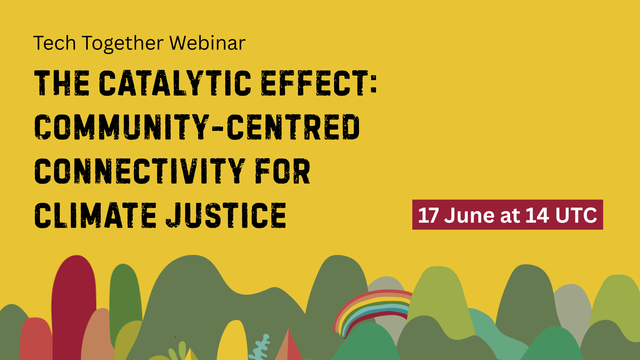
Join us for "The Catalytic Effect: Community-Centred Connectivity for Climate Justice," a Tech Together #webinar exploring how community-led connectivity can strengthen resilience, support environmental stewardship and contribute to more equitable futures.

🔗 Find out more and register: https://s.apc.org/TechTogetherWebinar-register

📅 17 June 2026 • ⏰ 14:00 UTC

📢 Deadline extended to 12 June!

How can community networks challenge extractive AI narratives and build sovereign digital futures?

🔗 https://www.apc.org/en/news/call-contributions-ccci-ai-anthology-challenging-extractive-ai-through-community-centred

We’re looking for reflections, case studies and visual stories from communities advancing digital sovereignty, environmental justice and community centred approaches to AI.

APC and our network are at #DRAPAC26 this week in Manila, joining activists, researchers, technologists and advocates from across the Asia Pacific region. APC staff, members and partners will be contributing to discussions on AI, digital rights, internet governance, accessibility, digital security and community networks.

See where to find us throughout the programme: https://www.apc.org/en/news/apc-drapac-2026

If you're attending DRAPAC26, come say hi 👋

APC at DRAPAC 2026

The Digital Rights Asia-Pacific Assembly (DRAPAC) is gearing up for its 2026 edition, this year taking place in Manila, Philippines, from 8 to 10 June.

Association for Progressive Communications

How can community networks challenge extractive AI narratives and build sovereign digital futures?

The call for contributions for our CCCI-AI Anthology is now launched, seeking reflections, raw case studies, and compelling visual stories from the frontlines of digital sovereignty.

Get the details on themes, deadlines and formats here 👉https://www.apc.org/en/news/call-contributions-ccci-ai-anthology-challenging-extractive-ai-through-community-centred

Submit your pitch by June 8.

What unique perspective from your community are you most excited to see featured in this anthology?

RightsCon's cancellation was more than the loss of a conference.

Explore reflections from across the APC network: https://www.apc.org/en/news/rebuilding-solidarity-and-trust-apc-community-reflects-cancellation-rightscon-and-learnings

From trust and solidarity to civic space and collective action, APC members, staff and partners share lessons from a moment that continues to resonate across digital rights movements worldwide.

Rebuilding solidarity and trust: The APC community reflects on the cancellation of RightsCon and learnings moving forward

The shock of the cancellation of RightsCon in Zambia this year is still reverberating across civil society, with many viewing it as unprecedented. In this piece, voices from APC’s community around the world explore the implications of this shift, examining how we can safeguard our spaces for organising in the current climate.

Association for Progressive Communications