 Le Daron
 Gabriele Svelto
I have never seen a graph explain more clearly what's going and why it's completely unsustainable (and this is just cash-flow, it doesn't take into account the rapidly climbing debt!).
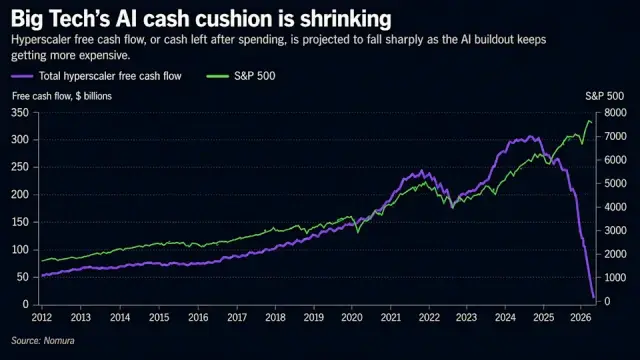
I have never seen a graph explain more clearly what's going and why it's completely unsustainable (and this is just cash-flow, it doesn't take into account the rapidly climbing debt!).
@gabrielesvelto i dropped out of economics, so am not quite versed on the nitty gritty academic aspects of the field, so gotta ask:
has there ever been a time in history when a few companies trapped themselves into an incestuous cycle of investments?
what’s happening around NVidia and the slopware bros is eyebrow raising, especially since there isn't really any cash or even assets transferring hands. it’s basically promisory notes that make it look like they’re making money.
just wondering.
Huh, interesting question.
First thought was the East India Company, but that one was highly extractive, but still tended to follow "normal" commerce (they paid on contracts for things like ships and some goods without needing those companies to buy from them). In some respects, NVidia is also acting like a monopsony, since it's pretty much the sole provider of the GPUs being used by AI centers, with the rest of the high purchases (memory, disk, etc) being tack-on to that.
The thing that is really weird is that NVidia is essentially funding their customers to establish it's own market, and I'm hard pressed to come up with an example of any other market doing that. Even some of the most egregious self constructed monopsony markets (Standard oil) actually produced something of value outside of it's own market, which lead to it self-maintaining.
( granted, I'm an amateur history buff, so I expect someone actually versed in this to have a better answer )
@jrconlin @blogdiva @gabrielesvelto Also an amateur looking for a similar answer, the closest I've got and the thing I keep coming back to is the radio boom of the 1920s.
(I'm also not the only one: https://finance.yahoo.com/news/big-short-investor-michael-burry-223042880.html )
It's not a great match, but it's ... got commonalities, particularly in the mass buildout that never paid RCA shareholders back.
The collapse of that bubble didn't cause the great depression by itself, but it sure didn't help.
Maybe the bubble is starting to deflate, at last? 🙂
@ayl @glc @simonzerafa @gabrielesvelto that's why Elon Musk rushed the SpaceX IPO and why it is being fast-tracked into the Russell and Nasdaq indexes, so the people left holding the bag are working class folks in the form of their retirement accounts.
It's an unprecedented transfer of wealth from the working class to a handful of billionaires.
@gabrielesvelto hey, true, apparently google took on a lot of debt this year, if i didnt fuck up that research somehow.
No wonder their stock is selling off a bit, not a good look
@gabrielesvelto
The debt thing is not true for all mag7 or wannabe ai players tho
(Edit: to be clear, consensus seems to be that spacexai is a scam/rugpull, while openai and cohorts are junk, financially speaking. Antropic had one good massive earning, dubious how the next one will go. The mag7s are massively exposed to this but at least they are burning cash they actually earn and have)
Yesterday, the Wall Street Journal ran a story about how Anthropic is “about to have its first profitable quarter,” specifically an operating profit, or EBITDA profitability: Anthropic’s revenue is set to more than double to $10.9 billion in the second quarter, an explosive rate of growth that will
To cite EVE Online film "Clear Skies":
"Our problem is cash flow. We have no cash, thus no flow."
That purple line, remaining breathable air
looks like you can fool people twice and that's it
@gabrielesvelto That will go well, I'm sure.
Sigh.
@gabrielesvelto This looks like a pretty expected graph for startups to me. Holding cash is expensive, and a startup typically believes - rightly or wrongly - that they can buy revenue with it, and by extension a higher valuation. You'd expect cash to drop dramatically when they think raising more is expensive at their current valuation vs future.
Now, of course you'd *also* expect it if they're struggling to raise and struggling to reach profit.
But you can't tell from free cash flow alone.
@gabrielesvelto Put another way, when I worked at a VC, our modelling indicated that it'd be near optimal for a startup to almost run out of cash every 12-18 months, as long as you had reasons to be confident your valuation was going in the right direction - short cycles of nearly running out of cash correlated with higher returns.
Of course, it also correlates with risk, so it's not that none of these companies will fail - odds are many will.
@gabrielesvelto Low cash on hand != zero cash flow. None of these have zero cash flow, and you *want* debt to increase if you have good reason to think you can buy more cashflow with the money than it costs to service the debt - that motivated my startup comparison.
Debt to equity is meaningless unless you expect the company to fail.
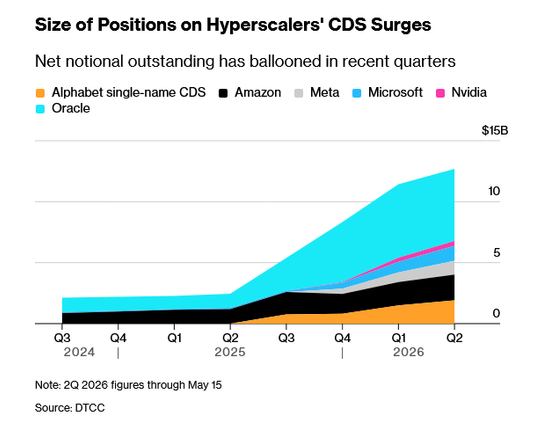
Oracle has a *market cap* of $446bn, or ~3x their debt, and costs of maintaining their debt equivalent to ~20%-25% of operating income. They are not at riskl.
@vidar I don't expect Oracle to fail but my opinion isn't worth much and CDS tell a different story
@gabrielesvelto The bubble is starting to burst at this point. As soon as the VCs get off the hype train, stop flushing money down the toilet, and do the 3rd grade math required to figure out this is all 100% unsustainable, things are going to come crashing down.

An anonymous reader quotes a report from The Guardian: A tech sell-off shook global markets on Tuesday as attention turned away from developments in the US war with Iran and toward the future of AI companies and chipmakers that have driven stock markets to record highs. The tech-heavy Nasdaq index c...
 your auntifa liza 🇵🇷 🦛 🦦
 Jay
Jay j-r conlin
 Solarbird
 Simon Zerafa
 GLC
GLC an actual bus
 🐡🏳️🌈
🐡🏳️🌈 Joe Cooper 🇺🇦 🍉
 cognitively accessible math
 datarama
 domi
domi Claudius
 Ryek Darkener
 Return of Aadmaa
 Everyday.Human Derek
 diana 🏳️⚧️🦋🌱
 Darwin Woodka
 matt [newly self-hosted]
 Florian 'floe' Echtler
 Bruce Elrick
 Hyblon
 Vidar Hokstad / Galaxy Bound
 Weltzeitgeist
 bit
bit Jay Deiman
 debn
debn