
A LOT OF TALK THIS MORNING about calls to "reform" #SCotUS.

Both Rep. Ro Khanna on #FnS and Sen. Corey Booker on #MtP called for "expanding the court" & "term limits" (Khanna went even further, limiting every prez to "2 appointments"… leaving a vacancy to the next prez if they already got their two.) 🤦‍♂️ 😒

NO NO NO NO.

There IS a way to reform the court w/o resorting to likely unconstitutional modifications sure to be challenged by the #GOP:
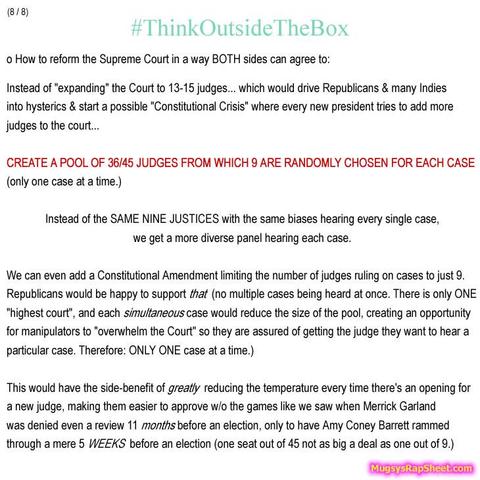

#ThinkOutsideTheBox

@MugsysRapSheet

But this is still expanding the Court.

In any case, critically, this undermines one of the major roles of the Supreme Court: predictability.

If the random choice would change outcomes (or else why do it?) then the legal system would lose determinism that it relies on.

The justices of the court try to present coherent philosophies to guide the US legal system. This undermines that.

Really, the low hanging fruit of Court reform involves its interaction with the public since so many are completely wrong about what they actually rule. That's the first thing they need to address or else politicians will continue exploiting misunderstandings for political gain.

#SCOTUS #USPolitics

@volkris
I fully dispute "predictability" is an asset or exists at all.

If the outcome is "predictable", why bother having a #SCotUS at all? And a Justice suddenly passing away or resigning at any time is quite unpredictable.

Older Justices resigning just before a preferred Potus leaves office just to give them a seat to fill for the next 40 years is "manipulation". And what the #GOP did to #MarrickGarland vs #AmyComeyBryant was nothing short of "gaming" the Court.

Randomization would HELP.

@MugsysRapSheet

There are a few reasons to have a Supreme Court.

One huge job of the SCOTUS that dovetails here is to be a practical manager. Even when judicial outcomes are predictable there still has to be someone to design the literal and figurative paperwork for lower courts.

Even as the Court issues rulings, how do lower courts actually implement them? Someone has to design the procedures, and that's what SCOTUS does.

Your question of why bother having one is a great question, one that far too many misunderstand even as they promote bad ideas about how to change the institution they know far too little about.

@volkris
I didn't argue in favor of "not" having a SCotUS.

I was making the point that if your argument for restricting which judges rule on every case is b/c you know how they'll vote in advance on every issue, you render the point of even HAVING a court moot.

@MugsysRapSheet

Even if that was my argument, which it's not, it doesn't follow that having a Court is moot. The practical aspects of having a Court--the administrative and formal elements--are, again, a huge part of the Court that is too often overlooked or misunderstood.

Even if a ball is clearly fair and will be called fair there still must be an umpire to make the call.

That's why we have a Supreme Court.

@volkris

I didn't say "having a High Court is moot". I said if the outcome was predictable, it WOULD BE moot/pointless.

But I understand what you are saying. You'd still need that "rubber stamp" of confirmation.

...but in the end, that's all it would be: a rubber stamp.

Rubber stamps are not conducive to a democracy. That's how we got #JimCrow in the early 1900's (and how we are seeing #JimCrow2.0 under T****.)