
🏷️ AI content is getting labels.

Just like energy ratings or safety certifications help you make informed choices, the same logic now applies to AI.

From 2 August 2026, the AI Act will require clear labelling in key cases:
🔹 Deepfakes
🔹 AI-generated or manipulated content
🔹 Interactions with chatbots and AI systems

You have the right to know whether what you see, hear or read has been made or altered by AI 🤖
👉 https://link.europa.eu/jrcdgq

@EUCommission how is this enforced?
@jansteen @EUCommission by requiring back door to each messenger so that uncle dieter won’t share his ai images anymore.
@_holger
seems conspiracy nonsens.
this will probably be 'enforced' by reporting, checks, penalties.
@jansteen @EUCommission
@jansteen @EUCommission it almost sounds like this code is opt-in.

@placebo @jansteen @EUCommission

Today, the code is opt-in. Come August, the legal requirements are obligated.

https://mastodon.online/@davidaugust/116796793417245817

David August ❌👑 (@[email protected])

@[email protected] @[email protected] @[email protected] nope, useful to read further: “These transparency obligations, applicable from 2 August 2026…Even though adherence to the code is voluntary, the transparency requirements under article 50 of the AI Act are legal obligations…it provides an EU-wide recognised practical framework for signatories to demonstrate compliance with those obligations.” Opt-in now to get ready to show compliance in August.

Mastodon
@jansteen @EUCommission From the link: "Today, the European Commission published the final Code of Practice on marking and labelling of AI-generated content. The Code is voluntary and" will therefore not be enforced.
@stiiin @EUCommission thnx, i was afraid of that...

@jansteen @stiiin @EUCommission nope, useful to read further: “These transparency obligations, applicable from 2 August 2026…Even though adherence to the code is voluntary, the transparency requirements under article 50 of the AI Act are legal obligations…it provides an EU-wide recognised practical framework for signatories to demonstrate compliance with those obligations.”

Opt-in now to get ready to show compliance in August.

@davidaugust @jansteen @EUCommission The Code, which is a guideline on how to label AI slop, is voluntary and will not become mandatory in August.

In August, the transparency obligations that were already in the AI Act become mandatory. Each member state has to choose for itself how supervision works. Given the lackluster enforcement of the GDPR, due to a lack of resources for the DPAs, I don't think there will be effective enforcement.

@stiiin @davidaugust @jansteen @EUCommission I have been at the centre of a GDPR ICO investigation, trust me they were not lackluster...

@Vonskinnback @davidaugust @jansteen @EUCommission In 2025, the Dutch DPA had maybe 10 employee-hours on average to spend for each reported breach and complaint (if you factor in their 36-hour work week and a bunch of paid leave; ignoring the fact that not all employees process these signals full-time or even at all, and that not all worked hours are productive). https://www.autoriteitpersoonsgegevens.nl/over-de-autoriteit-persoonsgegevens/feiten-en-cijfers

Of course, that average doesn't mean much for the long tail. I'm sure that once you're being investigated, they spend a lot of time and effort on your case. That said, if tens of thousands of signals per year result in only a few dozen investigations, that's more likely due to a bottleneck than the nature of the personal data breaches.

Continuing to read: "The Code is voluntary and … to help … systems meet the AI Act transparency obligations that will apply from 2 August 2026. From that date, the AI Act will require clear labelling." It's voluntary until August, at which point it becomes obligatory.

I was skeptical until I read the post, but it might actually work. The obligation is on publishers to mark their content: news papers that use LLMs to generate articles, companies that put up a support chat-bot, … If they don't, they can be convicted according to the law.

There's a gap for shit-flingers on Twitter, whether funded by enemies in the US or Russia, but any law setting out to regulate around that will fail.

As I read it, this is meant to force European companies to disclose if they outsourced customer service to Johnny 5 or writing newspapers to Tom Servo. And that's a genuinely good and meaningful step, IMO. From just the post, it's not entirely clear how (if) it will apply to SoMe.
@jansteen @EUCommission exactly! It needs to have teeth! This seems impossible to enforce.
@jansteen @EUCommission
they send you to the slop-gulag
@felipeB @jansteen @EUCommission I imagine the camps as a place where you have to do art and writing by hand. Where after turning in three pieces of art, you'll be set free again. Can you imagine the horror!

@jwrm22 @felipeB @jansteen @EUCommission

After three pieces of true art! 🎨

@EUCommission
I also would like to have a *binding* and enforceable way for disallowing ai scraping my products. They all keep ignoring my labels, banners, headers an explicit network bans I've put in front of my web server. They try to diminish the revenue of my work.

I need a way to force microsoft, meta, bytedance, tencent and more stop hammering at my little server and taking away resources for humans (and money, time and quality)!
@EUCommission Ok, a good start. From the top of my head I'd also like to see what were the main sources of training data, was it stolen, and how much energy was consumed in the training process.
@ekari @EUCommission Ok, it's not explicit, but still, the label is right there. If it says "AI Generated", then you can be absolutely certain the training data was illicitly obtained.

@EUCommission

Credit where credit is due

@EUCommission
Good move, hope you can enforce it!

@EUCommission
Now make use of it illegal in all merchandice and adverticement unless the company can prove they trained their LLM with only their own data which theh fully own the copyright for.

Also ban public LLM's (also known as Generative AI) for its proven copyright infringement of unfathomable quantity that should not be in the hands of consumers of companies. Fight the erosion of information, ownership, and the very ability for humans to think for themselves.

@EUCommission

Great move, but somehow that will not work for malignant toxic actors that will use AI to deceive us.

An electronic signature indicating the traceable source would be a start.

@xs4me2 What would that signature do?

@stiiin

Indicate the safe and approved source… blockchain could do that in a unique way.

@xs4me2 @stiiin ahah haha hahahahaha... Blockchain doesn't do shite

@canleaf @stiiin

Bullshit is easy, reasoning mostly not…

@xs4me2 @stiiin Cue 2022, when I had to attend courses on the bloquechain. deemed "wery important" by my employer. Only usecase "Tip the picker of your coffee directly"... what a waste of time.

@canleaf @stiiin

I repeat my statement ;)

@xs4me2 I see. Because that worked so well for NFTs.

@stiiin

Apparently you have no idea…

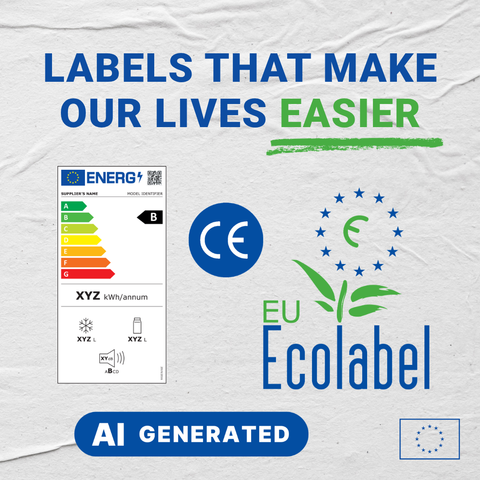
@EUCommission the CE one is so stupid, also the one with the trash bin. hate it on my iPhone...
@d4v @EUCommission are you aware of what the CE mark actually means?
@EF @EUCommission not really as most people in EU don't, I could google it if I wanted to know, but I know it's some useless thing that could be only in settings of the phone
CE marking - Wikipedia

@EF @EUCommission thanks, I knew it was something useless that could be hidden in the phone settings or with a sticker you could just remove

@EUCommission A self-enforced labelling system is the same as not doing anything: the ones who were transparent will use the tag, but the ones who weren't will move on without disclosing AI use.

Please stop beating around the bush and forbid GenAI that's been trained with stolen data and regulate datacenters already.

@EUCommission Weak, bland, useless.

the CE label really isn't the good example you think it is

also energy labels? I'm all for those energy classes and normed labels… but then there was that A++++-Fuckup?

…and that was solved by making the previous A into a C and the previous A++ into A? And the label looked the same? Because making it distinct would be too obvious?

All I'm saying is: your idea might be okay, but the examples are stupid

@EUCommission And today, as heard in the actual AI-Podcast "KI-Update" from @heiseonline big companys like #ikea, #H&M, #zalando, #inditex wrote a letter to act against this and want to have an exeption. Because, AI-Models for clothing photos or fakes for living rooms are much cheaper than paying a model for a photoshooting or an interieur designer to put the newest Smörebrod-Furniture in a room. And, will they get that exeption? Of course they will. 🤨
@EUCommission @heiseonline Think of that, every photo on the #ikea website will have that label... They neeeeeever wanna do that...
@mawirai @EUCommission @heiseonline Could you be more specific why you believe that they will ge that exception?
@voxel @EUCommission @heiseonline Why do I believe that there are companies lobbying against something like this? Well, how can I put this neutrally? Let’s call it learning from past examples: companies are lobbying against #EUDR and the EU “#Digital Omnibus” to weaken the #GDPR and the #AI-Act, but even these measures aren’t enough for big companies. And even if they don’t get everything, in the end, nothing is implemented by the European Commission as “strictly” as was grandly announced.
@voxel @EUCommission @heiseonline Or as i said before, you will not see something like this in the future:
@EUCommission how are you going to enforce it?
I don't want people labelling their deepfakes, I want people to stop creating them. Anyone trying to blackmail or hurt someone else's reputation will not be stoped by a stupid label.
@senda
This is obviously not aimed at criminals. This is supposed to be informative and I welcome the information. I of course hope there will be more to actually protect people, but lets say this is a start.
@EUCommission

@senda

No, but the label would make it easy to call out the deepfake as being fake.

Which, honestly, is probably better. Banning things rarely works and tends to hurt innocent people as a side effect (see also: social media age verification). Labels, on the other hand, hurt only those who are trying to deceive.

As for enforcement, I dunno. Malicious actors could post a malicious deepfake and crop the label off. But if they do, then they're broadcasting that they've done something illegal.

@EUCommission I don’t want huge data centers and crazy water consumption and a label ain’t fixing that

@EUCommission “voluntary”….

How stupid do you think we are?

@CynAq @EUCommission Read further, it will become mandatory in August 2026.

@voxel @EUCommission it says “providers who sign”. It’s a voluntary certification program which doesn’t even cover individuals/independent parties using gen AI on their own hardware.

Read better.

@CynAq @EUCommission Not sure if you're trolling, but if you do what I suggested you would see that: «(...) to help providers and deployers of generative artificial intelligence (AI) systems meet the AI Act transparency obligations that will apply from 2 August 2026.

From that date, the AI Act will require clear labelling in key cases. Deepfakes and AI-generated or AI-manipulated text published on matters of public interest must be clearly labelled.» (emphasis added).

@CynAq @EUCommission Also «Once the Commission and AI Board approve the Code as adequate, providers and deployers who sign will be able to demonstrate compliance with the relevant AI Act obligations that start to apply on 2 August 2026.» (emphasis added).

@voxel @EUCommission the same question back at you. It clearly says “…who sign”. Parties don’t sign anything are not obligated to do anything because they have nothing to lose without the compliance certificate they clearly rejected to begin with.

Second, I think you understand that this has nothing to do with protecting individuals from deep fakes, plagiarism etc from other individuals not using a commercially available service but running models on their own private hardware, and only addresses commercial services and publications that have some public facing official interface.

@CynAq @EUCommission I will no longer engage in this conversation as you seemingly do not seek to engage in a meaningful discussion and reject every clarification.

For anyone else, read the legal text of the AI Act.

In particular: Art. 3 (definitions) and Art. 50 (transparency obligations)